
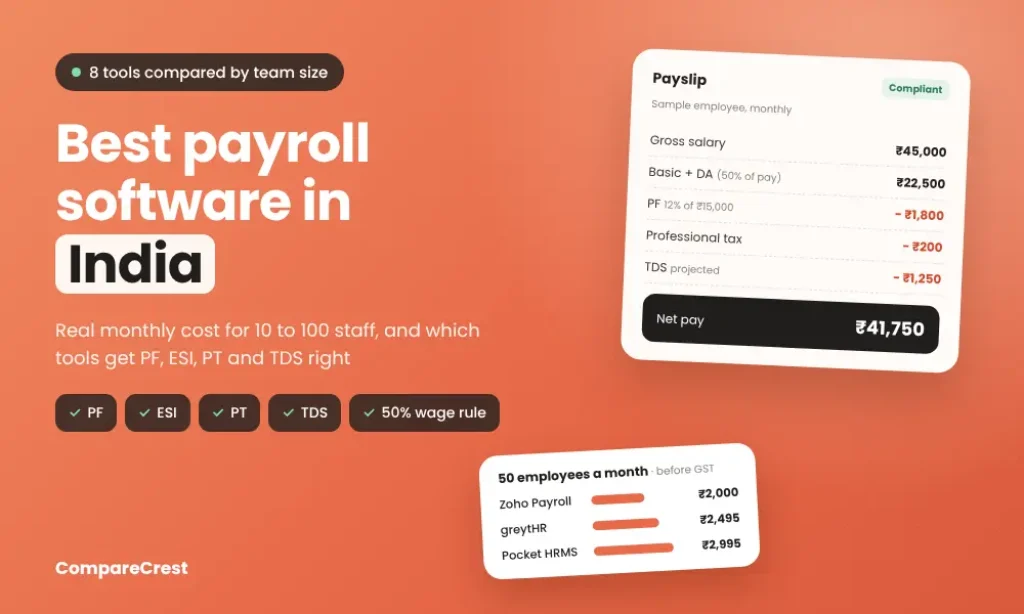

For most Indian businesses, the best payroll software depends on headcount. Zoho Payroll is the best choice for teams of up to 25, with full PF, ESI, PT and TDS compliance free for up to 10 employees. greytHR is the best value for 25 to 100 employees, at ₹2,495 a month for the first 50 on its entry plan. RazorpayX Payroll suits businesses that want salaries and statutory payments to go out from the same place, and Keka is the stronger pick for growing companies that want payroll inside a complete HR suite.
Payroll software in India is less about features than about getting compliance right every month. A good tool should calculate PF, ESI, professional tax, labour welfare fund and TDS without you checking each figure, generate challans and returns on time, and handle the salary structure rules that came with the new labour codes. This guide compares eight tools on exactly that, plus what each one actually costs for a team of your size.
What Payroll Software Costs for 10, 25, 50 and 100 Employees
Most Indian payroll tools charge a flat monthly fee for the first block of employees and a per-employee fee after that, so the cheapest tool changes as you grow. Figures are monthly, before 18% GST, on each vendor’s entry plan with payroll included.
| Tool | Entry plan with payroll | 10 employees | 25 employees | 50 employees | 100 employees |
|---|---|---|---|---|---|
| Zoho Payroll | Free up to 10; Standard ₹1,000 for 25 (annual) | ₹0 | ₹1,000 | ₹2,000 | ₹4,000 |
| SumHR | Startup ₹49/employee (annual) | ₹490 | ₹1,225 | ₹2,450 | ₹4,900 |
| greytHR | Essential ₹2,495 for up to 50 | ₹2,495 | ₹2,495 | ₹2,495 | ₹4,745 |
| Pocket HRMS | Standard ₹2,995 for up to 50 (annual) | ₹2,995 | ₹2,995 | ₹2,995 | ₹5,995 |
| RazorpayX Payroll | Prime ₹3,499 up to 20; Elite ₹6,499 for 50 | ₹3,499 | ₹6,499 | ₹6,499 | ₹13,999 |
| factoHR | Core ₹4,499 for up to 50 (annual) | ₹4,499 | ₹4,499 | ₹4,499 | ₹8,949 |
| HROne | Basic ₹4,950 for up to 50 | ₹4,950 | ₹4,950 | ₹4,950 | ₹9,900 |
| Keka | Free trial, then pricing from Keka’s sales team | Quote | Quote | Quote | Quote |
Payroll vendors change plans and per-employee rates often, so confirm current pricing on each vendor’s site, and check compliance rules for your state with a professional.
These plans don’t include the same things. Zoho Payroll’s figures are for payroll only, while greytHR, factoHR, HROne, Pocket HRMS and Keka bundle leave, attendance and core HR. A cheaper payroll-only tool can end up costing more if you then pay separately for attendance.
How We Chose These Tools
We compared official pricing, product documentation and independent user feedback. We focused on Indian compliance, labour code readiness, total cost, attendance and leave integration, and ease of setup. Unpublished prices and third-party estimates are clearly labelled.
The Compliance Every Indian Payroll Tool Must Get Right
Before comparing tools, it helps to know what they’re actually calculating. These are the main deductions and filings on an Indian payslip:
| Item | Who it applies to | Rate or rule | What the software should do |
|---|---|---|---|
| Provident Fund (EPF) | Establishments with 20+ employees, and covered employees | 12% employee and 12% employer on PF wages | Calculate, generate the ECR file, track UAN |
| Employees’ State Insurance (ESI) | Employees earning up to ₹21,000 a month in covered establishments | 0.75% employee, 3.25% employer | Calculate eligibility monthly, generate the challan |
| Professional Tax (PT) | Most states, rates vary | Up to ₹2,500 a year per employee | Apply the right state slab per employee location |
| Labour Welfare Fund (LWF) | Several states | Small fixed amounts, half-yearly or yearly | Deduct on the right months |
| TDS on salary | Employees above the taxable limit | Based on the tax regime the employee chooses | Project annual tax, collect investment proofs, file Form 24Q, issue Form 16 |
The new labour codes add another check. Under the Code on Wages, in force since 21 November 2025, basic pay plus dearness allowance must make up at least 50% of total remuneration. If allowances push it below that, the shortfall counts as wages for PF and gratuity. Payroll software should test every salary structure against this rule and flag the ones that fail, since getting it wrong raises PF liability and back-dated dues. Ask any vendor to show you this check before you buy.
The Best Payroll Software in India
1. Zoho Payroll
Zoho Payroll has the most useful free plan in Indian payroll. For up to 10 employees, it calculates salaries and payslips and handles income tax, EPF, ESI, state-wise PT and LWF, with an employee self-service portal for investment proofs and reimbursements. That’s real statutory payroll, not a trial.
Paid plans stay cheap as you grow. Standard costs ₹1,000 a month on annual billing for 25 employees, then ₹40 per extra employee, and adds direct salary payments through ICICI Bank, TDS challan recording, statutory bonus, loans and contractor payroll. Professional (₹3,000 a month annually, for 50) adds off-cycle and bonus pay runs and approvals, and Premium (₹4,000) adds leave and attendance.
The trade-off is scope. Zoho Payroll is a payroll product first, so leave and attendance only arrive on Premium, and support on the free plan is email only. It fits best for businesses already on Zoho Books or Zoho People, where data flows across without re-entry.
| Plan | Price (annual billing, before GST) | Employees included | Extra employee |
|---|---|---|---|
| Free | ₹0 | 10 | Not applicable |
| Standard | ₹1,000/month | 25 | ₹40 |
| Professional | ₹3,000/month | 50 | ₹60 |
| Premium | ₹4,000/month | 50 | ₹80 |
2. greytHR
greytHR is widely used by Indian SMEs, and its pricing helps explain why. The Essential plan costs ₹2,495 a month for up to 50 employees, then ₹45 per extra employee, and bundles payroll with leave management, onboarding and exit, and an employee helpdesk. For a 40-person company, that’s about ₹62 per employee for payroll and core HR together.
Growth, at ₹4,495 a month for 50, adds advanced attendance with shifts, overtime and geo-fencing, which matters for retail, manufacturing and field teams. Performance management, expense management and GPS tracking are add-ons unless you move to Premium. There’s a 7-day free trial.
greytHR works well for the large middle of Indian businesses: 20 to 500 employees, mostly in one or a few states, who want compliant payroll without an HR consultant.
3. RazorpayX Payroll
RazorpayX Payroll’s advantage isn’t the calculation, it’s the payout. Salaries and statutory payments can go out directly from your RazorpayX account, and compliance calculation, payments and filings are listed on every plan. For a founder doing payroll alone, that removes the step of downloading files and paying each challan separately.
Pricing is higher than greytHR or Zoho. Prime costs ₹3,499 a month for up to 20 employees, and Elite costs ₹6,499 a month for 50, with ₹150 per extra employee on both, plus 18% GST. Time and attendance and basic expense management are included, but full expense management and full support sit on the Enterprise plan. It suits startups that already bank with Razorpay and value fewer moving parts over the lowest price.
4. Keka
Keka is a common choice for Indian tech companies and startups that want HR, attendance, performance and payroll in one well-designed product. Its payroll handles Indian statutory compliance, and employees get a polished app for payslips, leave and investment declarations.
Keka offers a free trial, and pricing after that comes from its sales team based on your headcount and the modules you need. Use the trial to run a sample payroll with your real salary structures, then ask for a written quote that lists the payroll plan, any add-on modules such as recruitment or performance, the billing cycle, any setup fee and GST. Compare that total against greytHR and HROne at your headcount before deciding.
5. SumHR
SumHR prices purely per employee, which makes it the cheapest paid option on this list for small teams. The Startup plan costs ₹49 per employee per month on annual billing and includes self-service, onboarding, attendance and leave, automated payroll and a mobile app. Basic, at ₹69, adds expense claims, biometric integration and MIS reports.
Prices are annual commitments, so you pay for the year up front. SumHR also offers a free plan tied to employees using Jupiter salary accounts, which suits some startups but not companies that want to keep their existing bank setup.
6. Pocket HRMS
Pocket HRMS offers payroll, HR and statutory compliance (PF, ESIC, PT and TDS) on its Standard plan at ₹2,995 a month for up to 50 employees on annual billing, then ₹60 per extra employee. Professional, at ₹4,495, adds a custom payslip designer, and integrations with tools like ClearTax and WhatsApp sit on higher tiers.
Budget for a one-time implementation fee, which depends on company size, customisation and data migration. GST invoices are provided, and payment by net banking is supported, which some smaller Indian businesses prefer to cards.
7. factoHR
factoHR stands out for attendance. Its Core plan includes AI face-recognition attendance alongside payroll, onboarding, leave and a mobile app, which suits factories, retail chains and clinics where staff clock in on site. Core costs ₹4,499 a month for up to 50 employees on yearly billing, then ₹89 per employee.
There’s a free plan for up to 20 employees, but it covers employee records, letters and payslip generation rather than full statutory payroll, so treat it as a starting point. Premium (₹5,499) adds travel, expenses and geo-fencing for field staff.
8. HROne
HROne builds its time office around how Indian field and shift teams actually work, with geo-tagging, geo-fencing, selfie and offline attendance on the Basic plan alongside payroll and core HR. Basic is listed at ₹4,950 a month for 50 employees and Professional at ₹6,500, with extra users at ₹99 and ₹130.
HROne’s own FAQ quotes lower per-user rates (₹85 and ₹115) than its plan table, so confirm the current figure before budgeting. Billing is by credit card only, with no lock-in but two months’ notice to exit. Payroll outsourcing is available as an add-on for companies that want HROne’s team to run payroll for them.
Also Worth a Look
peopleHum sells a modular HR suite from US$2 per employee per month, where you pick hiring, performance, engagement and core HR modules. It suits companies that want to assemble their own HR stack, though detailed module pricing needs a quote.
How to Choose Payroll Software for Your Business
The right choice usually follows from three questions.
How many people are on payroll, and how fast is that changing?
Under 25, Zoho Payroll or SumHR keep costs lowest. Between 25 and 100, flat-block plans from greytHR or Pocket HRMS give the best value. Past 100, compare Keka, greytHR and HROne on the features you’ll use.
Where do your employees work?
If staff are spread across states, check that PT and LWF are handled per employee location, not per company. For shop floors and field teams, attendance matters as much as payroll, which points to factoHR or HROne.
Who runs payroll?
A founder doing it alone benefits from RazorpayX’s built-in payouts. A finance team using Zoho Books or Tally should check how payroll entries reach the accounts. Our guide to accounting software for freelancers covers the bookkeeping side for very small businesses.
Questions to Ask Before You Sign
- Does the price include statutory filings, or only calculations?
- Is there a setup or implementation fee, and how much?
- Can it import year-to-date salary and tax data if you’re switching mid-year?
- How does it handle the 50% wage rule under the labour codes?
- Are PT and LWF set per employee location?
- Is billing monthly, quarterly or annual, and can you downgrade if headcount drops?
- Who answers when a challan fails or a TDS figure looks wrong?
Switching Payroll Software Mid-Year
You can change payroll tools at any point, but April is easiest because tax projections reset. If you switch mid-year, carry over each employee’s year-to-date earnings, TDS deducted and investment declarations, so Form 16 is correct at year end. New joiners from other companies should submit their previous employer’s income and TDS details (usually through Form 12B) so tax isn’t under-deducted. Run one month in parallel with the old system and compare payslips line by line before switching off the old tool.
What Payroll Software Won’t Do for You
Payroll software calculates and files based on the rules and salary structures you set up. It won’t decide whether a salary structure is sensible for your business, sort out a PF or ESI notice, or replace professional advice on labour code changes in your state. Most small businesses still benefit from a CA or payroll consultant reviewing the setup once a year, even with a good tool.