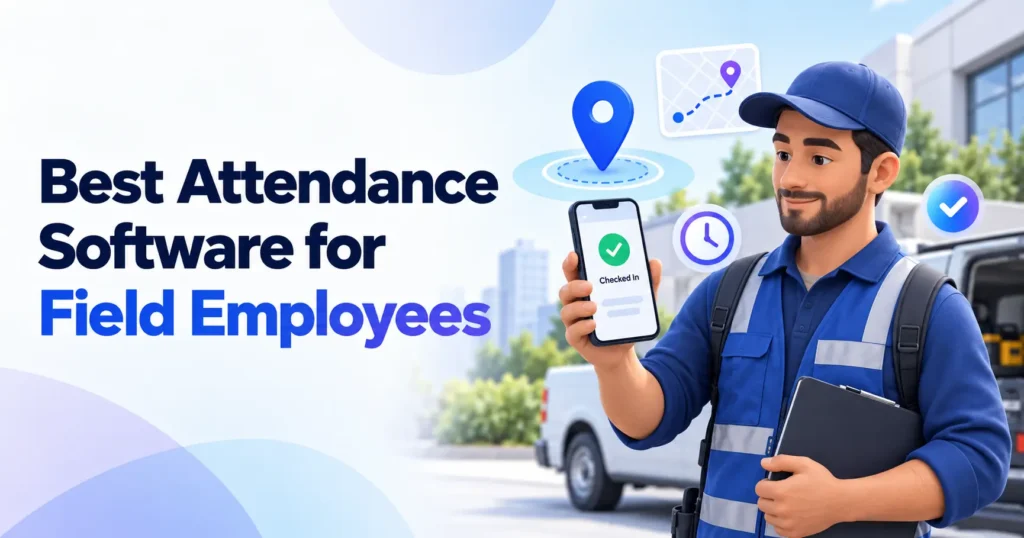
Field employees do not clock in at a fixed desk, so ordinary office attendance software often falls short. A delivery driver, pharma representative, site engineer or service technician needs an app that can verify location, work on an affordable Android phone and handle inconsistent mobile connectivity. Managers need those attendance records to reach payroll without hours of manual reconciliation.
The best choice depends on what you are trying to verify. Some tools capture a GPS point when an employee clocks in and out. Others record location during the shift. Field-force platforms go further by adding routes, beat plans, client visits, orders and expense tracking. Those are different levels of monitoring, with different costs and privacy implications.
For most small field teams, Connecteam offers the strongest balance of scheduling, attendance and predictable pricing. SalaryBox is the better fit for Indian businesses that want attendance and payroll in one system. TrackoField is more suitable for FMCG, pharma and other sales teams that work from planned routes and client visits. Workyard is the specialist pick for construction and field-service businesses that need job costing alongside GPS time tracking.
Best Field Employee Attendance Software Compared
| Software | Best for | Location verification | Continuous tracking | Offline capability | Payroll support | Starting price* |
|---|---|---|---|---|---|---|
| Connecteam | Small and mid-sized frontline teams | GPS stamps and geofences | Available through GPS tracking features | Limited, verify for clock-ins | Payroll integrations | Free for up to 10 users; paid from $29/month for the first 30 users |
| Jibble | Budget-conscious teams needing verified attendance | GPS, geofences and facial recognition | Location features vary by plan | Available for supported mobile workflows | Payroll integrations and exports | Free; Premium from $4.49/user/month annually |
| SalaryBox | Indian businesses combining attendance and payroll | GPS attendance and geofencing | ₹100/user/month add-on | Confirm during trial | Native Indian payroll | ₹1,500/month plus ₹30/user |
| TrackoField | FMCG, pharma and structured field-sales teams | Geo-verified attendance and visits | Real-time field tracking | Yes | Integrations and exports | From about ₹250/user/month annually |
| Buddy Punch | Teams focused on clock-in fraud prevention | GPS, geofencing and facial recognition | Primarily attendance verification | No reliable offline mode advertised | Payroll integrations | From $6.99/user/month plus $19 base fee |
| Workyard | Construction and job-site crews | GPS time clock and geofences | Yes | Supports remote-area workflows | Payroll integrations | Around $6/user/month plus $50 base fee |
*Pricing checked in September 2026. Taxes, add-ons and monthly billing can increase the figures shown. Confirm a written quote before rollout.
How We Evaluated These Tools
This comparison focuses on field attendance rather than general HR software. We reviewed current product documentation and pricing information against the requirements that matter when employees work across customer sites, routes and job locations:
- GPS verification at clock-in and clock-out
- Geofencing around approved sites
- Continuous tracking where a business genuinely needs it
- Behaviour in low-connectivity areas
- Identity checks such as selfies or facial recognition
- Payroll integrations or native payroll processing
- Pricing for realistic team sizes, including platform fees and add-ons
- Field workflows such as routes, visits, mileage and job costing
We did not claim hands-on testing or use vendor-reported productivity figures to rank products. Buyers should test the shortlisted apps with a small group of real field employees before signing an annual contract.
Three Types of Field Attendance Software
Before comparing brands, decide how much tracking your business actually needs.
GPS attendance captures the employee’s location when they clock in or out. It is usually enough when the goal is to verify arrival at a warehouse, customer site or branch.
Continuous location tracking records movement during working hours. It can help verify routes, mileage and time spent at jobs, but it collects more employee data and requires a clearer internal policy.
Field-force management combines attendance with routes, beat plans, client visits, tasks, orders and expenses. It makes sense for a sales or service operation, but it is unnecessary if the business only needs reliable timesheets.
Connecteam: Best Overall for Small and Mid-Sized Field Teams
Connecteam combines its mobile time clock with scheduling, forms, tasks and team communication. Employees can clock in from their phones, while managers can apply geofences to control where a punch is accepted. GPS stamps show where an employee clocked in or out, and broader location features can provide visibility while the employee is on the clock.
Its pricing model is the main advantage for a growing team. The Small Business plan is free for up to 10 users. Paid Operations Hub plans start at $29 per month for the first 30 users, with an additional per-user charge beyond that. This can cost less than a strictly per-seat product when a company has 15 to 30 field employees.
The limitation is that Connecteam sells separate Operations, Communications, and HR and Skills hubs. The $29 figure does not unlock every feature across the complete platform. Offline behaviour also varies across functions, so businesses working in weak-signal areas should ask the vendor to demonstrate a full offline clock-in and later synchronization.
Best for: Field-service companies, cleaning teams, security businesses and other frontline employers that want attendance, scheduling and daily operations in one mobile app.
Main drawback: Features spread across multiple hubs can make the complete system more expensive than the entry price suggests.
Jibble: Best Free Starting Point
Jibble remains attractive for teams that want to begin with free time tracking. Its attendance features include GPS clock-ins, geofencing, kiosk modes and facial recognition for identity verification. The free plan supports unlimited users, although some controls and management features require a paid tier.
Current standard pricing is higher than figures still shown in older comparisons. Premium costs $4.49 per user per month on annual billing or $5.99 monthly. Ultimate costs $7.99 per user per month annually or $10.99 monthly. Jibble also uses localized pricing in eligible markets, so the amount shown after signing in may differ.
Jibble works well when attendance is the central requirement. It is less suited to teams that also need detailed beat planning, client-visit management or construction job costing.
Best for: Businesses that want free core attendance and the option to add stronger controls later.
Main drawback: The paid tiers are no longer as inexpensive as older reviews suggest, particularly for larger teams.
SalaryBox: Best for Indian Attendance and Payroll in One System
SalaryBox connects GPS-verified attendance with Indian payroll and statutory-compliance workflows. Its Starter plan includes attendance, leave management, notifications and reports. The Business plan adds payroll, payslips, rosters, automations and attendance-fraud controls.
The current pricing requires more explanation than a single per-employee figure. Starter costs ₹1,500 per month plus ₹30 per employee. Quarterly billing reduces that to ₹1,350 per month plus ₹27 per employee. Business costs ₹3,000 per month plus ₹75 per employee, or ₹2,700 plus ₹67.50 per employee on quarterly billing. Taxes apply.
Continuous live-location tracking is a separate ₹100 per employee per month add-on. The Field Force CRM add-on costs ₹250 per employee per month and adds geo-verified trips, meetings, distance tracking, timelines and field dashboards.
This structure makes SalaryBox useful when payroll is part of the requirement, but potentially expensive if a business adds live tracking and field-force features for every employee. Calculate the complete cost for the exact modules and headcount rather than comparing only the Starter rate. If payroll matters more than continuous field tracking, compare it with Zoho Payroll, which is a payroll product rather than a dedicated field-force tracker.
Best for: Indian SMEs that want verified attendance to flow directly into payroll.
Main drawback: Live tracking and field CRM are additional costs, not standard attendance features.
TrackoField: Best for Beat Plans and Field Sales
TrackoField is closer to a field-force management platform than a basic attendance app. It combines geo-verified attendance with route planning, client visits, tasks, territory management, expenses and live field visibility. Its automated beat planning is particularly relevant to FMCG, pharma, telecom, financial services and collection teams.
TrackoField also advertises an offline mode that records field activities in low-network areas and synchronizes them later. Public comparison material from the company lists pricing around ₹300 per user per month quarterly, ₹275 half-yearly and ₹250 annually, although final pricing may depend on modules and deployment size.
The extra functionality will be unnecessary for a company that only needs clock-ins. For a sales manager who needs to know whether representatives followed planned beats and completed assigned visits, it is much closer to the actual operational requirement than a general time clock. Companies that need attendance inside a broader HR platform, rather than route and beat planning, can also evaluate Keka.
Best for: Structured field-sales and collection teams managing routes, territories and recurring visits.
Main drawback: More complex than a simple attendance product, with pricing and implementation best confirmed through a demo.
Buddy Punch: Best for Strong Clock-In Verification
Buddy Punch focuses on stopping inaccurate or fraudulent punches. It supports GPS, geofencing, facial recognition, QR codes and other clock-in controls. Administrators can restrict employees to approved locations and use identity checks to reduce buddy punching.
Pricing consists of a $19 monthly base fee plus a per-user charge. The current Starter rate begins at $6.99 per user per month, while Pro begins at $7.99 per user per month. Higher tiers and monthly billing cost more.
The base fee makes Buddy Punch relatively expensive for a very small team. It is easier to justify when preventing time theft is a more important requirement than adding broad field-sales or job-management functions. Businesses operating in areas with unreliable connectivity should test it carefully because a dependable offline clock-in workflow is not a prominent part of its current offering.
Best for: Employers dealing with buddy punching, shared devices or disputed clock-ins.
Main drawback: The $19 base fee increases the effective per-person cost for small teams.
Workyard: Best for Construction and Job Costing
Workyard is built for construction, trades and field-service crews. Its GPS time clock connects employee hours to jobs and cost codes, helping businesses use the same records for payroll, labour costing and project reporting. Managers can restrict clock-ins to geofenced job sites and review location trails linked to timesheets.
Entry pricing is around $6 per user per month plus a $50 monthly base fee, although buyers should confirm the current plan and included functions. This is considerably more expensive than a basic attendance app, but the comparison is not entirely like for like. Workyard is selling job-level cost visibility as well as attendance.
For an Indian sales team, this would usually be the wrong product. For a construction contractor trying to allocate labour across several active sites, it can solve a problem that Jibble or SalaryBox does not address as deeply.
Best for: Construction companies, contractors and field-service businesses that need GPS timesheets tied to jobs.
Main drawback: The base fee and construction-focused workflow make it excessive for simple attendance tracking.
Best Software by Team Type
Small team with up to 10 employees: Connecteam’s free Small Business plan is the most practical starting point if its GPS controls meet your needs.
Budget-conscious team needing basic verified attendance: Jibble offers the strongest free attendance foundation, with paid upgrades for more control.
Indian business needing attendance and payroll together: SalaryBox is the better fit, provided you calculate the platform fee, per-user fee and any location add-ons.
Growing company needing a wider HRMS: HROne is worth comparing when attendance must sit alongside recruitment, payroll and broader employee-management workflows.
FMCG, pharma or telecom field-sales team: TrackoField is the most relevant because attendance sits alongside beat plans, visits and territories.
Team with a recurring buddy-punching problem: Buddy Punch provides the deepest set of clock-in verification options in this group.
Construction or multi-site contracting crew: Workyard is the specialist choice for continuous GPS records, job costing and payroll-ready timesheets.
What to Check Before You Subscribe
Test the app on the phones employees actually use
A polished manager dashboard means little if the employee app performs poorly on older Android devices. Run a pilot using ordinary staff phones, battery-saving settings and the mobile networks used in the field.
Demonstrate a real offline clock-in
Do not accept “offline support” as a checkbox. Put a test phone in airplane mode, record a punch, restore connectivity and check whether the correct time, location and employee identity reach the admin dashboard.
Decide between GPS stamps and continuous tracking
A location stamp answers where someone clocked in. Continuous tracking records movement through the shift. Collecting a full route when two attendance points would be enough creates extra cost, battery usage and privacy risk.
Request the complete price in writing
Ask the vendor to quote the platform fee, users, administrators, payroll integration, location tracking, implementation, taxes and support. A low per-user price can become misleading once required add-ons are included.
Check how attendance reaches payroll
Native payroll is different from exporting a spreadsheet or connecting through a third party. Ask the vendor to demonstrate the complete path from an approved timesheet to a payroll run, including overtime, leave and missed punches. Another India-focused option to assess is Pocket HRMS, particularly when payroll, attendance and employee self-service need to operate in one HR system.
Create a written location-data policy
Employees should know what information is collected, when tracking starts and stops, why it is needed, who can access it and how long it is retained. Tracking outside working hours should be disabled unless a specific, lawful requirement has been reviewed.