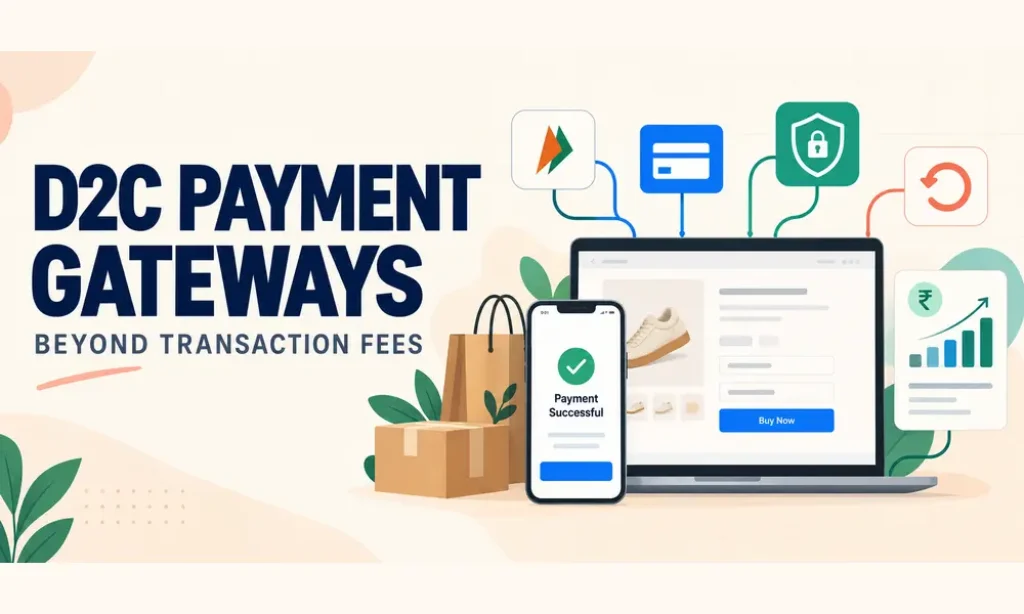

The best payment gateway for a D2C brand is not necessarily the one advertising the lowest transaction rate. A small difference in fees can be wiped out by failed payments, slow settlements, refund support work, reconciliation gaps or fraud rules that block genuine customers.
For most Indian D2C brands, Cashfree and Razorpay are the strongest general-purpose starting points. Cashfree currently has the more aggressive introductory offer, while Razorpay has a broad payments ecosystem and familiar developer experience. PhonePe Payment Gateway deserves a serious look for UPI-heavy stores, and PayU is useful when EMI, BNPL and affordability options matter. Less obvious providers such as Easebuzz, Zaakpay, and PayGlocal can be better fits for specific situations.
This guide does not rank gateways solely by their advertised fee. It compares the parts that affect the full cost of taking and fulfilling an order.
D2C Payment Gateways in India Compared
| Payment gateway | Best for | Published pricing position | Main strength | Important limitation |
|---|---|---|---|---|
| Cashfree | Growing Indian D2C brands wanting a broad payment operations stack | Promotional 0% gateway fee up to eligible GMV for new merchants; conditions apply | Settlements, payment monitoring, refunds and risk tools in one ecosystem | The promotional rate is temporary and eligibility-dependent |
| Razorpay | Brands wanting a mature developer ecosystem and adjacent payment products | Standard rate shown as 2%, with a current introductory free period and custom pricing at volume | APIs, plugins, payment links, subscriptions and broader finance stack | Add-on products and accelerated settlements can increase total cost |
| PhonePe Payment Gateway | UPI-heavy mobile commerce | Current limited-period zero-fee offer; standard rate shown as 1.99% before the offer | Recognisable consumer payment brand and plug-and-play ecommerce integrations | Confirm when the promotional rate ends and what pricing follows |
| PayU | D2C brands using cards, EMI and BNPL | 2% for listed domestic methods and 3% for listed premium or international methods, plus GST | Wide payment-method and affordability coverage | UPI pricing varies by business type and volume |
| CCAvenue | Brands needing broad method, bank and international coverage | Plan and merchant-specific pricing | Long operating history and broad payment coverage | Pricing structure and merchant experience can feel less straightforward |
| Easebuzz | Indian SMEs wanting collections plus business-payment tools | Quote or campaign-led pricing (Pay as you go) | Broad collection products and reconciliation focus | Public pricing is not dependable enough for a worked cost estimate |
| Zaakpay | Brands that want an India-built gateway backed by MobiKwik | 1.85%+ taxes | Hosted and self-hosted checkout options, payment links and bulk links | Limited public pricing detail and less third-party coverage |
| PayGlocal | D2C brands with meaningful international sales | Quote-based; setup fee shown as zero | Cross-border-first stack, localised checkout and automated foreign-remittance documents | Overkill for a domestic-only store |
Pricing checked in October 2026. Promotional offers, merchant eligibility, GST, settlement charges and custom rates can change the final cost.
How We Evaluated These Gateways
We compared official pricing, features, integrations and documented merchant experiences. We did not test every gateway with live orders, and vendor success-rate claims were not treated as independently verified. Test shortlisted providers using your own traffic and payment mix.
Best Payment Gateways for D2C Brands
Cashfree: Best All-Round Starting Point for Growing D2C Brands
Cashfree combines payment collection with settlements, refunds, payment links, transaction monitoring, risk controls and international acceptance. That breadth makes it a practical shortlist option for a D2C business whose finance, support and operations teams all need visibility into the same payment lifecycle.
Its current offer advertises zero payment-gateway fees for eligible new merchants up to ₹20 lakh in GMV, with the offer running until 31 March 2027. Do not treat that as permanent pricing. Ask what rate applies after the offer, whether your business category qualifies and which payment methods or services sit outside it.
Choose Cashfree if: you want a broad India-focused payment operations stack and settlement options matter to working capital.
Skip it if: your decision depends entirely on keeping the promotional rate after its stated period.
Razorpay: Best for Developer Experience and Product Breadth
Razorpay is the safest mainstream comparison point because it supports common D2C payment methods and connects to a larger ecosystem covering links, subscriptions, routing, payouts and business-finance products. Its official pricing page currently shows a free introductory period, with the standard gateway rate presented as 2% and custom pricing available for merchants processing higher volumes.
The strength is not simply checkout. It is the ability to expand into more payment workflows without rebuilding the core integration. The trade-off is that the full stack can cost more than the headline gateway rate once instant settlements or additional products are involved.
Choose Razorpay if: your engineering team values established documentation, integrations and a wide payments ecosystem.
Skip it if: you only want the lowest possible rate for a simple UPI-heavy checkout.
PhonePe Payment Gateway: Best for UPI-Heavy Consumer Brands
PhonePe Payment Gateway is worth evaluating when most orders happen on mobile and UPI is the dominant payment method. It supports UPI, cards, net banking and ecommerce integrations including Shopify and WooCommerce.
Its pricing page currently displays a limited-period zero-fee offer, with 1.99% shown as the crossed-out standard rate. The correct budgeting question is not whether it is free today, but what your effective rate becomes after the offer and whether any settlement or value-added features are charged separately.
Choose PhonePe PG if: you run a UPI-heavy store and want a recognisable payment experience.
Skip it if: you need stable long-term pricing before committing engineering resources.
PayU: Best for EMI, BNPL and Affordability Options
PayU is a stronger candidate for higher-ticket D2C categories where cards, EMI, BNPL and offers influence conversion. Its official page lists 2% for Visa, Mastercard, domestic net banking, BNPL and wallets, and 3% for Diners, American Express, EMI and international transactions. GST is additional. It lists no setup or annual fee and a standard T+2 settlement, with priority settlement options depending on the merchant.
PayU says merchant UPI pricing varies by business type and volume. Get that figure in writing rather than applying the 2% card rate to your full payment mix.
Choose PayU if: affordability options are central to converting higher-value carts.
Skip it if: you need one published rate covering every payment method.
CCAvenue: Best for Broad Payment Coverage and Complex Merchant Needs
CCAvenue remains relevant for merchants that need a long list of cards, banks, EMI options, currencies or less common payment methods. It can also suit businesses that prefer a long-established provider and are prepared for a more traditional sales and onboarding process.
Its public pricing can vary by plan, partner page and merchant arrangement. Do not copy a rate from a reseller or old registration page. Request a proposal tied to your expected monthly volume and payment mix.
Choose CCAvenue if: broad method and acquiring-bank coverage matter more than a modern self-serve experience.
Skip it if: transparent pricing and a simple dashboard are your highest priorities.
Underrated Payment Gateways Worth Considering
These providers should not automatically rank above the mainstream gateways, but each has a reason to be included in a serious D2C shortlist.
Easebuzz: Worth Checking for Indian SME Payment Operations
Easebuzz positions itself as more than a checkout provider, with payment collection, links, business-payment tools and reconciliation features. It can fit Indian SMEs that want several collection workflows from one vendor.
The limitation is pricing transparency. Its public pages promote competitive rates, but a dependable standard rate is difficult to verify. Request a written quote covering UPI, cards, refunds, chargebacks, settlement acceleration and any annual commitments.
Zaakpay: An India-Built Alternative Backed by MobiKwik
Zaakpay supports payment-gateway checkout and payment links, including hosted and merchant-controlled checkout approaches. Its documentation also describes bulk payment-link generation, which can help brands recovering orders through support or assisted-commerce workflows.
Public pricing information is thin, and there is less independent operational coverage than for Razorpay or Cashfree. Treat it as a pilot candidate, not an automatic primary gateway.
PayGlocal: The Specialist Pick for Cross-Border D2C
PayGlocal is the most differentiated underrated option here. It is built around cross-border acceptance rather than treating international cards as a small add-on. The company lists RBI authorisations for domestic and cross-border aggregation, support for international payment methods, ecommerce plugins and automated FIRA or FIRC-related documentation.
Its pricing is quote-based. It makes the most sense for a brand already receiving meaningful international traffic, not one that merely hopes to sell overseas later.
What Matters More Than the Transaction Fee
Payment Success by Method and Device
Do not accept one overall success-rate figure. Ask for performance split by UPI, cards, bank, device type, order value and customer geography. Your own store data matters more than a provider-wide marketing claim.
A modest success-rate improvement can recover more revenue than a small fee reduction, particularly when paid acquisition brings expensive traffic to checkout.
Mobile Checkout and Retry Experience
Test the checkout on real Android devices, iPhones, mobile browsers and in-app webviews. A useful D2C checkout should preserve the cart during a failure, explain the problem clearly and let the customer retry or switch methods without creating duplicate orders.
Prepaid, COD and Partial Payment Workflows
A payment gateway does not replace a COD provider, but it can help move more customers toward prepaid orders through UPI, payment links, partial deposits or post-order recovery. Measure COD acceptance, return-to-origin rate and reverse-logistics cost before assuming COD is cheaper because it avoids a gateway fee.
Settlement and Working Capital
Compare the standard cycle, weekend treatment, cut-off times, reserve policies, failed-settlement handling and the cost of faster settlement. Faster access to money is valuable only when the benefit exceeds the additional fee and reconciliation remains clean.
Refunds and Customer Support
Finance and support teams need to distinguish between a refund requested, initiated, processed and received by the customer. Confirm support for partial and bulk refunds, refund reference numbers and exports that link the refund to the original order and payment.
Fraud Controls Without Excessive False Positives
Useful controls include velocity rules, order-value rules, customer-history signals, allowlists, blocklists, device signals and manual review. Aggressive fraud prevention can reduce legitimate conversion, so ask how blocked payments are explained and reviewed.
Reconciliation
The gateway should let finance match the merchant order ID, transaction ID, gross amount, processing fee, GST, refunds, disputes, settlement value, settlement date and bank reference. Brands selling through marketplaces and their own site may also need a dedicated operations platform. Our EasyEcom profile covers one option for multichannel order and payment reconciliation.
A Practical D2C Evaluation Scorecard
| Area | What to verify during a pilot |
|---|---|
| Checkout | Mobile load time, redirects, UPI intent, QR, retries and confirmation page |
| Success rate | Results by method, device, issuer, order value and customer segment |
| Payment states | Initiated, pending, failed, cancelled, abandoned and successful states remain distinct |
| Webhooks | Signing, retries, duplicate delivery and idempotent processing |
| Settlements | Standard timeline, holidays, reserves, failures and bank references |
| Refunds | Full, partial and bulk refunds with status tracking |
| Fraud | Rule controls, reason codes, manual review and false-positive monitoring |
| Reconciliation | Order-to-payment-to-settlement matching and usable exports |
| Support | Production escalation path and written response commitments |
| Pricing | Method-level rates, GST, settlement fees, refund costs and renewal terms |
Best Gateway by D2C Situation
- General-purpose Indian D2C brand: Start by piloting Cashfree and Razorpay.
- UPI-heavy mobile store: Add PhonePe Payment Gateway to the pilot.
- High-ticket products needing EMI or BNPL: Compare Cashfree, PayU with Razorpay.
- International D2C sales already generating volume: Evaluate PayGlocal alongside Cashfree and Razorpay international products.
- Broad or unusual payment-method requirements: Request a proposal from CCAvenue.
- SME looking beyond the largest brands: Compare Easebuzz, and Zaakpay, but test support and reconciliation carefully.
For a broader fee comparison, see our payment gateway charges in India guide. If UPI cost is your main concern, use our separate comparison of the cheapest UPI payment gateways.
Final Verdict
Cashfree and Razorpay are the most sensible first comparison for a typical Indian D2C brand, but there is no universal winner. PhonePe can be compelling for UPI-led mobile commerce, PayU for affordability-led checkout and PayGlocal for cross-border sales. Easebuzz, and Zaakpay credible additional quotes when their product fit matches your workflow.
Shortlist two or three providers and run representative payment journeys before migrating meaningful traffic. Measure payment success, checkout recovery, settlement timing, webhook reliability, refunds, reconciliation and support. The gateway that produces the lowest total cost per successfully fulfilled order is more valuable than the one with the lowest advertised transaction fee.