
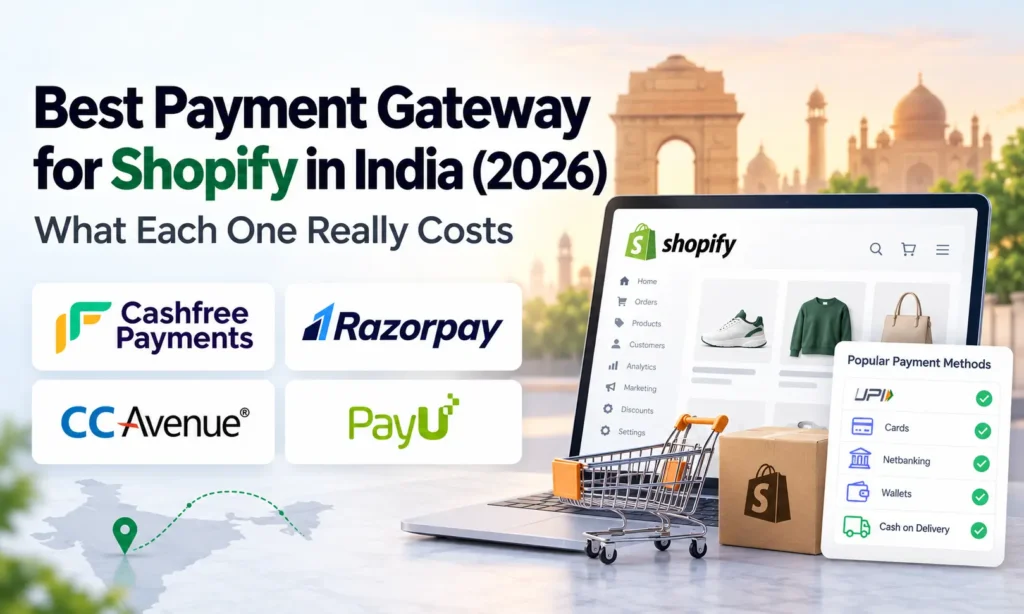

Choosing a payment gateway for a Shopify store in India is not simply a question of finding the lowest processing fee. Shopify Payments isn’t available in India, so Indian merchants generally need a third-party payment gateway, and Shopify can then charge its own third-party transaction fee on top of what the gateway charges.
That means a gateway advertised at 1.95% does not necessarily mean your total payment cost is 1.95%. For most Indian Shopify stores, the better comparison includes the Shopify transaction fee, gateway fee, GST, payment mix and checkout requirements.
We compared Cashfree, Razorpay, CCAvenue and PayU using their published pricing and offer terms to see how those costs can work in practice.
Quick Comparison- Cashfree vs Razorpay vs PayU vs CCAvenue
| Payment gateway | Standard domestic rate | Setup fee | Annual fee | Current new-merchant offer | Worth considering for |
|---|---|---|---|---|---|
| Cashfree | 1.95% | ₹0 | ₹0 | 0% platform fee up to ₹20 lakh eligible domestic GMV | New and India-focused Shopify stores |
| Razorpay | 2% | ₹0 | ₹0 | 0% up to ₹5 lakh GMV or 90 days, subject to eligibility | Domestic + international payment mix |
| CCAvenue Startup Pro | 2% | ₹0 | ₹1,200, first FY waived | Check current offer | Merchants comparing plan-based pricing |
| CCAvenue Privilege | 1.90%, debit cards 1.10% | ₹20,000 | ₹3,600, first FY waived | Check current offer | Stores with payment mix suited to its lower card rates |
| PayU | 2% standard | Check current pricing | Check current pricing | Check current offer | Businesses seeking merchant-specific pricing |
Short version: Cashfree currently has the most substantial new-merchant offer among the offers compared here, while Razorpay, CCAvenue and PayU remain established alternatives. The better long-term choice depends on your payment mix, Shopify plan, international volume and negotiated commercial terms.
Why the Gateway Fee Is Only Half the Story
Shopify charges a third-party transaction fee when merchants use an external payment provider, and the amount depends on the Shopify plan.
| Shopify plan | Monthly price, annual billing, before GST | Third-party fee on prepaid orders |
|---|---|---|
| Basic | ₹1,499 | 2% |
| Grow | ₹5,599 | 1% |
| Advanced | ₹22,680 | 0.6% |
Manual payment methods such as cash on delivery are generally exempt from the third-party transaction fee. GST also needs to be included because Shopify applies applicable GST to its fees, while payment gateway processing fees are generally subject to GST as well.
So if you’re on Shopify Basic and your gateway charges around 2%, your payment-related cost on a prepaid transaction can be considerably higher than the gateway’s advertised 2%.
What ₹1 Lakh of Prepaid Sales Actually Costs
The difference becomes easier to understand with a real cost example. The following calculation uses ₹1 lakh of prepaid sales and includes 18% GST on the Shopify and gateway fees.
| Shopify plan | Shopify fee incl. GST | Total with a 2% gateway | Total with Cashfree at 1.95% | Effective rate with 2% gateway |
|---|---|---|---|---|
| Basic | ₹2,360 | ₹4,720 | ₹4,661 | 4.72% |
| Grow | ₹1,180 | ₹3,540 | ₹3,481 | 3.54% |
| Advanced | ₹708 | ₹3,068 | ₹3,009 | 3.07% |
A GST-registered business may generally be able to claim eligible GST as input tax credit, subject to applicable tax rules. But the comparison reveals something more important: at standard pricing, the difference between a 1.95% and 2% gateway is only about ₹59 per ₹1 lakh of prepaid sales after GST, while moving from Shopify Basic to Grow changes Shopify’s fee by approximately ₹1,180 on the same ₹1 lakh of sales.
For a growing store, the Shopify plan can therefore affect payment economics more than a small difference between gateway rates.
How We Evaluated the Gateways
We did not run controlled live transactions through all four payment gateways. This comparison uses published gateway pricing and terms along with Shopify’s published fee structure. Performance claims made by payment providers should be treated as provider-reported unless independently verified, and gateway pricing can also vary based on business category, transaction volume and negotiated commercial terms.
Cashfree for Shopify
Cashfree’s standard published rate for applicable domestic payment methods is 1.95%, compared with the common 2% standard rate charged by several Indian gateways. On its own, that difference isn’t huge, but its current introductory offer is more significant for an eligible new merchant.
According to the Cashfree pricing terms referenced for this comparison, eligible merchants signing up on or after 21 July 2026 can receive a 0% platform fee on eligible domestic payment gateway transactions up to ₹20 lakh in cumulative GMV. The offer runs through 31 March 2027 or until the applicable GMV limit is reached, whichever comes first.
What Could the Cashfree Offer Save?
Suppose an eligible new Shopify store processes ₹10 lakh in qualifying domestic prepaid transactions. At a standard 1.95% gateway rate, that would normally represent approximately ₹19,500 in gateway charges before GST. If those transactions qualify for the promotional offer, the applicable platform fee can be waived.
Shopify’s own third-party transaction fee still applies, so the transactions aren’t completely free to process. But for a new store, removing the gateway platform fee during the offer period can have a much larger impact than choosing between two gateways based on a 0.05 percentage-point difference in their normal rates.
Check the Offer Conditions
The offer isn’t universal. The terms referenced for this comparison include eligibility for qualifying domestic payment gateway transactions, one-time eligibility per PAN or bank account, and standard charges for American Express, Diners Club and corporate cards. Other eligibility and usage requirements may also apply, so check the latest terms before using the offer in your cost forecast.
Checkout and COD Tools
Cashfree also extends beyond basic payment processing with products around checkout, offers and COD/RTO management, which can matter for Indian D2C stores. If a store has a large COD share, reducing failed deliveries or converting more customers to prepaid can potentially have a larger financial impact than saving a few basis points on gateway processing.
This makes the broader checkout stack worth considering alongside Cashfree’s gateway pricing rather than treating the payment-processing rate as the only selection factor.
Razorpay for Shopify
Razorpay’s standard domestic pricing is generally 2% plus applicable GST, with different rates for certain payment methods and international cards. Its international card rate referenced for this comparison is 3%, and Razorpay also provides additional products such as Magic Checkout and Optimizer for merchants looking for functionality beyond standard payment acceptance.
Eligible new merchants may also qualify for its current introductory offer, which provides a 0% platform fee on domestic payments up to ₹5 lakh in cumulative GMV or for 90 days from activation, subject to the applicable terms. Larger businesses can request custom pricing based on their transaction volume and requirements.
For merchants comparing Cashfree and Razorpay, the standard domestic rate is unlikely to be the only deciding factor. Current offers, international payment requirements, checkout functionality and negotiated rates can have a greater impact.
CCAvenue for Shopify
CCAvenue takes a somewhat different approach because it provides Shopify-specific pricing plans. Startup Pro has a 2% domestic rate with no setup fee, while its Privilege plan charges a ₹20,000 setup fee but reduces the referenced domestic credit-card rate to 1.90% and debit-card rate to 1.10%.
International rates are different, and annual software charges can apply depending on the plan. That makes CCAvenue difficult to compare using one headline percentage because a store with substantial debit-card volume can arrive at a different blended cost from a store dominated by UPI, credit cards or international transactions.
Merchants considering CCAvenue should therefore calculate their expected cost using their actual payment-method mix.
PayU for Shopify
PayU is another established payment provider available to Indian online businesses. Its standard domestic pricing is generally around 2%, while merchant-specific rates can vary based on transaction volume, business category and commercial terms.
Public pricing doesn’t necessarily capture the final rate available to larger businesses, so merchants considering PayU should request pricing based on their expected volume and payment mix. International payment requirements should also be confirmed during onboarding rather than assuming the domestic rate will apply.
Cashfree vs Razorpay vs CCAvenue vs PayU
Looking only at the standard domestic rate produces a fairly narrow comparison.
| Factor | Cashfree | Razorpay | CCAvenue | PayU |
|---|---|---|---|---|
| Standard domestic pricing | 1.95% | 2% | Varies by plan | Around 2% |
| Setup fee | ₹0 | ₹0 | ₹0 or ₹20,000 | Check current terms |
| Current introductory offer | Up to ₹20 lakh eligible domestic GMV | Up to ₹5 lakh / 90 days | Check current terms | Check current terms |
| Shopify-specific pricing structure | Standard gateway pricing | Standard gateway pricing | Yes | Confirm during onboarding |
| Custom pricing | Available depending on requirements | Available at scale | Plan-dependent | Available depending on requirements |
For a new India-focused Shopify merchant, Cashfree’s current introductory offer is the biggest pricing difference in this comparison. Once promotional pricing ends, however, the standard-rate differences become considerably smaller, and transaction mix, checkout requirements, international payments, settlement terms and negotiated pricing become more important.
When Should You Upgrade From Shopify Basic to Grow?
Gateway comparisons can distract merchants from a potentially larger saving: changing their Shopify plan. Shopify Grow costs approximately ₹4,100 more per month than Basic using the annual pricing referenced here, but the third-party transaction fee falls from 2% to 1%.
That produces an approximate break-even point of ₹4.1 lakh in monthly prepaid sales. Once a store consistently processes more than that amount, the reduction in Shopify’s transaction fee can potentially offset the higher subscription cost.
This doesn’t mean every store crossing ₹4.1 lakh should immediately upgrade. Shopify features, taxes, pricing changes and other requirements should also be considered, but it’s a calculation worth revisiting as prepaid GMV increases.
COD Can Change the Answer Again
Indian Shopify stores often have another major variable: cash on delivery. Manual payment methods such as COD generally don’t attract Shopify’s third-party transaction fee, so a store with 60% prepaid orders has a different payment-cost structure from a store with 90% prepaid orders, even when both generate the same GMV.
But COD isn’t automatically cheaper. Return-to-origin orders, refused deliveries and additional logistics can make unsuccessful COD orders expensive, which is why COD-heavy businesses should evaluate checkout and payment tools alongside gateway rates.
For these stores, improving the prepaid share or reducing RTO may ultimately have a bigger impact than moving from a 2% gateway to a 1.95% gateway.
So, Which Payment Gateway Should a Shopify Store Choose?
Start with your actual payment mix by estimating how much monthly GMV comes from UPI, debit cards, credit cards, international cards, netbanking and COD. Then calculate the gateway fee for that mix and add Shopify’s third-party transaction fee.
For new India-focused Shopify stores, Cashfree is worth evaluating early because its current introductory offer can materially reduce gateway costs on eligible domestic transactions. For stores with meaningful international sales, international card rates and currency requirements deserve more weight than the domestic headline rate.
For established high-volume stores, public pricing becomes less useful, so requesting commercial quotes from multiple gateways and comparing the final rates, settlement terms and services being offered makes more sense. Stores approaching roughly ₹4 lakh or more in monthly prepaid sales should also compare Shopify Basic and Grow before spending too much time trying to save 0.05 percentage points on the payment gateway.
The cheapest-looking gateway isn’t always the lowest-cost payment setup.
Is Shopify Payments available in India?
No. Shopify Payments isn’t currently available to merchants in India, so Indian Shopify stores generally need to use a supported third-party payment gateway.
Does Shopify charge an extra fee for third-party payment gateways?
Yes. Shopify can charge a third-party transaction fee in addition to the payment gateway’s own processing charge. Using the pricing referenced here, the fee is 2% on Basic, 1% on Grow and 0.6% on Advanced for applicable transactions.
What does Cashfree charge Shopify merchants?
Cashfree’s standard domestic rate referenced in this comparison is 1.95% for applicable payment methods before GST. Eligible new merchants may qualify for its current 0% platform-fee offer on qualifying domestic transactions up to the applicable ₹20 lakh cumulative GMV limit.
Cashfree or Razorpay for Shopify?
Their standard domestic rates are relatively close at the pricing referenced here: 1.95% for Cashfree and 2% for Razorpay. The larger current difference for an eligible new merchant is the introductory offer. Cashfree’s referenced offer covers up to ₹20 lakh of eligible cumulative domestic GMV, while Razorpay’s referenced offer covers up to ₹5 lakh or 90 days, subject to their respective terms.
Beyond introductory pricing, compare checkout features, payment mix, international requirements and any negotiated rates.
Which Shopify payment gateway has the lowest fees in India?
There isn’t one answer for every merchant. Cashfree has a 1.95% standard domestic rate in this comparison, while CCAvenue’s Privilege plan has lower rates for some card types but includes a setup fee. For eligible new merchants, introductory offers can also make the effective cost substantially different from the standard rate, so calculate the blended cost using the payment methods your customers actually use.
Does Shopify charge transaction fees on COD orders?
Manual payment methods such as cash on delivery are generally exempt from Shopify’s third-party transaction fee. COD still creates other potential costs, including return-to-origin and failed-delivery expenses.
Is UPI free on Shopify?
Not necessarily. Even where UPI MDR is zero under applicable rules, the payment provider’s commercial pricing and Shopify’s separate third-party transaction fee need to be considered. Check the provider’s current pricing rather than assuming UPI transactions have no cost.
When should I move from Shopify Basic to Grow?
Based only on the plan-price difference and third-party transaction fees referenced in this article, the approximate break-even point is around ₹4.1 lakh in monthly prepaid sales. Actual economics can vary with Shopify pricing, taxes and the store’s transaction mix.
What should I compare besides payment gateway fees?
Look at payment-method coverage, settlement requirements, international payment pricing, checkout experience, COD tools, support, current merchant offers and negotiated commercial terms. For Shopify merchants, always include Shopify’s own third-party transaction fee in the calculation.
Pricing and promotional terms referenced as of September 2026. Payment gateway rates, promotional offers and Shopify pricing can change. Verify current terms with the respective provider before making a commercial decision.