
Table of Contents
- Best Overall: Cashfree
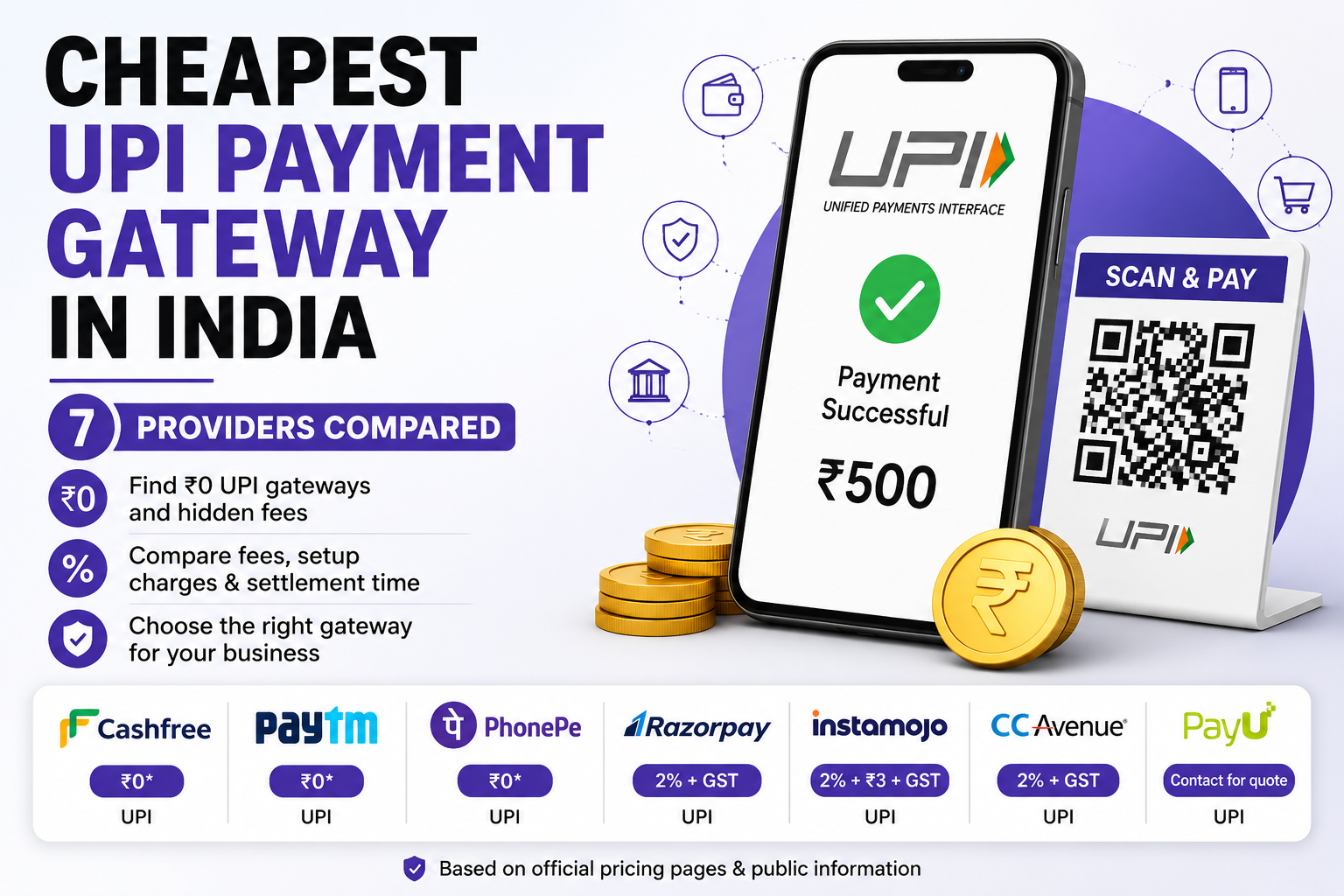
- Best ₹0 UPI Options: Cashfree, Paytm Payment Gateway, PhonePe Payment Gateway
- Best for Mixed Payments: Razorpay
- Best for High-Volume Businesses: PayU (Custom Pricing)
If you’ve looked into this before, you’ve probably run into the same confusing thing we did: everyone tells you UPI is free, then you open a gateway’s pricing page and see a fee sitting right next to the word “UPI.” Both things are true at once, and the gap between them is worth understanding before you pick a provider, because it’s real money, not a rounding error.
The government’s zero-MDR rule means no bank or card network takes a cut when a customer pays through UPI. That part really is free. It doesn’t cover the payment gateway itself – the company building your checkout page, routing the transaction, screening for fraud, and moving the money into your account. Some gateways absorb that cost on UPI specifically. Others fold it into the same rate they charge for everything. We checked the official pricing pages of seven providers used in India to see which is which, as of today.
Three gateways currently charge nothing for UPI. Four charge close to what they’d charge for a card payment. One won’t give a flat number until you talk to their team.
Before comparing prices, here’s how we approached the research.
- 1. We reviewed each provider's official pricing page first.
- 2. Where pricing wasn't clear, we checked public documentation and independent sources.
- 3. We did not estimate missing prices or fill gaps with assumptions.
- 4. We did not test live merchant accounts for this comparison.
Our goal was simple: help business owners make a decision using transparent, publicly available information—not marketing claims.
Cheapest UPI Gateways Side by Side (Comparison Table)
| Gateway | UPI Fee | Setup Fee | AMC | Card/Other Modes | Settlement |
|---|---|---|---|---|---|
| Cashfree | ₹0* | ₹0 | ₹0 | 1.90–3.5% | T+2 (instant options available) |
| Paytm Payment Gateway | ₹0 (“lifetime free”) | ₹0 | ₹0 | Varies by mode | T+1 (instant options available for eligible merchants only) |
| PhonePe Payment Gateway | ₹0 | ₹0 | ₹0 | Contact PhonePe for card/other-mode pricing | T+1 (business day) |
| Razorpay | 2% + 18% GST | ₹0 | ₹0 | 2% + GST (3% premium modes) | T+2 (instant options available) |
| Instamojo | 2% + ₹3 + GST | ₹0 | ₹0 | Same flat rate across modes | T+3 |
| CCAvenue | 2% + 18% GST | ₹0 (Startup Pro) | ₹1,200/yr (waived yr 1) | 2–4.99% | T+2 to T+3 (Express settlement options available) |
A RuPay Credit Card linked to a UPI app is not treated as free UPI. It is processed as a credit card transaction and usually attracts gateway fees. This is one of the most common reasons merchants see unexpected charges on their invoices.
Top 7 Cheapest UPI Payment Gateways in India
Cashfree – Best for UPI-Only Businesses
UPI Pricing: ₹0 platform fee on UPI and RuPay debit, per Cashfree’s official charges page.
Pros: No setup fee, no AMC, a wide UPI toolkit (collect, intent, QR, WhatsApp payment links), and instant settlement available as an option.
Cons: The ₹0 rate sits next to a separate promotional banner tied to a ₹20L sales threshold on Cashfree’s own pricing page. Contact Cashfree’s team to confirm which terms apply to your specific account before committing.
Best For: UPI-heavy D2C sellers, service businesses, and marketplaces that want zero-cost UPI collection with the option to add instant settlement.
Paytm Payment Gateway – Best for Existing Paytm Users
UPI Pricing: Published as “lifetime free” on UPI and RuPay cards, with zero setup fee and zero AMC, per Paytm’s official business pricing page.
Pros: No cost on UPI, a checkout experience familiar to customers already using the Paytm app, no annual charges.
Cons: A third-party source describes a ₹2,000 transaction threshold above which a 1.99% rate may apply – this conflicts with Paytm’s own “lifetime free” language. Contact Paytm’s team directly to confirm pricing at higher ticket sizes before assuming zero cost across the board.
Best For: Businesses already using Paytm’s QR codes or soundbox for in-person collection, who want one provider across online and offline UPI.
PhonePe Payment Gateway – Best for PhonePe-Heavy Customer Bases
UPI Pricing: PhonePe’s dedicated UPI page advertises “Zero Transaction & Setup Fee” for UPI specifically.
Pros: No setup fee, no cost on UPI, strong recognition with customers who already use PhonePe daily.
Cons: PhonePe doesn’t publish a flat card or net-banking rate on the same page. Contact PhonePe’s team for full pricing if you need more than UPI before assuming the rest of the stack is free too.
Best For: Businesses whose customers lean toward PhonePe as their default UPI app, or those wanting to consolidate online and QR-based UPI collection under one provider.
Razorpay – Best for Mixed UPI and Card Volume
UPI Pricing: 2% + 18% GST – the same rate Razorpay applies to cards and net banking, with no separate discount for UPI.
Pros: Zero setup fee, zero AMC, one predictable rate across every payment method, and strong documentation for teams that build their own checkout.
Cons: Not the cheapest option specifically for UPI, since Razorpay treats it the same as any other payment method rather than passing along the zero-MDR benefit.
Best For: Businesses processing a genuine mix of UPI, cards, and net banking who’d rather have one predictable rate than chase the cheapest number per payment method.
Instamojo – Best for Simple Storefronts and Payment Links
UPI Pricing: Flat 2% + ₹3 per transaction, excluding GST, applied uniformly across UPI, cards, net banking, and wallets – no UPI-specific waiver, per Instamojo’s official help center.
Pros: No setup fee, no AMC, and an option to pass the fee on to the customer instead of absorbing it.
Cons: The flat ₹3 per-transaction component makes small-ticket UPI sales comparatively more expensive here than at the ₹0-UPI gateways.
Best For: Small sellers using Instamojo’s payment links and storefront tools who value simplicity over chasing the lowest possible UPI rate.
CCAvenue – Best for International and Multi-Language Checkout
UPI Pricing: 2% + 18% GST platform fee on UPI under the standard Startup Pro plan, per CCAvenue’s official pricing dashboard.
Pros: No setup fee on Startup Pro, broad international card support, 18 checkout languages, and one of the longer track records in this market (founded 2001).
Cons: UPI is priced the same as cards, and the higher-tier Privilege plan carries a ₹30,000 setup fee plus recurring charges – worth avoiding unless you specifically need what it adds. Contact CCAvenue’s team for current settlement timelines, which weren’t independently confirmed here.
Best For: Established merchants needing extensive international card and multi-language checkout support alongside UPI, rather than UPI-only sellers chasing the lowest fee.
PayU – Best for High-Volume, Negotiated Pricing
UPI Pricing: PayU’s own pricing page confirms UPI person-to-person transfers are zero-MDR, but merchant UPI pricing “varies by business type and volume” – contact PayU’s team for a quote rather than expecting a flat published rate.
Pros: No setup, onboarding, or annual fees, and volume-based pricing that can favor larger merchants willing to negotiate.
Cons: The lack of a published flat UPI rate makes it harder to compare against fixed-rate competitors without a sales conversation. One secondary source cites roughly 0.90% + GST as of early 2026, but this couldn’t be confirmed against PayU’s own materials – treat it as a starting point for that conversation, not a number to plan around.
Best For: Higher-volume businesses willing to negotiate custom pricing rather than sign up for an off-the-shelf rate card.
How Much These UPI Gateway Fees Actually Cost You
Say you’re running ₹5 lakh a month in UPI sales – a fairly typical volume for a growing D2C brand or service business. At Cashfree, Paytm, or PhonePe, that costs ₹0 in gateway fees. At Razorpay’s 2% + GST, the same ₹5 lakh costs roughly ₹11,800 a month – around ₹1.4 lakh a year – for transactions that would have cost nothing elsewhere. Same customers, same sales, different bill.
If you’re a course creator or content seller running a lot of small transactions – ₹200 here, ₹300 there – Instamojo’s structure treats you differently than it treats a business selling ₹2,000 items. The flat ₹3 fee on top of the 2% doesn’t change with ticket size, so on a ₹200 sale it’s already 1.5% before the percentage cut even applies. Effective rate can land closer to 3.5%, even though the headline says “2%.” Worth doing that math if your business runs on volume of small sales.
And if CCAvenue’s long track record is what’s drawing you in, know that the ₹30,000 setup fee only applies to its Privilege tier. The Startup Pro plan has no setup fee and charges the same 2% on UPI either way – unless you specifically need what Privilege unlocks, there’s rarely a reason to pay for it.
When the Cheapest UPI Gateway Isn’t the Right Choice
If more than 30–40% of your payments come from cards, EMI, or international customers, your total payment costs may be lower with a gateway that has a higher UPI fee but better overall pricing.
A ₹0-UPI gateway is the easy pick right up until cards, EMI, or international payments start making up a real share of your volume – at that point, your blended rate across everything matters more than the UPI line item in isolation. Razorpay’s flat 2% across the board might be the more honest pricing model of the seven here, even though it’s not the cheapest option if UPI is 95% of your business.
Treat a promotional ₹0 rate carefully if you’re planning finances more than a few months out. If Cashfree’s zero-fee UPI pricing turns out to be tied to that ₹20L threshold rather than a permanent policy, growing past it could change your effective rate without much warning – get it in writing now, while it’s easy to ask.
Negotiated pricing, from PayU and often from Cashfree once you’re doing real volume, stops being a black box the moment you have leverage to use. Under roughly ₹5–10 lakh a month, you probably won’t get much better than the published rate – that’s an informed read on how this market typically works, not a sourced statistic. Above that volume, it’s worth a call, because the rate card usually isn’t the final word.
Is UPI actually free for merchants?
The network is – zero MDR since January 2020 on standard bank-to-bank UPI. What you pay depends on your gateway’s own platform fee, a separate cost from the UPI network itself.
Why would a gateway charge for something the government made free?
The zero-MDR rule covers the UPI rail, not the gateway’s checkout page, fraud screening, or settlement infrastructure. Some providers absorb that cost on UPI to compete for your business; others fold it into the same flat rate they charge everywhere.
If a rate says ₹0 today, will it still be ₹0 next year?
Not guaranteed – at least one gateway here pairs its ₹0 claim with a promotional threshold on the same page. Get the terms in writing if you’re planning finances around it.
Does paying by UPI always mean I'm not charged?
Not always. A RuPay credit card routed through a UPI app is billed as a credit transaction – typically 1.1% to 2.15% – no matter which gateway you use.
What if I need both UPI and card payments?
Then don’t decide on the UPI number alone. Look at your blended rate across whatever mix you actually process – a flat-rate gateway can be simpler to plan around even when it isn’t the single cheapest option for UPI.
