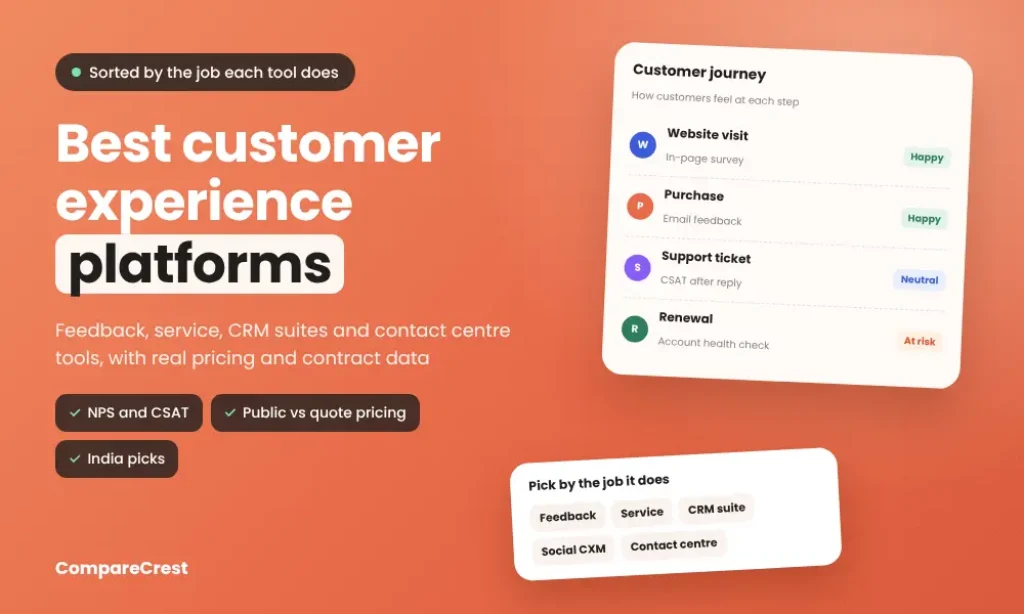

Customer experience software is not one category. Qualtrics and Medallia collect and analyse customer feedback, Zendesk and HubSpot manage service conversations, Sprinklr handles social and messaging at enterprise scale, Gainsight focuses on customer retention, and Genesys runs contact-centre operations.
For most growing businesses, the best choice is the platform that fixes the main break in the customer journey. Start with SurveySparrow or Zonka Feedback for NPS and CSAT, Zendesk when support is the main customer touchpoint, Zoho CRM Plus when sales, marketing and service need one customer record, and Genesys when voice operations are central. Enterprise teams running a formal voice-of-customer programme should shortlist Qualtrics or Medallia.
This guide compares the platforms by the job they perform, their realistic cost, implementation effort and the type of organisation they suit.
TL;DR: Which CX Platform Should You Choose?
- For enterprise feedback and VoC: Choose Qualtrics for flexibility or Medallia for large, complex customer programmes.
- For NPS, CSAT and surveys without enterprise complexity: Start with SurveySparrow, Zonka Feedback or Survicate.
- For support-led customer experience: Zendesk is the strongest dedicated option, while HubSpot works better when support must connect with marketing and sales.
- For the best value across sales and service: Zoho CRM Plus is the practical choice for growing teams that want multiple customer-facing tools in one suite.
- For specialised needs: Choose Gainsight for customer success, Sprinklr for social and omnichannel engagement, or Genesys for a voice-heavy contact centre.
- Watch the real cost: AI resolutions, survey-response limits, onboarding and implementation can cost more than the advertised subscription.
What Counts as a Customer Experience Platform?
A customer experience (CX) platform helps a business understand and improve how customers experience it across every touchpoint, from the first visit to support and renewal. In practice, products sold under the label fall into five groups:
| Type | What it does | Examples |
|---|---|---|
| Experience management (XM) and feedback | Runs NPS, CSAT and CES surveys, analyses open-text feedback, alerts teams to unhappy customers | Qualtrics, Medallia, SurveySparrow, Zonka Feedback, Survicate |
| Service-led CX | Handles support conversations and measures satisfaction inside the service workflow | Zendesk, HubSpot Service Hub |
| CRM suites | Puts sales, marketing and service on one customer record | Zoho CRM Plus, HubSpot Customer Platform |
| Unified and social CXM | Combines social listening, messaging and service across many channels | Sprinklr |
| Customer success and contact centre | Tracks account health and renewals, or runs voice and digital queues | Gainsight, Genesys Cloud CX |
If you only need to answer customer emails and chats, you need a helpdesk, not a CX platform. Our helpdesk software guide covers that.
Customer Experience Platforms Compared
| Platform | Best for | Best-fit organisation | Published or reported starting point |
|---|---|---|---|
| Qualtrics XM | Enterprise feedback and experience management | Large organisation with a dedicated CX team | Custom quote |
| Medallia | High-volume feedback across locations and channels | Large multi-location or regulated enterprise | Custom quote |
| SurveySparrow | Conversational NPS, CSAT and CES surveys | Small and midsize feedback programmes | Free plan; paid pricing varies by product |
| Zonka Feedback | In-store, kiosk and multi-location feedback | Healthcare, retail, hospitality and service locations | Custom or response-based pricing |
| Survicate | Website and in-product surveys | SaaS, product and ecommerce teams | From US$114/month on annual billing |
| Zendesk | Support-led customer experience | Growing and midsize support teams | Suite Team from US$55/agent/month annually |
| HubSpot Customer Platform | Connected marketing, sales and service | Businesses already using HubSpot | Starter pricing varies by package and promotion |
| Zoho CRM Plus | Connected sales, marketing and customer service | Cost-conscious small and midsize businesses | Check current regional pricing |
| Sprinklr | Social listening and omnichannel engagement | Large consumer brands | Enterprise quote |
| Gainsight | Customer success and churn management | B2B SaaS companies | Custom quote |
| Genesys Cloud CX | Voice and digital contact centres | Midsize and enterprise service operations | Pricing varies by region and licence model |
Prices change by region, billing period, usage and contract size. Quote-only platforms should be compared using the complete first-year cost, not the subscription alone.
How We Chose These CX Platforms
We compared official pricing and product documentation with independent contract data and documented user feedback. We did not run a complete CX programme on every platform. We focused on the job each product solves, pricing transparency, implementation effort, channel coverage, feedback workflows, AI costs and the size of organisation each platform realistically suits. Third-party contract figures are treated as reported estimates, not official vendor pricing.
Best Platforms for Customer Feedback and Voice of Customer
These platforms measure what customers think and help teams identify where the experience breaks. Most do not replace a helpdesk or CRM, but they can send alerts and feedback into those systems.
1. Qualtrics XM: Best for Enterprise CX Programmes
Qualtrics CustomerXM is one of the best-known enterprise experience-management platforms. It supports surveys across multiple channels, text and sentiment analysis, journey dashboards, role-based reporting and workflows that route negative feedback to the relevant team. Its main advantage is flexibility. Large organisations can build different feedback programmes for customers, employees, products and brands while maintaining central governance.
The trade-off is cost and complexity. Qualtrics does not publish standard CustomerXM prices, and the total depends on products, responses, users and services. Businesses should request a quote that separates the recurring licence, implementation, integrations, support and renewal terms.
Qualtrics has also discontinued Delighted, its lighter NPS and survey product. Former Delighted users who do not need an enterprise suite should compare simpler alternatives before moving to CustomerXM. Qualtrics confirms that Delighted is no longer available.
Best for: Large organisations with a dedicated CX or research team.
Avoid if: You need a simple, self-serve NPS tool with transparent pricing.
2. Medallia: Best for High-Volume Enterprise Feedback
Medallia competes most directly with Qualtrics. It is designed to bring together feedback from surveys, reviews, contact-centre conversations, chat transcripts, digital behaviour and physical locations.
Its frontline workflows are particularly relevant to retailers, banks, hotel groups and other organisations where branch or store managers need access to customer signals. Feedback can be routed to operational teams instead of remaining inside a central research dashboard.
Medallia sells by quote, and implementation can be substantial. Ask the vendor to separate platform licensing, data connectors, professional services, training and ongoing support.
Best for: Large organisations collecting feedback across many locations and channels.
Avoid if: Your team only needs NPS, CSAT or a few website surveys.
3. SurveySparrow: Best for Conversational NPS and CSAT
SurveySparrow uses a conversational survey format that feels less like a traditional long form, especially on mobile. Its CX tools support recurring NPS, CSAT and CES surveys, automated follow-ups and integrations with popular CRM and support platforms.
A free plan is available, but product packaging, response limits and CX features can differ between plans. Review the current SurveySparrow pricing for the exact survey type, response allowance and number of users you require.
The most important limitation is not the survey builder. It is whether the selected plan supports enough active surveys, responses and integrations for your programme.
Best for: Small and midsize teams starting a structured feedback programme.
Avoid if: You need enterprise governance, advanced research controls or very high response volumes.
4. Zonka Feedback: Best for Multi-Location and In-Person Feedback
Zonka Feedback is particularly useful when feedback happens at a physical location. It supports tablet and kiosk surveys, QR codes, email, SMS, website surveys and other channels, including offline response collection.
This makes it a practical option for clinics, hospitals, restaurants, retail chains and service centres. Its feedback intelligence features can group open-text comments by theme and sentiment.
Some third-party listings show starting prices without clearly stating the currency or included response volume. Do not budget from those figures. Request a written quote that confirms responses, locations, devices, channels and AI features.
Best for: Healthcare, hospitality, retail and other multi-location businesses.
Avoid if: You only need occasional email surveys and want fully transparent self-serve pricing.
5. Survicate: Best for Website and In-Product Surveys
Survicate is built for collecting feedback while a customer is using a website, app or product. A SaaS company can trigger a survey after onboarding, when someone visits a pricing page or when a user cancels.
It also supports email surveys and integrations with product analytics, customer service and CRM tools. This makes it useful for connecting feedback with user behaviour.
Survicate does not offer a permanent free plan. Its Growth plan is listed from approximately US$114 per month on annual billing, but response limits and included capabilities matter more than the headline price. Check the current Survicate pricing before subscribing.
Best for: SaaS, product and ecommerce teams collecting contextual feedback.
Avoid if: You expect high response volumes on a limited budget.
Best Customer Service Platforms for CX
For many businesses, customer support is where customers form their strongest opinion of the company. These platforms begin with service conversations and add AI, satisfaction measurement and reporting.
6. Zendesk: Best When Support Drives the Customer Experience
Zendesk combines email, messaging, live chat, voice, self-service and ticket management in one agent workspace. It measures CSAT within the support workflow and can automate common requests using AI agents.
Zendesk Suite Team currently starts at US$55 per agent per month on annual billing. Higher plans add more advanced routing, analytics and workforce capabilities. Check the current Zendesk pricing page before budgeting.
AI agents are included in Zendesk plans, but usage is measured through automated resolutions or resolution allowances. The pricing model can vary by account and contract, so request a quote showing included AI usage and the price of additional resolutions.
Zendesk is strong at support-led CX but is not a direct replacement for Qualtrics or Medallia. Teams that need journey research or broader NPS programmes may still require a feedback platform. See our detailed Zendesk profile for plan considerations.
Best for: Businesses where customer support is the main customer touchpoint.
Avoid if: Your main requirement is market research or a company-wide VoC programme.
7. HubSpot Customer Platform: Best for Existing HubSpot Teams
HubSpot Service Hub runs on the same customer record as HubSpot’s marketing and sales products. A support agent can see previous emails, deals and website activity, while marketing teams can use service information when building customer campaigns.
Depending on the plan, Service Hub includes helpdesk features, a knowledge base, customer portals, feedback surveys and AI-assisted service tools.
Starter pricing can be accessible, but costs rise sharply when a business adds Professional products, multiple Hubs, onboarding and additional seats. Promotions can also make the displayed starting price difficult to use for long-term budgeting. Confirm the current total through HubSpot’s Service Hub pricing.
Our HubSpot CRM profile explains where the free and paid CRM products fit.
Best for: Businesses already running sales or marketing through HubSpot.
Avoid if: You only need a dedicated helpdesk and do not plan to use HubSpot’s wider platform.
Best CRM-Based Customer Experience Suite
8. Zoho CRM Plus: Best Value for Connected Sales and Service
Zoho CRM Plus brings CRM, customer support, live chat, marketing campaigns, social media management, surveys, projects and analytics under one licence.
For a business already paying for several separate customer-facing tools, the bundle can provide a more affordable connected view. Sales, marketing and support teams can work from related customer data instead of maintaining separate records.
The trade-off is setup. Zoho’s breadth can create administrative work, and individual applications may not provide the same depth as specialised enterprise products.
Check the current regional Zoho pricing and confirm whether the quote includes every required application, user and support service. If you only need sales management, see our Zoho CRM profile. For ticketing and customer support, compare the separate Zoho Desk profile.
Best for: Small and midsize businesses that want sales, marketing and service tools under one vendor.
Avoid if: You need the deepest specialist product in every department.
Best Platform for Social and Omnichannel CX
9. Sprinklr: Best for Large Brands with Heavy Social Volume
Sprinklr’s Unified-CXM platform combines social listening, social publishing, messaging, customer service and analytics across a large number of digital channels.
It is designed for global consumer brands receiving high volumes of public mentions, direct messages and service requests. Central governance, permissions and cross-channel reporting are important parts of its value.
Sprinklr currently directs buyers towards an enterprise sales process for its main platform. Older self-serve prices should not be used as the basis for a new budget. Request a quote that separates users, channels, listening volume, implementation and optional modules.
Best for: Large consumer brands managing social engagement at scale.
Avoid if: Social media is a minor support channel or your team needs a simple inbox.
Best Customer Success Platform
10. Gainsight: Best for B2B SaaS Retention
Gainsight approaches customer experience from the account-retention side. It combines product usage, customer activity, health scores, renewal information and risk signals so customer success managers can prioritise accounts.
This is useful for B2B SaaS companies where retention, adoption and expansion matter more than individual support tickets. Gainsight can be paired with a survey tool when the team also needs NPS or relationship feedback.
Pricing is quote-only. Ask how customers, users and products are counted, and request separate figures for onboarding, integrations, AI features and recurring licences. Our Gainsight profile covers the product’s fit and limitations in more detail.
Best for: B2B SaaS businesses with a formal customer success function.
Avoid if: You mainly need surveys, ticketing or support automation.
Best Contact Centre Platform
11. Genesys Cloud CX: Best for Voice-Heavy Operations
Genesys Cloud CX is a contact-centre platform for voice, digital messaging, routing, workforce management, quality assurance and AI-assisted customer service.
It is most relevant when phone and digital queues are central to the customer experience. Genesys supports named, concurrent and usage-based licence models, so the right option depends on how many agents need access and how regularly they handle interactions.
Pricing varies by region and licence model. Genesys also notes that some AI capabilities consume additional tokens or usage allowances. Review the current Genesys Cloud CX pricing and request a quote based on actual concurrent agents, channels and interaction volume.
For a smaller Indian sales or calling team, a CRM with calling capabilities may be more economical.
Best for: Midsize and enterprise contact centres where voice is a major channel.
Avoid if: Your team only handles a small number of calls or primarily uses email and chat.
Other CX Platforms Worth Shortlisting
| Platform | Consider it when |
|---|---|
| InMoment | You need another enterprise VoC option for retail, hospitality or location-based feedback |
| Chattermill | You already collect plenty of feedback but need help analysing comments, reviews and tickets |
| CleverTap | You operate a consumer mobile app and need behaviour-based engagement, push notifications and journeys |
| MoEngage | You need cross-channel customer engagement for a mobile or digital consumer product |
| Salesforce Service Cloud | Your organisation already runs sales and customer data inside Salesforce |
| Intercom | You want an AI-first support platform for SaaS or digital products |
Intercom charges separately for some AI-resolved outcomes, so model both seat costs and AI usage. See our complete Intercom profile before comparing it with Zendesk or HubSpot.
Best Delighted Alternatives After Its Shutdown
Qualtrics has discontinued Delighted. The right replacement depends on how your organisation previously used the product.
| If you used Delighted for | Consider | Why |
|---|---|---|
| Simple recurring NPS surveys | SurveySparrow | Conversational surveys and a low-friction starting point |
| In-store or kiosk feedback | Zonka Feedback | Tablet, QR code and offline collection |
| Website or in-product surveys | Survicate | Targeting based on page, product event or user action |
| CSAT after support tickets | Zendesk or HubSpot | Feedback remains connected to the service conversation |
| A larger formal CX programme | Qualtrics | Broader experience-management and research capabilities |
Do not move to a large enterprise platform simply because it owns or replaced the product you previously used. If Delighted’s simplicity was its main benefit, a focused feedback tool will probably be a closer replacement.
CX Platform Pricing and Hidden Costs
The subscription price is only one part of a CX platform’s cost.
| Cost area | What to check |
|---|---|
| Survey responses | Annual and monthly response limits, overage charges and duplicate responses |
| Users and agents | Whether pricing applies to every employee, administrator or active agent |
| AI usage | Included resolutions, tokens or conversations and the overage price |
| Implementation | Configuration, integrations, migration, training and consultancy |
| Communication channels | Voice minutes, SMS, WhatsApp, email and telephony provider charges |
| Data storage | Retention periods, recording storage and export access |
| Contract terms | Minimum term, renewal uplift, cancellation window and usage commitments |
For quote-only software, ask every vendor to price the same user count, response volume, channels and implementation scope. Otherwise, apparently similar quotes may cover very different requirements.
Which Customer Experience Platform Should You Choose?
| Your situation | Start with |
|---|---|
| You’ve never measured NPS or CSAT | SurveySparrow free plan or Zonka Feedback trial |
| Support is your main customer touchpoint | Zendesk, or a helpdesk with CSAT surveys |
| Indian SMB with sales, marketing and support in separate tools | Zoho CRM Plus |
| Marketing and sales already on HubSpot | HubSpot Service Hub |
| B2B SaaS where churn drives revenue | Gainsight plus a survey tool |
| Large brand with heavy social and messaging volume | Sprinklr |
| Formal CX team and enterprise budget | Qualtrics or Medallia |
| Phone-heavy service operation | Genesys Cloud CX |
Mistakes to Avoid When Buying a CX Platform
Buying an enterprise suite before you have someone to act on the feedback. A dashboard full of detractor scores that nobody follows up on changes nothing.
Choosing on the survey builder alone. Most tools build decent surveys. The difference is whether results reach the person who can fix the problem, through alerts in your helpdesk, CRM or Slack.
Ignoring response limits. A tool that looks cheap at 2,500 responses a year gets expensive once you survey after every ticket.
Treating a helpdesk as a CX strategy. A helpdesk measures satisfaction with support. It won’t tell you why customers churn after onboarding or stop buying after a price change.