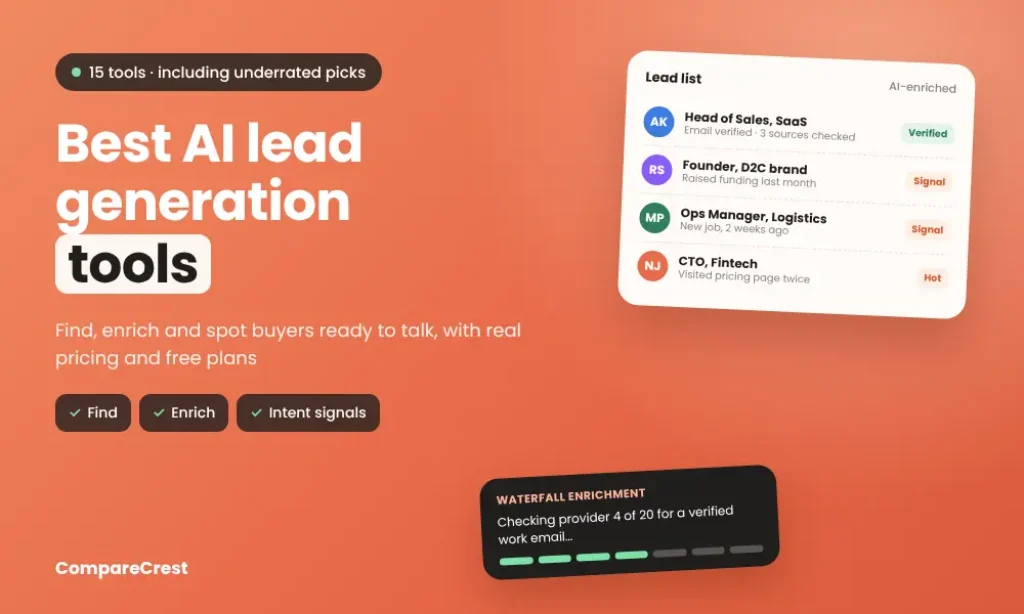

The best AI lead generation tool depends on which part of lead generation you’re stuck on. Apollo.io is the best all-in-one starting point, with a free plan and a large contact database. Clay is the most powerful tool for building and enriching lead lists with AI, if you’re willing to learn it. For smaller budgets, Hunter is the cheapest reliable way to find business emails, and underrated tools like Persana AI, Bitscale and FullEnrich do much of what Clay does for less.
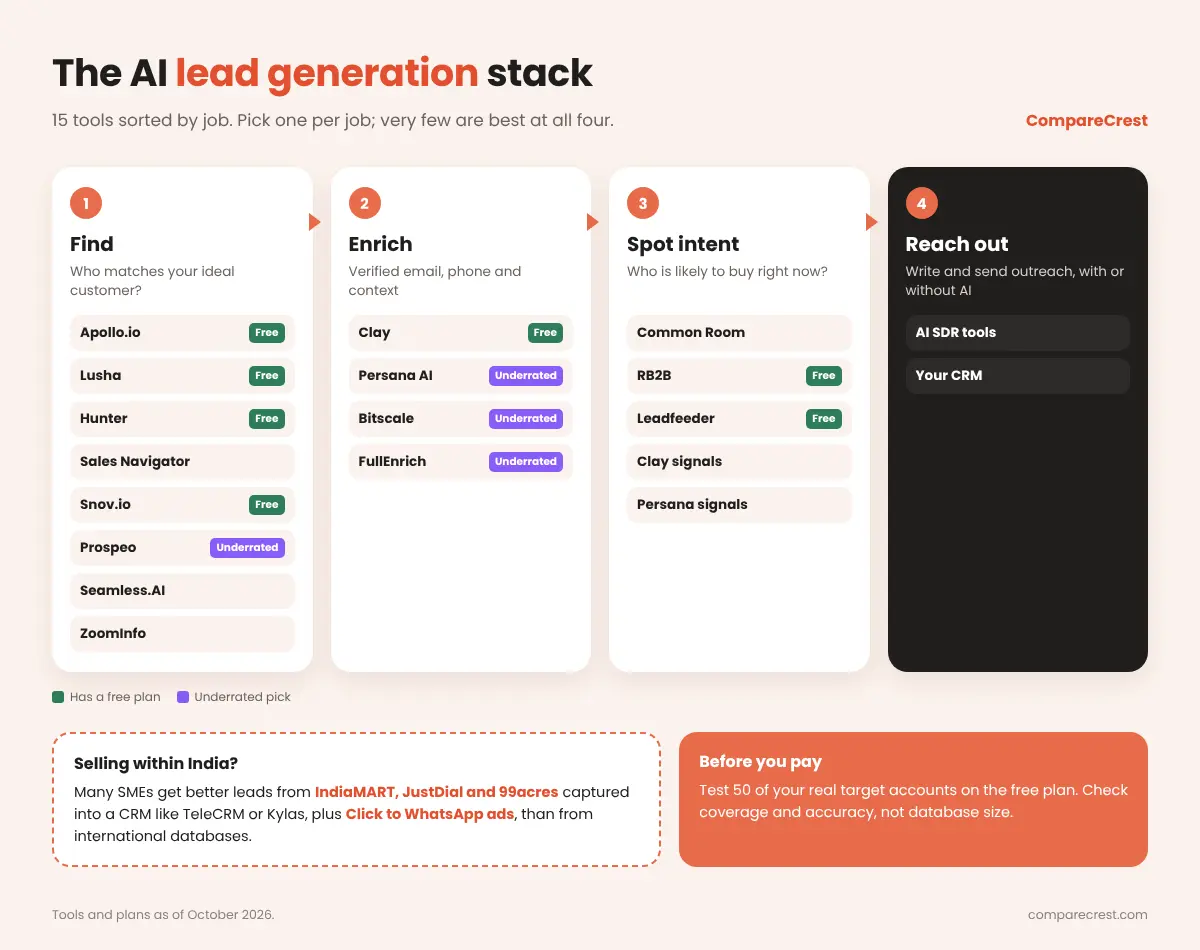
“AI lead generation” covers three different jobs that are often mixed up: finding the right people, enriching them with accurate contact details and context, and spotting which of them are ready to buy right now. Very few tools are best at all three. This guide covers nine top picks in depth and six more worth considering, grouped by the job they do best, with real prices, so you can build a stack that fits your budget rather than paying for a platform you’ll only half use.
AI Lead Generation Tools Compared
| Tool | Best at | Free plan | Paid from |
|---|---|---|---|
| Apollo.io | Finding contacts in a large database | Yes | US$49/user/month (annual) |
| Lusha | Quick contact lookups from LinkedIn and the web | 40 credits/month | About US$49.90/month list |
| Hunter | Finding and verifying business emails | 50 credits/month | US$49/month (US$34 annual) |
| Clay | Building and enriching lists with AI workflows | 500 actions, 100 data credits/month | US$185/month (US$167 annual) |
| Persana AI | Clay-style enrichment at a lower price | 50 credits | US$85/month (US$68 annual) |
| Bitscale | Enrichment and signals with pay-on-success credits | 200 credits | US$349/month |
| FullEnrich | Waterfall email and phone enrichment | 50 trial credits | US$55/month for 1,000 credits |
| Common Room | Buying signals across web, community and product | No | US$2,500/month (annual) |
| LinkedIn Sales Navigator | Prospecting directly on LinkedIn | Free trial | Varies by region |
| Snov.io | Email finding plus built-in cold email | 50 credits/month | US$39/month |
| Prospeo | Low-cost verified emails from LinkedIn | 100 credits/month | US$49/month (US$37 annual) |
| Seamless.AI | Real-time contact search for high volume | Yes, limited credits | Quote-based |
| ZoomInfo | Enterprise-grade data and intent | No | Quote-based, annual contracts |
| RB2B | Identifying US website visitors by person | 150 resolutions/month (company only) | US$79/month |
| Leadfeeder | Identifying companies visiting your site | 100 companies/month | €79/month (annual) |
Prices are before tax and were checked in October 2026. Where a vendor doesn’t publish prices on its pricing page, we’ve used recent third-party breakdowns and labelled them.
How We Chose These Tools
We compared official pricing and documentation with independent user feedback. We focused on data accuracy, credit usage, failed-lookup charges, free-plan value, CRM integrations and ease of setup.
The Three Jobs of AI Lead Generation Tools
Finding leads means building a list of people who match your ideal customer: role, company size, industry, location. Databases like Apollo and Lusha are built for this, and their AI features help you describe the buyer in plain language instead of setting dozens of filters.
Enriching leads means adding the details you need to reach and personalise: verified email, phone, LinkedIn profile, company tech stack, recent news. Enrichment tools like Clay, Persana AI, Bitscale and FullEnrich check several data providers in turn (a “waterfall”) so you find more valid contacts than any single database would give you.
Spotting intent means finding which leads are likely to buy now, based on signals such as job changes, hiring, funding, website visits or engagement with your content. Common Room, and the signal features in Clay and Persana, cover this.
Outreach is a fourth step, and if you want AI to write and send messages for you, see our guide to AI SDR tools.
Best Tools for Finding Leads
1. Apollo.io: Best All-in-One Starting Point
Apollo combines a contact database of more than 200 million people with search filters, email sequences and AI-assisted writing, which makes it the most common first tool for small B2B teams. You can find leads, verify emails and start a simple sequence without buying anything else.
According to recent third-party pricing breakdowns, the free plan includes about 1,200 email credits a year plus a few mobile and export credits a month, enough to test whether Apollo’s data covers your market. Paid plans start at US$49 per user a month on annual billing (US$60 monthly) for Basic, and US$79 for Professional, which adds more mobile and export credits and AI features. Credits don’t roll over, and these figures come from third-party breakdowns rather than Apollo’s own page, so confirm them on Apollo’s pricing page before buying.
Data quality varies by region. Documented user experiences point to strong coverage of US and European tech companies and thinner, less accurate coverage of Indian SMEs, so test a sample of your target accounts before committing.
2. Lusha: Best for Quick Lookups While You Browse
Lusha works best as a browser extension. While you’re on a LinkedIn profile or a company website, it shows verified emails and phone numbers, and you can push the contact straight to your CRM. That suits founders and account executives who prospect one account at a time rather than building large lists.
The free plan gives 40 credits a month. An email costs 1 credit and a phone number 5, so the free plan covers a handful of phone reveals at most. Paid plans list from about US$49.90 a month according to third-party pricing breakdowns, with frequent promotional discounts on annual billing. Monthly plans let unused credits roll over up to twice the monthly limit.
3. Hunter: Cheapest Reliable Email Finder
Hunter does one thing well: finding and verifying business email addresses from a name and company domain. Its AI assistant in the Discover feature helps you search for companies in plain language, and it’s included even on the free plan.
The free plan gives 50 credits a month, and Starter costs US$49 a month or US$34 a month on annual billing for 2,000 credits. Growth, at US$149 a month (US$104 annually), adds 10,000 credits. For teams that already know who they want to contact and just need valid emails, Hunter is usually cheaper and simpler than a full database.
4. LinkedIn Sales Navigator: Best for LinkedIn-First Prospecting
If your buyers are active on LinkedIn, Sales Navigator remains the most direct way to find them, with advanced filters, saved lead lists, alerts for job changes and AI-assisted search. It doesn’t give you email addresses or phone numbers, so most teams pair it with an enrichment tool such as FullEnrich or Lusha. Pricing varies by country and plan, and LinkedIn offers a free trial.
Best Tools for Enriching Leads
5. Clay: Most Powerful AI Enrichment Platform
Clay is a spreadsheet-like workspace where each column can pull data from a different provider, run an AI research step, or trigger an action. Its AI agent, Claygent, can visit websites and answer questions like “does this company sell to healthcare?” for every row in a list. For growth teams that want to build very specific, well-researched lead lists, nothing else is as flexible.
Clay prices by two allowances: actions (each step it runs) and data credits (each data point it buys). The free plan includes 500 actions and 100 data credits a month with up to 200 rows per table, and Claygent is available even on free. Launch starts at US$185 a month on monthly billing (US$167 on annual), and adds phone enrichment, signals such as job changes, and email sending. CRM sync only arrives on Growth, from US$495 a month (US$446 annually).
The catch is the learning curve. Clay rewards people who think in workflows, and teams without that skill often pay for capacity they don’t use. Some AI models now cost a variable number of credits based on token use, so heavy AI research can be harder to predict.
6. Persana AI: The Underrated Clay Alternative
Persana AI covers much of the same ground as Clay, with waterfall email and phone enrichment, an AI research agent, web scrapers and ready-made playbooks, at lower entry prices. The free plan includes 50 credits, Starter costs US$85 a month or US$68 on annual billing with 2,000 credits a month, and Growth is US$151 a month on annual billing.
Its higher tiers go further than Clay’s entry plans: Pro (US$400 a month, annual) adds signals such as job changes, hiring triggers and funding news, plus HubSpot and Salesforce integration. It’s worth testing if Clay’s interface or price has put you off, though signal availability on some plans depends on your agreement, so confirm it in writing.
7. Bitscale: Underrated Pick That Only Charges for Results
Bitscale is a lesser-known enrichment and workflow platform positioned as a Clay alternative, with data waterfalls, buying-signal tracking and AI agents in a grid-style workspace. Its most useful policy for small teams is how credits work: according to its pricing FAQ, credits are only spent when a provider returns a valid result, while failed lookups, formulas and CRM syncs are free.
The free plan is lifetime free with 200 credits. Growth costs US$349 a month for 15,000 credits, with credits rolling over up to three times and two-way HubSpot sync, and Booster costs US$799 for 50,000 credits with Salesforce integration. It’s pricier to start than Persana, but the pay-on-success credits can make costs more predictable for list-heavy work.
8. FullEnrich: Underrated Pick for Finding Hard-to-Get Contacts
FullEnrich doesn’t build lists. It takes the names you already have and checks more than 20 data providers in sequence to find a verified work email or mobile number, which means it often finds contacts that a single database misses. It’s a strong companion to Sales Navigator or a scraped list.
Pricing is simple: a free trial with 50 credits, then Pro from US$55 a month for 1,000 credits. A work email costs 1 credit and a mobile number 10, so it’s cheap for emails and expensive for phone-heavy outreach.
Best Tool for Spotting Buying Intent
9. Common Room: Signals Across Web, Community and Product
Common Room pulls buying signals from many places into one view: website visits, community and social engagement, job changes, product usage and third-party intent data from Bombora. Its AI assistant, RoomieAI, researches accounts and drafts messages, and it can identify companies visiting your website.
It’s priced for funded B2B companies, with the Essential plan at US$2,500 a month on annual billing for 5 seats and up to 100,000 contacts. For smaller teams, the signal features in Clay or Persana are a more realistic starting point.
Also Worth Considering
These six didn’t make the top nine, either because they overlap heavily with a pick above or because they suit a narrower team, but each is the right answer for some buyers.
10. Snov.io: Email Finder With Cold Email Built In
Snov.io bundles an email finder, verifier, warm-up and sequencing tool in one plan, so a solo seller can go from list to sent campaign without connecting anything else. Starter costs US$39 a month for 1,000 credits and 5,000 email recipients, and Pro S is US$99 for 5,000 credits. Each prospect and each verification costs 1 credit, and annual billing is 25% cheaper. The free plan resets every 30 days with 50 credits, but it excludes bulk search, exports and integrations, so it’s only useful for a quick quality test.
11. Prospeo: Underrated Budget Email Finder
Prospeo is a lower-profile alternative to Hunter and Lusha that finds verified emails from LinkedIn profiles, company domains or uploaded lists. Third-party pricing recorded in September 2026 shows a free plan with 100 credits a month (exports capped at 25 rows), and Starter at US$49 a month or US$37 on annual billing for 2,000 credits. An email costs 1 credit and a direct dial 10. Prospeo’s pricing page didn’t load for us, so confirm the figures and whether not-found lookups are charged before you buy.
12. Seamless.AI: High-Volume Real-Time Search
Seamless.AI searches for contact details in real time rather than only from a stored database, and is built for sales teams making a lot of calls and sending a lot of email. There’s a free plan with a small credit allowance, but paid plans are quote-based and Seamless doesn’t publish prices on its pricing page. Third-party figures vary widely, so get a written quote and ask how credits are counted. User reviews often mention aggressive renewal terms, so check the cancellation clause before signing an annual contract.
13. ZoomInfo: For Enterprise Teams With Budget
ZoomInfo is the most complete B2B data platform here, combining contacts, company data, intent signals and AI features in one contract. It’s also the most expensive and the least transparent: prices aren’t published, and SpendHound’s data from real customer contracts puts the average spend for companies with 50 to 1,000 employees at about US$49,000 a year. That makes it a tool for funded sales teams, not small businesses. If you’re considering it, compare a quote against an Apollo plus FullEnrich stack first.
14. RB2B: Find Out Who Is Visiting Your Website
RB2B identifies visitors to your website and posts them to Slack, which turns anonymous traffic into a lead list. On paid plans it can name individual visitors with their LinkedIn profiles, but person-level identification only works for US visitors; outside the US it identifies companies only. The free plan gives 150 company-level resolutions a month. Starter costs US$79 a month, and Pro, from US$149, adds business emails and CRM integrations. It’s most useful if a large share of your traffic comes from the US.
15. Leadfeeder: Company-Level Visitor Identification
Leadfeeder (Dealfront has gone back to the Leadfeeder name) identifies the companies behind your website traffic and pushes them to HubSpot, Salesforce, Pipedrive or Zoho. Unlike RB2B, it works at company level worldwide and is strongest in Europe. The free Lite plan shows the last 100 companies a month with 7 days of history. Discover starts at €79 a month on annual billing (€113 monthly) and is priced by the number of companies identified. Verified emails and phone numbers start on Activate, from €369 a month on annual billing.
Lead Generation for Indian Businesses
Most of the tools above are built for international B2B outbound, and their data on Indian companies is often thinner. Many Indian SMEs get their best leads from inbound sources instead:
- Marketplaces and portals such as IndiaMART, JustDial and 99acres. CRMs like TeleCRM and Kylas can capture these leads automatically and route them to a calling team.
- Click to WhatsApp ads, where leads message you directly and follow-ups for 72 hours are free. Our WhatsApp Business API pricing guide explains the costs, and tools like Interakt handle the conversations.
- Missed inbound calls, which an AI receptionist can answer and turn into qualified leads.
For B2B companies in India selling to international clients, Apollo, Hunter and Clay work well, since the target data is where their coverage is strongest.
How to Choose Your AI Lead Generation Stack
| Your situation | Start with | Add later |
|---|---|---|
| Founder or solo seller, small budget | Apollo free or Hunter free | FullEnrich for missing contacts |
| Small team doing regular outbound | Apollo Basic | Persana AI for enrichment |
| Growth team building precise lists | Clay or Persana AI | Common Room once signals matter |
| LinkedIn-heavy B2B selling | Sales Navigator | FullEnrich or Lusha for contact details |
| Indian SMB selling locally | TeleCRM or Kylas with portal capture | Click to WhatsApp ads |
| Website gets steady B2B traffic | Leadfeeder Lite or RB2B free | FullEnrich to reach the visitors |
| Solo seller who wants one tool | Snov.io Starter | Prospeo for cheaper bulk emails |
Whichever you pick, push leads into one place. Our guide to the best CRM software for small business in India covers which CRMs connect to these tools.
Mistakes That Waste Lead Generation Budgets
- Buying a big database before checking its coverage of your actual target accounts.
- Paying for phone credits when your team mostly sends email.
- Letting unused credits expire every month on plans without rollover.
- Sending to unverified emails, which damages your domain’s reputation.
- Building lists without a clear ideal customer profile, then blaming the tool.
- Running several tools that all enrich the same fields.