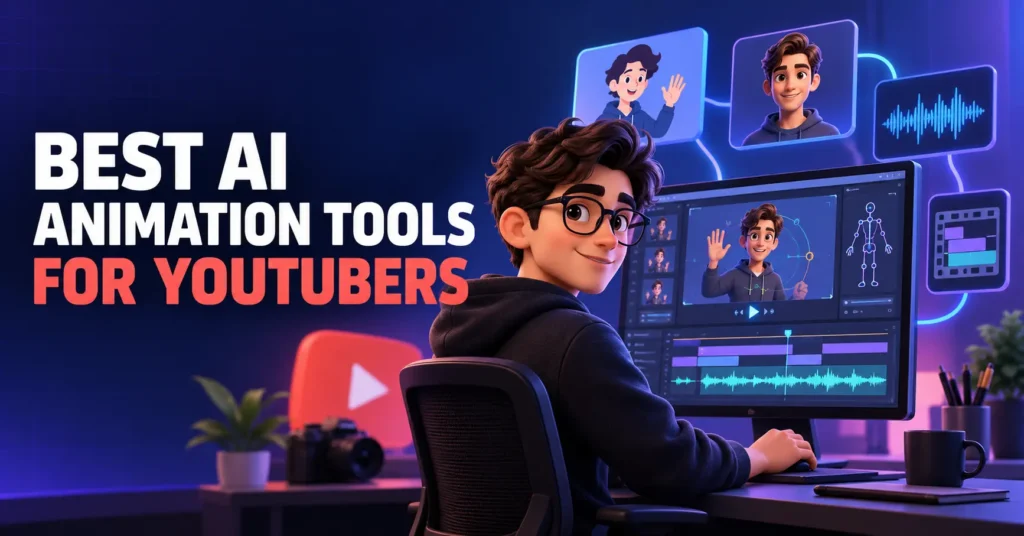
AI animation tools do not all solve the same problem. Some generate a finished video from a script, some give you reusable cartoon characters, and others create a digital presenter that speaks to the camera. Choosing the wrong type usually means paying for features your channel does not need or discovering that your character looks different in every video.
For most YouTubers, Animaker is the best affordable starting point for 2D cartoon explainers, while Krikey AI is stronger for a reusable 3D host or mascot. HeyGen works better for realistic presenters, Steve AI prioritizes speed, Powtoon fits presentation-style explainers, and Vyond is the premium business option.
If you only want to create occasional cinematic clips from prompts, you probably do not need one of these platforms. Our guide to the best free AI text-to-video generators covers that category separately.
6 Best AI Animation Tools
| Tool | Best for | Starting price* | Character approach | Main limitation |
|---|---|---|---|---|
| Animaker | Affordable 2D cartoon explainers | Free; paid from $15/month annually | Reusable library and custom characters | Commercial rights require Pro |
| Krikey AI | Recurring 3D hosts and mascots | Free; Pro $15/month | Custom 3D avatars | Limited visual styles |
| HeyGen | Faceless presenter channels | Free; Creator $29/month | Stock and custom realistic avatars | Premium avatars consume credits quickly |
| Steve AI | Fast script-to-animation production | Free; paid from $10/month annually | Library characters and character actions | Less scene-level control |
| Powtoon | Educational and presentation-style videos | Free; paid from $15/month annually | Customizable cartoon characters and avatars | AI credits and export limits vary by plan |
| Vyond | Polished business and training content | From $58/month annually | Deeply customizable recurring characters | Expensive for solo creators |
*Prices are based on annual billing where stated and were checked in September 2026. Plans, credits and regional pricing can change.
How We Chose These AI Animation Tools for YouTubers
We focused on the factors that matter in repeat production:
- Whether a character, mascot or presenter can be reused across multiple videos
- How much control the creator has over scenes, expressions, movement and branding
- Script-to-video capability and editing control
- Resolution, watermarks, credits and download limits
- Commercial-use conditions and suitability for long-form videos and Shorts
This comparison uses current provider documentation and published plan details. We have not claimed hands-on testing where it was not performed.
1. Animaker – Best Affordable 2D Animation Tool for YouTube
Animaker is the easiest recommendation for a creator who wants recurring cartoon characters without learning traditional animation software. Its browser-based editor lets you choose or customize a character, place it into reusable scenes, add actions and expressions, generate a voiceover, and assemble the video on a drag-and-drop timeline.
That workflow suits explainers, story channels and animated commentary. Because the character is an editable asset rather than something regenerated for every shot, it can retain the same appearance across a channel.
The subscription price does not tell the whole story. Animaker’s current plans include five downloads a month on Basic, ten on Starter and thirty on Pro. Additional downloads cost extra. More importantly for YouTubers, the platform lists commercial rights only with Pro and Enterprise. A monetized channel should therefore evaluate the $43-per-month Pro plan, billed annually, rather than assuming the $15 Basic plan is sufficient. The full limits are listed on the official Animaker pricing page.
Why choose it: It offers a straightforward combination of reusable characters, templates, voice generation and scene editing.
Not ideal for: Creators who want realistic human presenters, advanced hand-drawn animation or unlimited low-cost exporting.
2. Krikey AI – Best for a Recurring 3D Character or Mascot
Krikey AI is a better fit when the channel needs a recognizable 3D host rather than a flat cartoon character. You can create a custom avatar, reuse it across videos, apply animations, add a voiceover and build scenes inside a browser-based editor. It can also export FBX files, which gives more technical creators a route into other 3D workflows.
It suits animated podcast clips, educational content, virtual-host channels and brands that want a simple mascot, without much of the rigging work associated with 3D animation.
Krikey has a free option with 20 one-time credits. Pro costs $15 per month and includes 165 monthly credits, watermark removal, resizing and MP4, GIF, PNG and FBX exports. Its official plan comparison also offers one-time credit passes, which may suit creators who publish irregularly.
The trade-off is visual range. Krikey produces a recognizable 3D-avatar look, so it is not the right choice for cinematic animation, hand-drawn storytelling or channels that need a completely original visual language.
Why choose it: Custom avatars, automated movement and voice tools are combined in one accessible editor.
Not ideal for: Creators who need photorealism or detailed professional 3D production controls.
3. HeyGen – Best for Realistic AI Presenter Videos
HeyGen solves a different problem from Animaker or Krikey. Instead of building a cartoon scene, it creates a presenter who delivers a script directly to the camera. You can choose a stock avatar, create a custom video avatar or use a photo avatar, then generate speech in multiple languages.
That suits faceless tutorials, product walkthroughs and courses needing the same presenter without filming every episode. It is less useful when characters must move around a scene or interact with objects.
The free plan allows three videos a month of up to one minute each. Creator costs $29 per month and includes 600 credits, 1080p export, watermark removal and videos up to 30 minutes. Pro costs $49 per month and increases the allowance to 1,000 credits while adding 4K export.
Credit usage matters more than the headline subscription price. Avatar IV and Avatar V currently consume 20 credits per generated minute. That gives Creator approximately 30 minutes and Pro approximately 50 minutes if every minute uses one of those premium models. A weekly ten-minute upload would therefore exceed Creator’s allowance but fit within Pro before revisions. HeyGen explains these allowances on its current pricing page.
Why choose it: Strong custom-avatar, voice-cloning and multilingual presentation features.
Not ideal for: Cartoon storytelling, complex scenes or channels that need many premium-avatar minutes each month.
4. Steve AI – Best for Turning a Script Into an Animated Draft Quickly
Steve AI starts with the script. Paste an article, narration, prompt or podcast transcript, choose an animated style, and the platform assembles a first draft using characters, scenes, voiceover and stock media. You can then change the assets, character actions and timing before exporting.
This helps creators convert written content into YouTube videos. It reduces blank-timeline work but provides less scene control than building manually in Animaker or Vyond.
Current annual-plan pricing starts at $10 per month for Basic, $19 for Starter and $39 for Pro. The plans differ in video minutes, premium assets, resolution and generative credits; the full breakdown is available on the Steve AI pricing page.
There is an important distinction inside the platform. Steve AI includes both reusable animation assets and generative-video features. The reusable animation characters are the safer option for a recurring channel identity. Generative scenes can still experience changes in character appearance or style between shots.
Why choose it: It automates more of the script-to-scene process than a conventional animation editor.
Not ideal for: Precise character acting, complex storytelling or creators who want to control every visual decision.
If your computer struggles once the generated footage reaches the editing stage, see our comparison of video editing software for low-end PCs.
5. Powtoon – Best for Presentation-Style YouTube Explainers
Powtoon sits between a presentation builder and an animation platform. It combines cartoon characters, icons, charts, templates, stock media and AI-assisted video drafting. Give it a prompt, document or script and it can prepare an initial video that remains editable in the main studio.
It works well for educational channels and explainers where animated text, diagrams and infographics matter as much as the presenter. Character customization supports a recurring visual identity.
Powtoon has a limited free plan. Its Creation plan currently starts at $15 per month when billed annually and includes videos up to ten minutes, character customization and an annual allocation of AI credits. Because output quality, branding controls and AI usage depend on the plan, check the Powtoon plan comparison against your expected upload schedule before subscribing.
Why choose it: Strong combination of characters, animated data, templates and presentation assets.
Not ideal for: Cinematic storytelling or creators who want natural-looking character movement.
Creators mainly producing thumbnails, channel graphics and lighter motion content may not need a full animation subscription. Some options in our free Canva alternatives guide can cover those simpler workflows.
6. Vyond – Best for Professional Business and Training Channels
Vyond is the most polished character-animation platform in this comparison, but it is also the hardest to justify for a casual or newly launched channel. It combines customizable characters, templates, text-to-video tools, AI avatars, voice generation, screen recording and collaboration features in one editor.
The platform makes the most sense for channels publishing business education, financial explainers, healthcare training, software instruction or other content where a consistent professional style is more important than keeping costs low. Its reusable characters and branded assets are also valuable when several people work on the same content library.
Starter costs $99 monthly or $699 a year, equivalent to about $58 per month on annual billing. Professional costs $199 monthly or $1,199 annually, while Enterprise costs $1,649 per user per year. Vyond also sells a separate Agency plan for creators producing client-facing content. The official Vyond plans page provides the current credit and licensing differences.
Vyond allows videos to be published on monetized platforms such as YouTube. Selling a video or transferring its commercial rights to a client is a different use case and may require the appropriate plan or an additional rights-transfer fee.
Why choose it: Deeper character control, stronger brand consistency and more mature production features than most browser-based competitors.
Not ideal for: Solo creators who need only a few simple videos each month.
Which AI Animation Tool Should You Choose?
Choose based on the type of video your audience will actually see—not on which platform has the longest AI feature list.
| If you want to create… | Choose |
|---|---|
| Affordable 2D cartoon explainers | Animaker |
| A reusable 3D host or mascot | Krikey AI |
| A realistic faceless presenter | HeyGen |
| Fast videos generated from scripts | Steve AI |
| Educational videos with charts and animated text | Powtoon |
| Premium business or training animation | Vyond |
Animaker offers the most accessible entry into reusable 2D characters, but monetized creators should account for its commercial-rights requirement. Krikey AI is the clearest choice for a recurring 3D mascot. HeyGen is better when the channel needs a presenter rather than animated scenes. Steve AI prioritizes speed, Powtoon prioritizes presentation-style communication, and Vyond prioritizes production depth.
Do not overlook the rest of the workflow. AI animation can reduce production time, but rendering, compositing and final editing still require suitable hardware. Our guide to how much RAM you need for video editing explains what is practical for 1080p, 4K and motion-graphics work.
What to Check Before Paying
Character reuse
Confirm that you can save and reuse the exact character or avatar. A tool offering an image-reference field is not necessarily the same as one that stores the character as a persistent editable asset.
Commercial rights
Monetization, client work and asset ownership are separate questions. Check whether your plan allows monetized YouTube publishing and whether transferring a finished video to a client requires an additional licence.
Real monthly output
Translate credits into usable minutes or completed exports. Include revisions in the calculation: regenerating a ten-minute presenter video can consume twice the credits even when only the second version is published.
Editing control
Fully automated video creation is fast, but the first draft will not always match the script’s meaning. Look for the ability to replace individual scenes, change timing, edit pronunciation and keep important visual elements locked.
Export format and resolution
Check whether the plan removes the watermark and supports the resolution your channel needs. Also confirm whether vertical exports are included if Shorts are part of the publishing schedule.
Final Verdict
Start with Animaker if you want conventional 2D cartoon videos and can justify the plan that covers your export and commercial-use needs. Choose Krikey AI when the channel revolves around a reusable 3D character. Pick HeyGen when a consistent presenter matters more than animated scenes.
Steve AI is the faster choice for converting scripts into editable drafts, while Powtoon fits educational videos built around text, diagrams and presentation-style visuals. Vyond is the strongest premium option, but its price makes more sense for established channels, businesses and agencies than for creators still testing a format.
The best tool is the one that can reproduce your channel’s format every week without forcing you to rebuild its visual identity or recalculate an unexpected credit bill after every upload.
What is the best AI animation tool for YouTube?
Animaker is the best starting point for most YouTubers making 2D cartoon explainers. Krikey AI is better for a reusable 3D mascot, while HeyGen is better for a realistic AI presenter. Vyond offers more production depth but costs considerably more.
Which AI animation tool keeps characters consistent?
Animaker, Vyond and Powtoon keep characters consistent by treating them as reusable editable assets. Krikey AI does the same with custom 3D avatars, while HeyGen lets creators reuse stock or custom human-style presenters. This is generally more reliable than asking a prompt-to-video model to recreate the same character for every shot.
What is the cheapest AI animation tool for a monetized YouTube channel?
The cheapest advertised tier is not always the cheapest usable tier. Animaker starts at $15 per month annually, but its pricing table reserves commercial rights for Pro at $43 per month annually. Krikey AI Pro costs $15 per month and may be the more economical option for a recurring 3D character. Always verify the current commercial-use terms before publishing monetized content.
Can I make YouTube Shorts with these tools?
Yes. Krikey AI includes video resizing on Pro, while the other platforms can create or export footage that can be arranged vertically in their editor or a separate video editor. Check plan-specific resolution, duration and watermark restrictions before committing.
Is HeyGen an animation tool or an AI avatar tool?
HeyGen is primarily an AI avatar platform. It belongs in this comparison because a reusable presenter solves the same consistency problem for faceless YouTube channels, but it does not replace Animaker, Powtoon or Vyond for scene-based cartoon animation.
Can YouTube monetize AI-animated videos?
Using AI does not automatically prevent monetization. The finished channel still needs to meet YouTube’s monetization policies, including its requirements around original and authentic content. Repetitive, minimally changed or mass-produced videos may be ineligible even when the animation software allows commercial use. Review the official YouTube channel monetization policies before building an automated publishing workflow.

Ajay is an Organic Growth Manager specializing in SEO, competitive research, and digital growth. With experience across fintech, e-commerce, Gaming, and healthcare, he analyzes SaaS platforms, AI tools, payment gateways, and business software beyond marketing claims. CompareCrest is where he turns in-depth research, feature analysis, pricing comparisons, and real-world insights into practical buying guides businesses can trust.