Canva is one of the easiest design tools for creating social posts, presentations, thumbnails, flyers, and other visual content. But its free plan isn’t the right fit for everyone. You may want more advanced photo editing, better vector tools, stronger AI features, easier collaboration, or simply a design tool with fewer free-plan restrictions.
That’s where Canva alternatives come in.
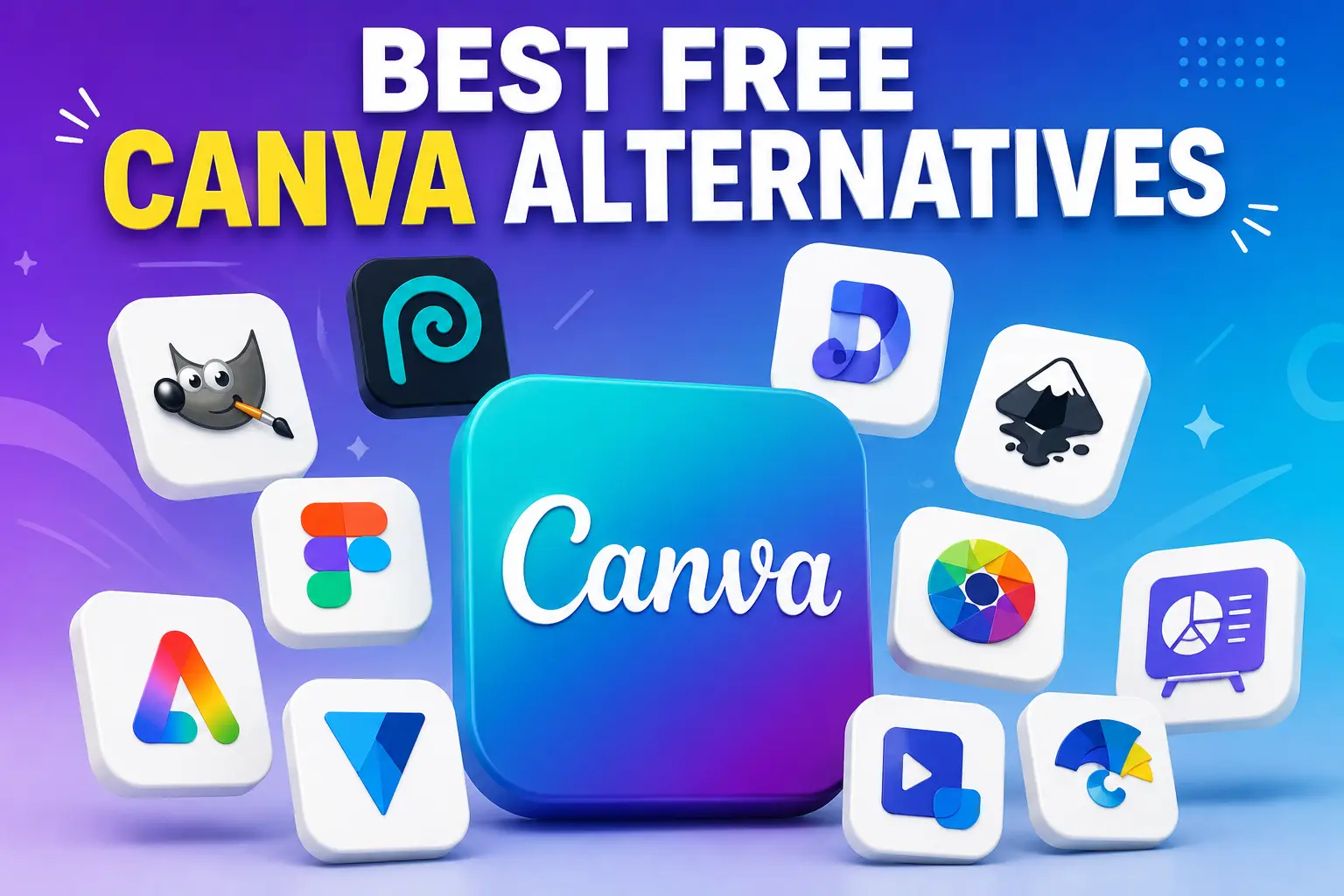
We compared 11 popular free design tools based on their free-plan limits, templates, editing features, AI capabilities, export restrictions, ease of use, and best use cases.
Free Canva Alternatives
| Tool | Best for | Biggest free-plan advantage | Main limitation |
|---|---|---|---|
| VistaCreate | Canva-like templates | 100K+ free templates and unlimited downloads of included content | Smaller ecosystem than Canva |
| GIMP | Advanced photo editing | Free and open source | Steeper learning curve |
| Photopea | Photoshop-style editing | Works in a browser and supports PSD files | Ads on the free version |
| Figma | Collaborative design | Unlimited drafts and team collaboration | Better suited to UI/product design |
| Adobe Express | AI-powered content creation | 100K+ templates and Adobe ecosystem | Some premium features require an upgrade |
| Microsoft Designer | AI-assisted design | Easy AI-powered visual creation | Less focused on traditional design workflows |
| Snappa | Quick social graphics | Large template and asset library | Only 3 downloads/month on free |
| Pixlr | Browser photo editing | Photo editing and AI tools | Ads and usage limits |
| Inkscape | Logos and vector graphics | Free and open source | Not a template-first tool |
| Fotor | Photo editing + templates | Basic editing and design tools | Watermarked free exports |
| Visme | Presentations and infographics | Unlimited projects | Watermark on free exports |
How We Evaluated These Canva Alternatives
We didn’t rank these tools simply by how many templates they advertise.
Instead, we looked at what you can realistically do without paying.
Our evaluation focused on:
-
Free-plan restrictions: What can you actually use without upgrading?
-
Templates: How useful and varied is the free template library?
-
Editing tools: Can you do more than basic drag-and-drop design?
-
AI features: Are useful AI tools included for free?
-
Exports: Are downloads limited or watermarked?
-
Ease of use: How quickly can a beginner get started?
-
Best use case: What type of user is the tool actually best for?
That matters because a tool can have a generous free plan but still be a poor Canva replacement for your particular workflow.
Why Look for a Canva Alternative?
Canva’s free plan is capable, but it doesn’t offer unlimited access to everything in the platform. Canva currently lists more than 1.6 million templates and millions of creative assets on its Free plan, alongside limitations on premium content and features. The bigger issue is that Canva alternatives aren’t all trying to solve the same problem.
For example:
- A photographer may prefer GIMP.
- A designer working with PSD files may prefer Photopea.
- A marketing team may prefer Adobe Express.
- A product designer may prefer Figma.
- Someone creating logos may prefer Inkscape.
- Someone who mainly wants Canva-style templates may prefer VistaCreate.
So the best Canva alternative depends on what you’re trying to create.
1. VistaCreate: Best Overall Free Canva Alternative
Best for: People who want a Canva-like template-based design experience.
VistaCreate is probably the closest alternative to Canva if your main goal is creating social media graphics, marketing visuals, ads, blog graphics, and similar content quickly. Its free Starter plan includes 100,000+ templates, more than 1 million creative assets, a brand kit, 10GB of storage, and social media scheduling. VistaCreate also says the Starter plan allows unlimited downloads of included content. The interface and workflow will feel familiar to Canva users: choose a template, customize the text and visuals, and export the finished design.
Pricing: Free Starter plan. Pro is available for users who need premium assets and advanced features.
Why choose it over Canva?
If your priority is template-based design and you want a generous free plan, VistaCreate is one of the first alternatives worth trying.
2. GIMP: Best Free Canva Alternative for Advanced Photo Editing
Best for: Photo editing, image manipulation, and users who want professional-level control without paying.
GIMP is fundamentally different from Canva. It is a desktop image editor designed for users who need layers, masks, retouching, compositing, and more detailed image manipulation. It’s free and open source, with versions available for Windows, macOS, Linux, and other platforms. The downside is simplicity. GIMP isn’t built around Canva-style templates and drag-and-drop social graphics, so beginners may need more time to learn it.
Pricing: Free and open source.
Why choose it over Canva?
Choose GIMP when editing control matters more than templates.
3. Photopea: Best for Photoshop-Style Editing in a Browser
Best for: Editing PSD files without installing desktop software.
Photopea is one of the most useful Canva alternatives for people who need more advanced image editing but don’t want to install an application. It runs in the browser and supports Photoshop-style workflows, including layered files such as PSD. The main trade-off is that the free version is supported by advertising.
Pricing: Free with ads; paid options are available for users who want an ad-free experience.
Why choose it over Canva?
If you regularly receive Photoshop files or need layer-based editing, Photopea is a much better fit.
4. Figma: Best Canva Alternative for Collaborative Design
Best for: Teams, UI design, prototypes, and collaborative design work.
Figma isn’t a direct Canva replacement, but it belongs on this list because it solves a major problem Canva users sometimes have: collaborative design. Figma’s free Starter plan provides unlimited files in Drafts and lets teams collaborate on up to three team files. It also includes AI functionality, although AI credits and feature availability depend on the plan. It’s particularly useful for product teams, UI designers, developers, and people working on structured design projects.
Pricing: Free Starter plan available; paid plans add more team and professional features.
Why choose it over Canva?
Choose Figma when collaboration, UI design, prototyping, or product design is more important than ready-made social templates.
5. Adobe Express: Best Canva Alternative for Adobe Users
Best for: Social media content, marketing graphics, quick videos, and AI-assisted design.
Adobe Express combines template-based design with Adobe’s broader creative ecosystem. Its Free plan currently includes 100,000+ static and video templates, 1M+ Adobe Stock assets, standard editing tools, 5GB of storage, and limited generative AI features. It’s especially attractive if you already use Photoshop, Illustrator, Lightroom, or other Adobe products.
Pricing: Free plan available. Premium adds more templates, assets, AI credits, brand features, and advanced tools.
Why choose it over Canva?
Adobe Express is a strong choice if you want Canva-style simplicity but already work inside the Adobe ecosystem.
6. Microsoft Designer: Best for AI-Assisted Design
Best for: Creating graphics and visual concepts with AI assistance.
Microsoft Designer is more AI-focused than traditional template-first tools. It’s useful when you want to generate or modify visual content rather than manually build everything from scratch. Its integration with Microsoft’s broader AI ecosystem makes it particularly interesting for Microsoft 365 users. Microsoft’s current AI credit limits vary by subscription, so avoid treating a specific monthly credit number as permanent.
Pricing: Free access is available, with additional AI capabilities depending on Microsoft subscriptions.
Why choose it over Canva?
Choose Designer if AI-assisted creation is more important to you than having Canva’s broader template ecosystem.
7. Snappa: Best for Occasional Social Graphics
Best for: Bloggers, marketers, and small businesses that only create a few graphics each month.
Snappa focuses heavily on speed. You can start with a template, customize it, and create social media graphics without dealing with a complicated editor. The free Starter plan currently includes 6,000+ templates, more than 5 million HD photos and graphics, and three downloads per month. That download limit is the biggest problem for anyone producing graphics regularly.
Pricing: Free Starter plan with three downloads per month. Paid plans remove the download restriction.
Why choose it over Canva?
Snappa works well if you only need a few social graphics each month and want a simple workflow.
8. Pixlr: Best for Browser-Based Photo Editing
Best for: Quick photo editing, background removal, and browser-based image work.
Pixlr sits somewhere between Canva and traditional photo editors. It’s useful when you need more control over photos than a template-based design platform provides, but don’t want to install desktop software. The free experience includes advertising and limits around some AI features.
Pricing: Free plan available; paid plans unlock additional tools and higher usage limits.
Why choose it over Canva?
Pixlr makes more sense when photo editing is the main task rather than creating template-based marketing graphics.
9. Inkscape: Best Free Canva Alternative for Logos
Best for: Logos, illustrations, icons, typography, and scalable vector graphics.
Inkscape is another tool that isn’t a direct Canva clone, and that’s precisely why it’s useful. It’s a free, open-source vector graphics editor designed for creating graphics that can scale without losing quality. It supports SVG as its primary format and can work with formats including AI, EPS, PDF, and PNG. For professional logo work, vector editing is a major advantage.
Pricing: Free and open source.
Why choose it over Canva?
Choose Inkscape when you’re designing a logo or other artwork that needs to work at many different sizes.
10. Fotor: Best for Photo Editing and Simple Designs
Best for: Beginners who want photo editing and basic design tools in one place.
Fotor combines photo editing, templates, effects, and AI-powered tools. Its free Basic plan includes basic editing, templates, collage tools, limited AI credits, and limited storage. However, free JPG, PNG, and PDF exports are watermarked. That makes Fotor less attractive for professional client work unless you’re willing to upgrade.
Pricing: Free Basic plan; Pro and Pro+ plans provide more AI credits, editing tools, templates, and watermark-free exports.
Why choose it over Canva?
Fotor is worth considering if photo editing is just as important as graphic design.
11. Visme: Best Canva Alternative for Presentations and Infographics
Best for: Presentations, infographics, reports, and data-driven visual content.
Visme is better thought of as a visual communication platform than a general-purpose Canva clone. Its free Basic plan includes unlimited projects, while paid plans unlock additional assets and export options. The biggest limitation of the free plan is that you need to upgrade for professional export options and additional premium capabilities.
Pricing: Free Basic plan. Paid plans start at around $12.25/month when billed annually.
Why choose it over Canva?
Choose Visme when you’re creating presentations, infographics, reports, or other information-heavy visual content.
Which Free Canva Alternative Should You Choose?
There’s no single winner for every type of design work.
Choose VistaCreate if:
You want the closest Canva-style experience with templates and simple editing.
Choose GIMP if:
You need advanced photo editing and don’t mind using desktop software.
Choose Photopea if:
You want Photoshop-style editing in your browser or need to work with PSD files.
Choose Figma if:
You need collaborative design, UI design, or prototyping.
Choose Adobe Express if:
You want AI-assisted content creation and Adobe integration.
Choose Microsoft Designer if:
You want AI to play a bigger role in creating graphics.
Choose Snappa if:
You create only a few social graphics each month.
Choose Pixlr if:
You need quick browser-based photo editing.
Choose Inkscape if:
You’re creating logos or scalable vector graphics.
Choose Fotor if:
You want photo editing plus basic design templates.
Choose Visme if:
You’re mainly creating presentations, infographics, and reports.
Are Free Canva Alternatives Actually Free?
Yes, but “free” doesn’t mean the same thing across every tool. Some tools are genuinely free and open source. GIMP and Inkscape are examples.
Others use a freemium model. They give you a useful free version but limit things such as:
- Downloads
- AI usage
- Premium templates
- Stock assets
- Storage
- Export formats
- Watermark-free exports
- Advanced editing features
That’s why the best way to compare Canva alternatives isn’t simply to ask “Is it free?”
Instead, ask: “Can I do what I need without paying?”
Final Verdict
Canva is still one of the easiest all-purpose design platforms, but you don’t have to use it for every design task.
The best choice ultimately comes down to what you need to create, not which platform has the longest list of features.
FAQs
What is the best free Canva alternative?
For most people who want a Canva-like design experience, VistaCreate is one of the strongest options. It offers a large free template library, creative assets, basic editing tools, and unlimited downloads of included content.
If your needs are different, GIMP, Photopea, Figma, Inkscape, or Adobe Express may be better choices.
What is the best Canva alternative without a watermark?
VistaCreate allows unlimited downloads of included free content, while GIMP and Inkscape don’t impose a software watermark because they are free and open source.
Always check the specific asset or export restrictions before using a free tool for client work.
Is there a completely free alternative to Canva?
Yes. GIMP and Inkscape are free, open-source applications with no conventional paid subscription required.
However, they are not Canva clones. GIMP focuses on image editing, while Inkscape focuses on vector graphics.
What is the easiest Canva alternative for beginners?
VistaCreate, Adobe Express, and Snappa are among the easier options for beginners because they use template-driven workflows.
GIMP and Inkscape offer considerably more control but require more time to learn.
What is the best Canva alternative for logos?
Inkscape is the strongest free choice for serious logo design because it is built around vector graphics and SVG.
What is the best free Canva alternative for photo editing?
For advanced editing, GIMP is the strongest free desktop option. For browser-based editing, Photopea is a strong choice.
What is the best Canva alternative for presentations?
Visme is particularly well suited to presentations and infographics. Figma is another option when the presentation is part of a broader collaborative design workflow.
Can I edit a Canva design in another app?
Not as a native, fully editable Canva project.
If you need to move a design to another tool, you’ll generally need to export it from Canva in a supported format such as PDF, PNG, JPG, or another available format, then import that file into the alternative. The amount of editing you retain will depend on the export format and the destination tool.
What is the best free Canva alternative for social media?
For a Canva-like workflow, VistaCreate is a strong option. Snappa is also useful for people who only create a small number of graphics each month.
