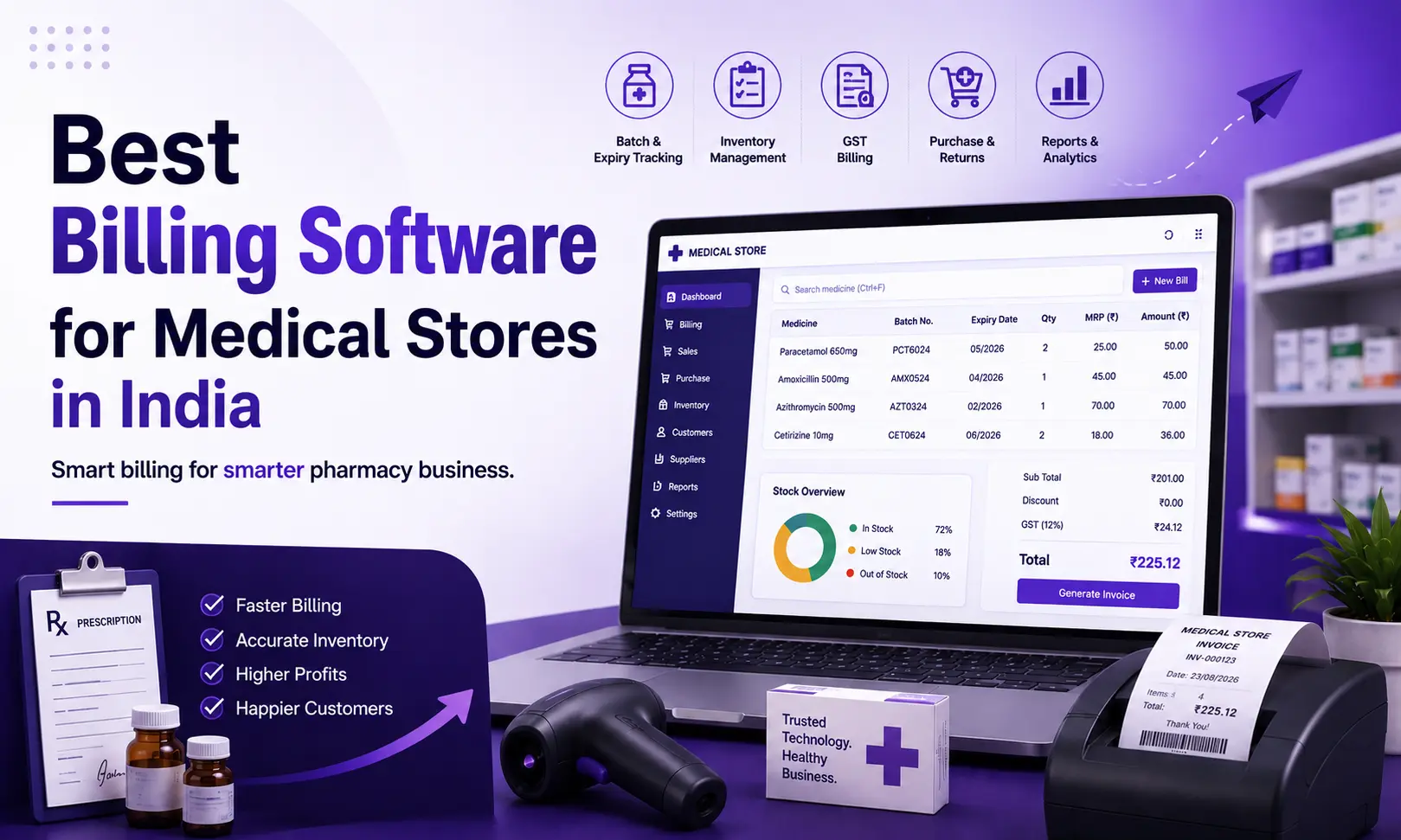
Running a medical store is not just about generating bills. You also need to keep track of medicine batches, expiry dates, purchases, GST, stock levels, customer credit and products that are sitting on the shelf for too long.
That is why ordinary retail billing software isn’t always enough for a pharmacy. The right medical store billing software should make billing faster while also handling pharmacy-specific tasks such as batch tracking, expiry management, purchase records and inventory control.
For a small shop, simplicity and price may matter most. For an established pharmacy, inventory and accounting can become more important. If you operate multiple stores, centralized stock and reporting can change the equation completely.
We compared popular pharmacy billing options in India based on their published features, pricing where publicly available, and how well they address common medical-store workflows.
Quick Answer
There isn’t one best billing software for every medical store.
Marg ERP is a strong option for established pharmacies that need deeper pharmacy and accounting functionality. eVitalRx is worth considering if you prefer a cloud-first pharmacy platform. GoFrugal Pharmacy is better suited to growing retail operations and multiple outlets, while Vyapar and myBillBook are more approachable options for smaller stores.
| Software | Best for | Pharmacy billing | Batch & expiry | Cloud/mobile | Multi-store | Starting price* |
| Marg ERP | Established medical stores | Yes | Yes | Yes | Yes | ₹5,550 + GST |
| eVitalRx | Cloud-first pharmacies | Yes | Yes | Yes | Yes | ₹7,500/year |
| GoFrugal Pharmacy | Growing retailers & chains | Yes | Yes | Yes | Yes | Contact vendor |
| Vyapar | Small medical stores | Yes | Yes | Yes | — | Free / ₹308/month + GST |
| myBillBook | Simple billing & inventory | Yes | Yes | Yes | Limited | ₹349/month |
| MEDEIL | Pharmacy & healthcare businesses | Yes | Yes | Yes | Yes | Contact vendor |
| RetailGraph / SWIL | Larger retail operations | Yes | Yes | Varies | Yes | Contact vendor |
*Starting prices are based on publicly listed plans and can vary by billing period, GST, users, modules and implementation requirements. Pricing checked in August 2026.
What Makes Pharmacy Billing Software Different?
A medical store doesn’t sell products in quite the same way as a typical retail shop. A medicine can have a batch number, manufacturing date, expiry date, MRP, GST classification and other pharmacy-specific information that needs to stay connected to the sale.
That means good pharmacy software needs to do more than print an invoice. It should help you manage billing, batch-wise inventory, expiry dates, purchases, supplier records, returns, stock levels and reporting from the same system.
The real test is whether these tasks become easier for the person working behind the counter.
Best Billing Software for Medical Stores
1. Marg ERP
Marg ERP is one of the better-known pharmacy-focused software options in India. Its pharmacy solution covers GST billing, barcode billing, batch and expiry management, inventory, prescription records, purchase management and pharmacy-specific reporting. Marg also publishes features such as substitute medicine search, reorder management and distributor ordering.
Marg currently says its software serves more than 1.75 lakh chemists and medical stores and has more than 850 sales and support centres. These are company-reported figures, not independent market-share data. Its current publicly listed pricing starts at ₹5,550 plus 18% GST for the Nano plan, while higher plans cost more depending on the required features.
Why consider it: Its pharmacy-specific feature depth makes it worth considering when inventory, purchasing and accounting are as important as billing.
Watch out for: A feature-heavy ERP may be more than a very small store needs.
2. eVitalRx
eVitalRx takes a more cloud-oriented approach to pharmacy management. Its platform covers billing, inventory, GST and customer management, with access across desktop and mobile. The company says it serves more than 10,000 pharmacies across 500+ cities and has processed more than 15 crore invoices. These figures are self-reported.
The software also focuses on inventory visibility, including near-expiry tracking, stock management and reorder workflows. The current published starting price is ₹7,500 per year for the Capsule plan. Higher plans are available for businesses requiring additional functionality.
Why consider it: The combination of pharmacy functionality and remote access is useful for owners who don’t want to depend on being at the billing counter to monitor the business.
Watch out for: Check which features, users and support options are included in the plan you choose.
3. GoFrugal Pharmacy
GoFrugal approaches pharmacy billing from a broader retail-POS perspective. Its pharmacy solution supports billing, drug categorisation, substitute medicine suggestions, customer history, reorder management and a drug database. It also supports multi-store pharmacy operations.
That makes it more interesting when you’re running more than one outlet or expect the business to grow. A single medical store may mainly need billing and stock management. A multi-store business has a different problem: keeping products, inventory and operations consistent across locations.
Why consider it: It fits businesses where pharmacy billing is part of a larger retail operation.
Watch out for: More advanced retail functionality can mean more setup than a simple billing application.
GoFrugal does not currently publish a straightforward comparable starting price for the pharmacy product, so we’ve listed it as Contact vendor rather than using an unverified third-party figure.
4. Vyapar
Vyapar is primarily known as business billing and accounting software, but it also offers pharmacy-specific functionality. Its pharmacy solution includes GST invoicing, batch-wise stock, expiry tracking, medicine inventory, barcode billing and stock reports. Vyapar also says its pharmacy software supports Schedule H/H1 record requirements.
Its current pharmacy page lists a free option, while the Gold plan is shown at ₹308 per month plus 18% GST when billed annually.
Why consider it: It can be a practical starting point if your requirements are relatively straightforward.
Watch out for: A general business platform may not offer the same depth of pharmacy workflows as a dedicated pharmacy ERP.
5. myBillBook
myBillBook offers pharmacy-specific billing features including batch-wise inventory, expiry tracking, medicine details, GST invoices and stock reports. The workflow is fairly straightforward: search or scan the medicine, generate the invoice, update stock and monitor batches and expiry.
Its current published pharmacy pricing starts at ₹349 per month for the displayed monthly plan, with annual plans and higher tiers also available.
Why consider it: If you don’t need a full pharmacy ERP, a simpler system may be easier to operate day to day.
Watch out for: Check whether the pharmacy-specific controls you need are included in your selected plan.
6. MEDEIL
MEDEIL offers pharmacy POS software covering billing, prescriptions, inventory, batch numbers, expiry dates and pharmacy management. It also supports cloud POS and multi-location operations.
Why consider it: Its broader product ecosystem can make it relevant to businesses that are moving beyond a single pharmacy counter.
Watch out for: MEDEIL does not provide a directly comparable public starting price for every pharmacy setup, so a vendor quote is the safer way to evaluate cost.
7. RetailGraph / SWIL
RetailGraph, part of the SWIL ecosystem, is aimed more at businesses that need structured retail management, inventory control, reporting and multi-store capabilities. It makes more sense when pharmacy operations have become complex rather than when the primary requirement is simply generating invoices.
Why consider it: The broader retail-management approach can be useful when several outlets, users and inventory processes need to be managed together.
Watch out for: Smaller stores may find a simpler cloud billing product easier to manage.
Which Pharmacy Billing Software Fits Your Store?
Instead of asking which software is universally best, start with the type of store you actually run.
| Your situation | Shortlist |
| Small single-store pharmacy | Vyapar, myBillBook, eVitalRx |
| Established medical store | Marg ERP, eVitalRx, GoFrugal |
| Multiple outlets | GoFrugal, Marg ERP, eVitalRx, MEDEIL |
| Cloud-first operation | eVitalRx |
| Deeper pharmacy management | Marg ERP, eVitalRx |
| Billing + basic accounting | Vyapar, Marg ERP |
| Growing retail operation | GoFrugal, Marg ERP |
This isn’t a ranking. The right choice depends on which part of your operation needs the most attention.
Features That Actually Matter
The most important pharmacy software features aren’t necessarily the ones that look impressive in a product demo.
- Batch-Wise Inventory: The system should let you identify stock by batch and connect the correct batch with each sale. This becomes particularly important when the same medicine is sitting on the shelf from multiple purchases.
- Expiry Management: Expiry tracking should go beyond storing an expiry date. Look for near-expiry reports, batch-level visibility and workflows that make it easier to identify stock that needs attention.
- Fast Billing: A busy pharmacy counter doesn’t need a complicated billing process. Medicine search, barcode scanning, batch selection and payment should take as few unnecessary steps as possible.
- Purchase Management: Purchasing is just as important as sales. The software should make it easy to record supplier purchases, update stock, track purchase rates and manage returns.
- GST and Reporting: GST invoices and reports should be straightforward to generate. Before buying, check exactly which GST, e-invoicing and reporting features are included in your plan rather than assuming they are available across every tier.
- Multi-Store Management: If you have multiple outlets, look beyond basic billing. Centralized inventory, branch-level reporting, user permissions and stock transfers become much more important.
What Is Changing in Pharmacy Billing?
Pharmacy software is gradually moving beyond the traditional billing-counter model. Instead of keeping billing, inventory, purchasing, customer communication and reporting in separate systems, newer platforms increasingly try to connect these workflows.
Digital payments are another part of that shift. NPCI’s August 2025 merchant-category data recorded 322.46 million UPI transactions for drug stores and pharmacies, worth around ₹12,580.60 crore.
That doesn’t mean every pharmacy needs sophisticated payment integrations. It does show how digital transactions have become a meaningful part of pharmacy retail, making the connection between billing and payments increasingly important.
Cloud access is also becoming more useful. A store owner may want to check sales, stock or outstanding payments without being physically present at the counter.
The bigger shift, however, is happening in inventory.
Knowing that you have 20 units of a medicine is useful.
Knowing which batch expires first, how quickly it sells and when to reorder it is much more useful.
That is where pharmacy software can move from being a digital cash register to an actual management tool.
How Much Does Medical Store Billing Software Cost?
There isn’t a single standard price. The products in this comparison range from free or relatively inexpensive billing applications to pharmacy ERP systems with more extensive functionality. For example, eVitalRx currently starts at ₹7,500 per year, while Vyapar offers a free option and paid plans. Marg ERP has a range of plans starting at ₹5,550 plus GST.
But the cheapest plan isn’t necessarily the cheapest solution.
You may also need to pay for additional users, branches, hardware, implementation, training or optional modules. Before comparing prices, work out what your store actually needs.
What to Ask During a Demo
Don’t spend the entire demo watching someone create a basic invoice.
Ask the vendor to demonstrate a few real pharmacy scenarios.
- Can the system handle two batches of the same medicine?
- How does it identify stock approaching expiry?
- What happens when a customer returns a medicine?
- Can the store continue billing if the internet goes down?
- Can you see fast-moving and slow-moving medicines?
- What happens when you open a second branch?
- Can you export your data if you stop using the software?
- Are additional users and branches charged separately?
These questions will tell you much more about the software than a long feature list.
Our Recommendation
- For an established medical store that needs deep pharmacy management, Marg ERP is one of the first options we’d investigate.
- For a cloud-first pharmacy, eVitalRx stands out as an option worth evaluating.
- For a growing business with multiple outlets, GoFrugal deserves a closer look.
- For a smaller store that mainly needs straightforward billing, inventory and accounting, Vyapar or myBillBook may be enough.
- MEDEIL and RetailGraph/SWIL become more interesting as the operational requirements become broader.
We would not choose purely on price. The better question is whether the software can handle the daily problems that actually cost your store time or money.
What is the best billing software for a small medical store?
Vyapar, myBillBook and eVitalRx are worth considering for smaller stores. The better choice depends on whether you prioritize simple billing, accounting, cloud access or deeper pharmacy inventory features.
Which billing software is best for pharmacy inventory management?
Look for batch-wise inventory, expiry tracking, purchase management, reorder controls and detailed stock reports. Marg ERP, eVitalRx and GoFrugal all publish pharmacy-specific inventory features.
Is pharmacy billing software different from normal billing software?
Yes. Pharmacy software typically needs to handle medicine batches, expiry dates, pharmacy inventory and other records that aren’t normally required by a general retail billing system.
Can pharmacy billing software work without the internet?
Some systems support offline or local billing, while others are primarily cloud-based. Ask the vendor what happens during an internet outage before buying.
Does pharmacy billing software track medicine expiry dates?
Many pharmacy-focused systems do. Marg, eVitalRx, Vyapar and MEDEIL all publish expiry or batch-management capabilities, although the exact alerts and reports can differ.
Can pharmacy billing software manage GST billing?
Yes. Many pharmacy billing platforms support GST invoicing and related reports. Check the current plan to confirm which GST features are included.
Should a pharmacy choose cloud or desktop software?
Cloud software can be useful when owners need access from different locations or devices. Desktop or hybrid systems can be more attractive when reliable offline billing is important.
Does pharmacy billing software include accounting?
Some products combine billing, inventory and accounting, while others focus mainly on pharmacy operations. Check whether you need full accounting or simply billing and GST reports.
How much does medical store billing software cost in India?
Pricing ranges from free plans to paid subscriptions and full pharmacy ERP packages. Publicly listed prices include eVitalRx from ₹7,500 per year, Marg ERP from ₹5,550 plus GST and Vyapar from a free plan with paid options available.
Is free billing software enough for a medical store?
It can be enough for basic invoicing, but pharmacy operations often require batch tracking, expiry management, purchasing and inventory reports. Check the actual capabilities of the free plan before relying on it.
Which is better: Marg ERP or eVitalRx?
Marg ERP is more attractive if you want deeper pharmacy ERP and accounting capabilities. eVitalRx is worth considering if cloud access and a pharmacy-focused platform are higher priorities. The better choice depends on your store’s workflow.
Is pharmacy billing software worth paying for?
For a store that handles significant inventory, paid software can be worthwhile if it reduces stock errors, makes expiry management easier and saves time at the counter. The value depends more on the workflow than the software price alone.
