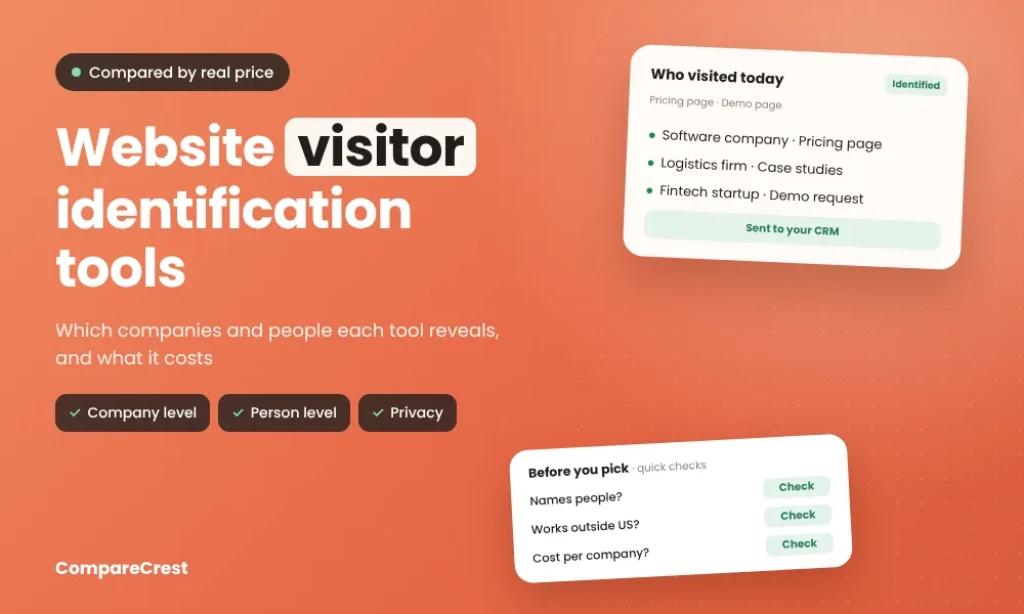

Website visitor identification tools show which companies visited your site without filling in a form, and a few also name the person. Company-level identification works worldwide. Person-level identification is limited to US visitors on RB2B and Apollo. For most B2B teams, Snitcher (from $49 a month) or Leadfeeder (free for 100 companies a month) is the practical start, and RB2B fits teams that mostly sell to US buyers.
Key Takeaways
- There are two kinds of identification Company-level (IP address to company) works globally. Person-level names individual visitors and is US-only on RB2B and Apollo.
- Coverage is lower than demos suggest RB2B says its premium tier covers 35 to 45% of traffic, Leadinfo says it identifies about 30% of visitors, and an independent MadKudu test found RB2B identified about a third as many visits as Clearbit, though more accurately.
- Pricing is usually by companies identified per month not seats. Around 1,000 a month costs $229 on Snitcher and €269 on Leadinfo (annual).
- Free plans are real but small Leadfeeder Lite shows 100 companies with 7 days of history, and RB2B gives 150 company-level matches a month.
- Indian traffic is harder to match About 1.03 billion of India’s 1.09 billion internet subscribers use wireless data, and mobile IP addresses belong to the telecom company, not the visitor’s employer.
How Visitor Identification Works
How website visitor identification works: company-level identification matches a visitor’s IP address to a business and works worldwide, but fails on home and mobile connections; person-level identification matches the visit to a named individual through an identity graph and works only for US visitors on tools such as RB2B and Apollo.
Company-level identification looks up the visitor’s IP address in a database that maps IP ranges to organisations. A visit from a company office network, or a VPN registered to that company, can be matched to the business, its industry, size and the pages it viewed. It can’t see who the person is. It works poorly for people browsing from home broadband or mobile data, where the IP belongs to an internet provider, not an employer. That’s a large share of traffic in remote-first teams and in mobile-first markets such as India, where TRAI data for March 2026 counts 1.027 billion wireless data subscribers out of 1.09 billion internet subscribers.
Person-level identification matches the visit to an individual using identity graphs: data from cookies, partner sites and email activity tied to a known person. It can give a name, job title and LinkedIn profile. RB2B and Apollo both limit person-level matches to US visitors and fall back to company-level everywhere else.
Website Visitor Identification Tools Compared
Prices are monthly unless noted. The last column shows where each figure comes from and when we checked it.
| Tool | Level | Free option | Paid from | How you pay | Source /Website |
|---|---|---|---|---|---|
| Snitcher | Company (contact reveal on request) | 14-day trial | $49/mo for 50 companies | Companies identified; unlimited seats | Snitcher pricing |
| Leadfeeder (Dealfront) | Company | Lite: 100 companies, 7 days of data | Discover from €79/mo (annual) | Companies + credits; unlimited seats | Leadfeeder pricing help |
| RB2B | Person (US) + company (global) | 150 company-level matches | Starter $79/mo (300); Pro from $149 (600) | Resolutions | RB2B pricing |
| Leadinfo | Company | 14-day trial | €49/mo (annual) for 50 companies | Companies identified | Leadinfo pricing |
| Albacross | Company + contact credits | 14-day trial | Starter €59/mo (annual) for up to 100 companies | Companies + credits | Albacross pricing |
| Warmly | Person + company | 500 identified visitors | TAM from $15,000/yr; Inbound from $30,000/yr | Annual contract | Warmly blog, |
| Apollo | Company free; contact via Inbound add-on (US) | Company-level on free plan | Add-on price not listed | Credits for emails and phones | Apollo visitor ID |
| Lead Forensics | Company + contacts | 7-day trial | Not published (est. $6,000 to $25,000/yr) | Annual contract, priced by traffic | ZoomInfo estimate |
| HubSpot (Clearbit) | Company | Inside HubSpot | Varies by HubSpot plan | HubSpot credits | HubSpot Clearbit |
What About 1,000 Identified Companies a Month Costs
Most tools charge by unique companies (or people) identified each month, and repeat visits from the same company count once.
| Tool | Plan at about 1,000 a month | Monthly cost | Per identified company |
|---|---|---|---|
| Snitcher | 751 to 1,000 companies, monthly billing | $229 | About $0.23 (about 30% less on annual billing) |
| RB2B | Pro at 600 plus 400 at the $0.25 overage (estimate) | About $249 | About $0.25 (people in the US, companies elsewhere) |
| Leadinfo | 751 to 1,000 companies, annual billing | €269 (€339 monthly) | About €0.27 |
| Leadfeeder | Discover | From €79; price at 1,000 not published | Ask for a quote |
| Lead Forensics | Annual contract | About $500 to $2,100 (estimate) | Depends on contract |
| Warmly | Inbound | About $2,500 (from $30,000/yr) | Includes chat, outreach and orchestration |
RB2B’s next Pro tier after 600 is 1,250 resolutions, priced on request, so a quote at that tier may come in below the overage estimate. Leadfeeder’s €79 is a starting price. Its help page lists Discover as “up to 1,000 companies” but doesn’t publish the price at each step, and CRM syncs and contact emails use credits on top. Discover includes 50 credits a month, and a CRM sync costs 1 credit per company.
Best Visitor Identification Tools
Snitcher: Best Value for Company-Level Identification
Snitcher prices only by companies identified, with unlimited users and all integrations on every plan. It starts at $49 a month for up to 50 companies, $99 for 250, and $229 for 1,000, with about 30% off on annual billing. It’s built for GDPR, relying on legitimate interest and company-level data, and only reveals individual contacts when you choose to. That makes it a sensible default for European and Indian B2B sites that want account lists without collecting personal data by default. The 14-day trial needs no card.
Leadfeeder: Best Free Plan and CRM Sync
Leadfeeder, which Dealfront has brought back as its main brand, has the most usable free plan: up to 100 identified companies a month with 7 days of history. Discover starts at €79 a month on annual billing and scales with the number of companies identified, up to 1,000. Identifying companies doesn’t use credits, but CRM syncs and contact details do. It syncs with HubSpot, Salesforce, Pipedrive and Zoho, and is especially strong on European company data. If you push most identified companies into your CRM, Activate (from €369 a month annual, up to 4,000 companies and 200 credits) is the realistic tier.
RB2B: Best for US Traffic and Person-Level Leads
RB2B is the person-level option. On Starter ($79 a month) it posts US visitors’ names and LinkedIn profiles to Slack or Teams. Pro (from $149) adds business emails, CRM integrations and alerts for hot pages and leads, and Pro+ (from $199) uses a wider identity graph that RB2B says covers 35 to 45% of traffic. Outside the US you get company-level data only, so it’s worth paying for only if most of your buyers are American. MadKudu tested RB2B against Clearbit Reveal on its own site and found RB2B identified about three times fewer visits but was about 42% more accurate, and only about 4% of companies were found by both tools.
Leadinfo and Albacross: Europe-Focused Alternatives
Leadinfo prices by companies identified, from €49 a month on annual billing for 50 companies up to €269 for 751 to 1,000, and says it identifies about 30% of visitors. It’s cookieless and keeps data in the EU, according to the company. Albacross starts at €59 a month on annual billing for up to 100 companies and €149 for up to 500, with a small allowance of email and phone credits and paid top-ups after that. Both suit European B2B companies that want company data with GDPR-friendly defaults.
Warmly: Best When You Want Identification Plus Automated Outreach
Warmly combines visitor identification with AI chat, meeting booking, pop-ups and outreach, so a pricing-page visit can trigger a sequence while the buyer is still interested. Its free tier covers 500 identified visitors a month. Paid plans are sold annually, from $15,000 a year (TAM) and $30,000 (Inbound), according to Warmly’s own May 2026 blog. It’s priced for funded SaaS sales teams, not small businesses. If you want AI-led outreach without visitor tracking, see our AI SDR tools comparison.
Apollo: Best If You Already Prospect in Apollo
Apollo shows company-level website visitors on its free plan and links them to its contact database, so you can find the right person at a visiting company and email them from the same tool. Contact-level identification needs the Inbound add-on and only covers US visitors. Verified emails and phone numbers use Apollo credits. For a team already using Apollo for outbound, it removes the need for a separate tracker.
Lead Forensics and Enterprise Platforms
Lead Forensics doesn’t publish prices. ZoomInfo, a competitor, estimates $6,000 to $25,000 a year for its Essential tier, priced by website traffic on annual contracts with automatic renewal. Enterprise ABM platforms such as 6sense and Demandbase include visitor identification within much larger intent and advertising suites. Vendr data cited in Warmly’s 6sense pricing analysis puts the median 6sense buyer at about $55,000 a year. Choose these only if you’re buying the whole account-based marketing stack.
HubSpot Users: Check What You Already Have
HubSpot acquired Clearbit and now provides company identification and buyer intent inside HubSpot, paid for with HubSpot credits. If you use HubSpot as your CRM, check whether your plan already shows visiting companies before buying another tool. Our HubSpot CRM profile covers the plans.
Is Visitor Identification Legal?
Company-level identification is generally treated as lower risk because it describes organisations, not people. Person-level identification is personal data processing, which is why vendors restrict it to the US.
| Market | What applies | Practical rule |
|---|---|---|
| United States | State privacy laws, no federal opt-in rule for B2B | Person-level tools operate here; honour opt-outs |
| EU and UK | GDPR | Company-level on legitimate interest; person-level needs a clear lawful basis and disclosure |
| India | DPDP Act 2023; Rules notified November 2025 | Notice and consent obligations apply from 13 May 2027. Under the Act’s Schedule, most breaches carry fines of up to ₹50 crore, and failing to protect personal data up to ₹250 crore |
Whichever tool you use, add it to your privacy policy and cookie notice, keep identified data out of cold outreach to people who never interacted with you, and check with your legal adviser before using person-level data outside the US.
Which Visitor Identification Tool Fits
| You are | Start with | Why |
|---|---|---|
| A small B2B site testing the idea | Leadfeeder Lite (free) | 100 companies a month at no cost |
| A SaaS or agency site with global traffic | Snitcher | Simple per-company pricing, unlimited seats |
| A European B2B company | Leadinfo or Albacross | EU data and GDPR-friendly defaults |
| A team selling mainly to US buyers | RB2B Pro | Names and emails of US visitors |
| A funded sales team that wants automated follow-up | Warmly | Identification, chat and outreach in one |
| An Apollo user | Apollo’s visitor tracking | No extra tool or data to sync |
| An Indian B2B business | Leadfeeder or Snitcher, company-level | Person-level isn’t available, and DPDP consent rules start in May 2027 |
Getting Value From Visitor Data
- Filter out ISPs, universities and your own team before judging a tool.
- Alert sales only on high-intent pages such as pricing, demo and comparison pages.
- Push identified companies into your CRM, not straight into cold email.
- Compare two tools on the same week of traffic before signing an annual contract.
- Check identified companies against your known customers to measure accuracy.
For tools that find and enrich leads beyond your website traffic, see our AI lead generation tools comparison. Once leads are in, our CRM guide for Indian small businesses covers where to manage them.
How We Compared These Tools
We compared published pricing and plan pages on 23 October 2026 and used an independent benchmark (MadKudu) for accuracy. Where vendors don’t publish prices, we used labelled vendor, competitor or Vendr figures. We didn’t run each tool on our own site, so identification rates on your traffic will differ.