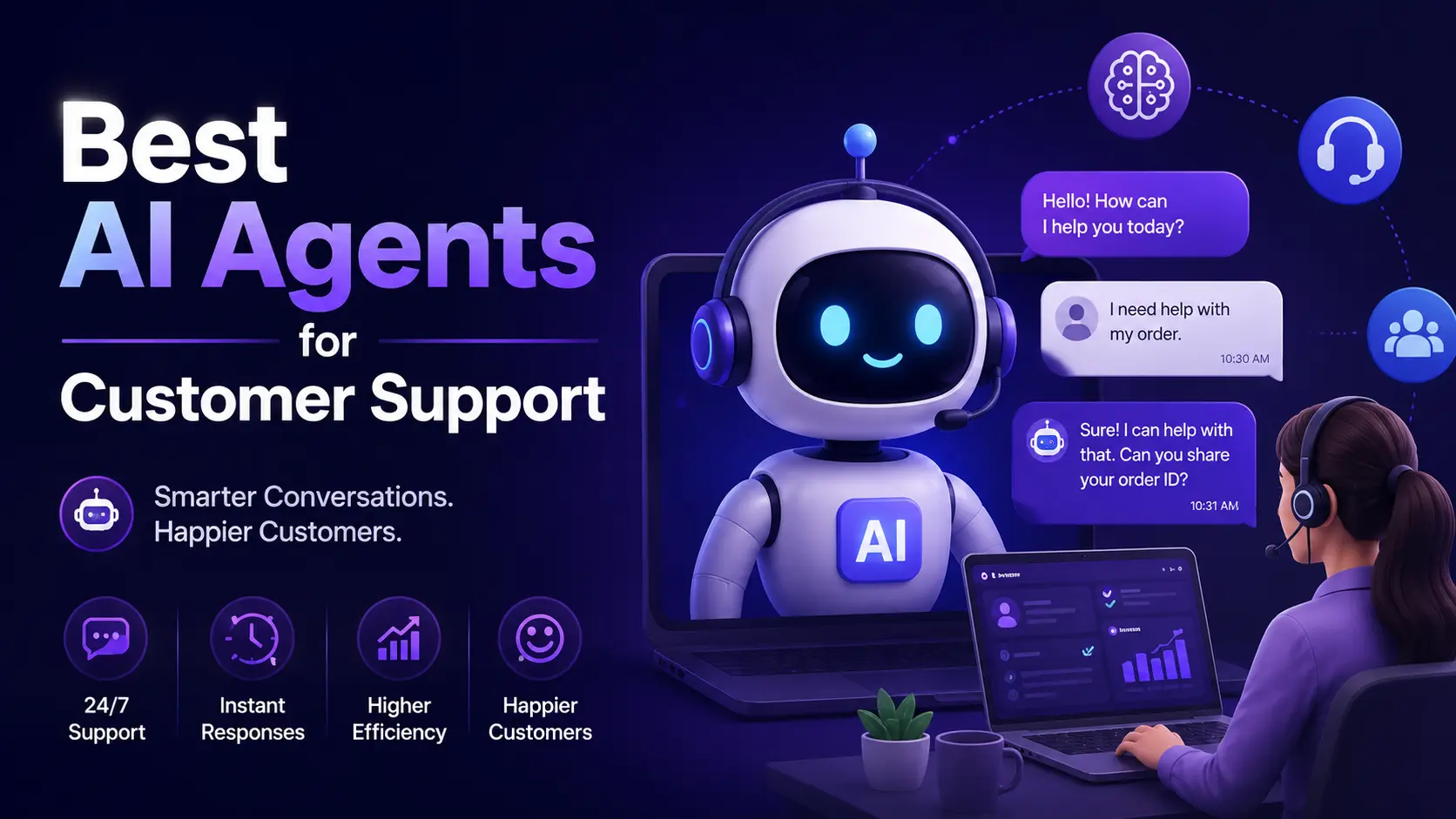
Customer support is moving beyond the chatbot.
Modern AI agents can interpret requests, search knowledge bases, retrieve customer data, take approved actions, and escalate to a human when needed. That makes them fundamentally different from the rule-based bots many businesses still use.
A chatbot might point a customer to a refund policy. An AI agent may check the order, identify the issue, follow the right workflow, and explain the next step.
That changes how support software should be judged. The key questions are no longer just whether an AI can answer, but how many issues it can resolve, what it can do, and what each resolution costs.
We evaluated 10 AI customer-support agents across capabilities, integrations, pricing, deployment, and fit for different support teams.
Quick Answer
There isn’t one best AI customer-support agent for every business.
Intercom Fin is a strong choice for growing teams that want an AI agent alongside a modern support platform. Zendesk AI Agents makes the most sense for businesses already using Zendesk, while Salesforce Agentforce is a natural fit for organizations that want AI connected to Salesforce data and workflows.
For ecommerce, Gorgias AI Agent is particularly relevant. Freshdesk Freddy AI is worth considering for businesses looking for an established helpdesk with AI built into the wider platform. Larger support organizations can also evaluate Decagon, Sierra, Forethought, and Ada.
| AI agent | Best for | Pricing approach | Main strength |
|---|---|---|---|
| Intercom Fin | Startups and growing teams | Per outcome + seats | AI-first support platform |
| Zendesk AI Agents | Zendesk customers | Platform + resolution allowances | Native helpdesk integration |
| Salesforce Agentforce | Salesforce-centric businesses | Conversations / credits / licensing | CRM and workflow access |
| Gorgias AI Agent | Ecommerce brands | Platform + AI outcomes | Ecommerce-specific actions |
| Freshdesk Freddy AI | Growing and enterprise support teams | Plan + AI add-ons/usage | Broad helpdesk + AI stack |
| Decagon | Complex support operations | Custom | Omnichannel AI automation |
| Sierra | Enterprise customer service | Custom | Action-oriented agents |
| Forethought | Support teams focused on automation | Custom | AI agents + ticket workflows |
| Ada | Enterprise and multilingual support | Custom | Automated customer service |
| Dixa AI | Omnichannel support teams | Custom / platform-based | Customer conversations across channels |
*Pricing models change frequently in this category, so treat the table as a buying guide rather than a permanent price sheet.
What Is an AI Customer-Support Agent?
An AI customer-support agent is software that can handle customer conversations and, depending on its configuration, take actions using connected business systems.
The important difference from a traditional chatbot is the ability to work through a request rather than simply respond with a predefined answer. An agent might look up an order, check an account, retrieve a policy, update information, or trigger an approved workflow before responding.
For example, if a customer asks, “My order hasn’t arrived. Can you check what’s happening?”, a basic chatbot might send them to a tracking page. An AI agent connected to the right systems could identify the order, retrieve its current status, and explain the situation.
The exact level of automation depends on the product, integrations, permissions, and workflows you provide. An AI agent is only as useful as the information and actions it can safely access.
Best AI Agents for Customer Support
1. Intercom Fin
Fin is Intercom’s AI customer-service agent and is designed to handle customer conversations using a company’s knowledge and connected systems. It can also work with an existing helpdesk, including platforms such as Salesforce, which makes it possible to introduce Fin without immediately replacing the support stack.
Fin currently costs $0.99 per outcome. Intercom’s annual seat pricing starts at $29 per seat for Essential, $85 for Advanced, and $132 for Expert. Businesses using Fin with an existing helpdesk can pay per outcome without seat costs, subject to the applicable terms and minimum commitments.
The outcome-based model is one of Fin’s more interesting characteristics. You are not simply paying for every conversation; Intercom defines outcomes such as resolutions and successfully completed procedures.
2. Zendesk AI Agents
If Zendesk already runs your support operation, its AI agents are the obvious first option to evaluate. Zendesk AI agents can interact with customers through supported messaging and email channels and are designed to resolve requests without human intervention when possible.
Zendesk has also changed how it measures AI usage. Its current system uses resolution allowances and automated-resolution tiers, with costs tied to the level of automation involved in resolving a request. That makes the economics different from a simple per-seat comparison.
3. Salesforce Agentforce
Agentforce is more than a customer-support chatbot. Salesforce positions it as an agent platform that can work across customer and employee workflows using Salesforce data and connected systems. Its pricing reflects that broader approach. Salesforce currently offers consumption-based options including $2 per conversation and $500 per 100,000 Flex Credits, alongside user-licensing options.
The biggest advantage is context. If your support agents already depend on Salesforce for customer records, cases, account information, and workflows, Agentforce can operate much closer to the systems where that information already lives.
4. Gorgias AI Agent
Gorgias has a narrower focus than many of the products on this list, and that’s part of its appeal. Its AI Agent is designed specifically around ecommerce conversations, including order tracking, returns, cancellations, missing items, and product questions. It can also take actions in connected tools, such as cancelling an order or processing a return, when those actions are configured.
Gorgias currently charges an additional outcome-based fee for AI Agent on top of its helpdesk usage. Its published pricing says most plans charge $0.90 per AI-resolved interaction on annual billing or $1.00 on monthly billing, while the exact plan structure determines the number of included interactions.
5. Freshdesk Freddy AI
Freshdesk has built AI into its wider customer-service platform through Freddy AI Agent, Freddy AI Copilot, and Freddy Insights. Freddy AI Agent can handle customer queries across channels, while the Copilot assists human agents with tasks such as summarizing conversations, suggesting responses, translating interactions, and identifying sentiment.
Freshworks says Freddy AI Agent can resolve up to 80% of queries, but this is a vendor-reported capability claim, not an independent benchmark.
Pricing depends on the Freshdesk plan and AI configuration. Freshworks currently positions Freddy AI Agent as an add-on for Pro and Enterprise customers rather than publishing one universal standalone price.
6. Decagon
Decagon is aimed at businesses that want AI to handle customer interactions across multiple channels and more complicated workflows. Its platform currently combines chat, voice, and email within one AI layer, with integrations that can connect the agent to existing support tools and business systems.
Decagon has also expanded beyond automated customer conversations with features such as proactive agents and AI assistance for human representatives. The company’s pricing is sales-led, so there isn’t a meaningful public monthly price to put beside self-service products such as Fin or Gorgias.
7. Sierra
Sierra focuses on AI agents that can understand customer requests and take actions across connected business systems rather than simply generating replies. That distinction matters for enterprise support. A useful agent may need to modify an order, manage an account, handle a subscription request, or complete another business process before the conversation is actually resolved.
Sierra is therefore more relevant to companies looking for end-to-end customer-service automation than businesses that simply need an AI FAQ tool.
8. Forethought
Forethought takes a support-automation approach that combines AI agents with ticket triage, workflows, insights, and human-agent assistance.
Its current plans include AI agents for chat and mobile, custom actions, ticket triage, multilingual support, and AI quality features. Higher tiers add AI agents for email, voice, Slack, knowledge-gap detection, and enterprise governance. Forethought uses quote-based pricing, so it is better suited to a sales evaluation than a simple self-service purchase.
9. Ada
Ada is focused on automated customer service and is particularly relevant to companies serving customers across multiple markets. Its enterprise positioning makes it less of a plug-and-play choice than some smaller support tools, but that can be an advantage for organizations that need more control over deployment, channels, languages, and integrations.
For international businesses, multilingual support can be more important than another incremental AI feature. An agent that can consistently handle common requests across markets can reduce the amount of repetitive work reaching human teams.
10. Dixa AI
Dixa approaches customer service from an omnichannel perspective, bringing customer conversations across channels into a shared support environment. That makes it relevant for companies where customers move between channels and the support team needs to retain context rather than treating every interaction as a separate ticket.
Dixa is worth considering when the priority is not just AI automation but combining AI with a broader customer-conversation platform.
What Should You Compare When Choosing an AI Support Agent?
The biggest mistake is comparing these products like ordinary chatbot software.
The useful question isn’t simply “Which AI gives the best answers?” It’s “Which customer problems can this system resolve without creating additional work?”
Resolution rate
Resolution rate is important, but vendor figures need context. Different companies can define a resolution differently, so a 70% rate from one platform isn’t automatically comparable with a 70% rate from another.
Zendesk, for example, has introduced more detailed resolution tiers and allowances for AI-agent usage.
Ask vendors to explain exactly what counts as a resolution and whether the figure represents customer-confirmed success, lack of further response, containment, or another metric.
Actions
A support agent that only answers questions has limited value compared with one that can perform useful actions.
Check whether the platform can access your order system, CRM, billing platform, subscription system, or other tools. Then ask which actions can be performed automatically and which still require human approval.
Knowledge
The agent needs reliable information to work from.
Check how it connects to your help centre, documentation, product catalogue, policies, CRM, and internal resources. Also ask how quickly changes to those sources become available to the AI.
Human handoff
A good support agent should know when it should stop.
The handoff should preserve the conversation and provide the human agent with enough context to continue without making the customer repeat everything.
Integrations
Integrations can matter more than model benchmarks.
An AI agent connected to the systems your support team uses every day can potentially resolve problems that a more sophisticated model with no system access cannot.
Cost per resolution
This is becoming one of the most important buying metrics.
Intercom charges $0.99 per Fin outcome, Gorgias uses outcome-based AI pricing, Zendesk uses resolution allowances, and Salesforce offers conversation and credit-based models.
Instead of asking only what the software costs per month, estimate:
Total support software cost ÷ successfully resolved customer issues
That gives you a much better picture of the actual economics.
AI Agent vs Traditional Chatbot
The distinction is becoming less obvious as traditional support platforms add agentic capabilities.
A traditional chatbot generally follows predefined flows or retrieves information from a knowledge base. An AI agent can interpret an open-ended request, decide what information it needs, use connected tools, and potentially complete an action.
For example, a traditional chatbot might send a customer to an order-tracking page. An AI agent could authenticate the customer, retrieve the order status, check the latest information, and explain the result.
The second experience requires access to customer data and permission to take actions.
That is why implementing an AI support agent involves more than adding a chat widget. You need reliable knowledge sources, integrations, permissions, workflows, and clear escalation rules.
Can AI Agents Replace Customer-Support Teams?
AI can automate a meaningful amount of repetitive support work, but that doesn’t mean human support teams disappear.
Customers still encounter unusual, sensitive, or complicated situations that require judgment. A good support operation uses AI for predictable work while keeping people involved where empathy, negotiation, investigation, or discretion matters.
For many companies, the better goal is not 100% automation. It’s automating the right conversations and making human agents more effective when they need to step in.
Which AI Support Agent Should You Choose?
The right shortlist depends heavily on your existing support stack.
Choose Intercom Fin if you want an AI-first customer-service platform and a relatively straightforward outcome-based pricing model.
Choose Zendesk AI Agents if Zendesk already runs your support operation.
Choose Salesforce Agentforce if your customer-service workflows depend heavily on Salesforce data and CRM processes.
Choose Gorgias if you’re an ecommerce business and much of your support revolves around orders, returns, shipping, and product questions.
Choose Freshdesk Freddy AI if you want AI automation together with a broader helpdesk, agent-assist, and analytics platform.
Consider Decagon or Sierra if you’re a larger organization looking for more complex, action-oriented automation.
Consider Forethought if ticket workflows, triage, and AI-assisted support operations are central to your requirements.
Consider Ada if multilingual customer service is a major priority.
Consider Dixa if omnichannel customer conversations are more important than simply automating chat.
Our Recommendation
For most growing companies, we would start by evaluating the AI agent already available within the support platform you use.
That means Fin for Intercom users, Zendesk AI Agents for Zendesk users, Agentforce for Salesforce-heavy teams, and Freddy AI for Freshdesk users.
Moving to another platform just to gain AI automation can create unnecessary migration and integration work.
Ecommerce is a notable exception. Gorgias deserves a serious look for Shopify-focused support teams because its AI is built around ecommerce data and actions rather than being a general-purpose support layer.
For enterprise teams with complex workflows, the decision becomes more involved. Decagon, Sierra, Forethought, and Ada are worth evaluating when standard helpdesk AI isn’t enough.
The best buying process is to give each shortlisted vendor a handful of real support requests from your own queue. Ask the AI to solve them, perform the necessary actions, explain what it did, and hand the case to a human when it reaches a limit. That tells you far more than a polished demo.
What is the best AI agent for customer support?
There is no universal winner. Fin is a strong option for growing teams, Zendesk AI Agents for existing Zendesk users, Agentforce for Salesforce-centric businesses, and Gorgias for ecommerce. Larger organizations may prefer platforms such as Decagon, Sierra, or Forethought.
What is the difference between an AI agent and a chatbot?
A traditional chatbot generally follows predefined flows or retrieves information. An AI agent can interpret an open-ended request, use connected tools, take actions, and work through a task with less predefined scripting.
Can AI agents completely replace customer-support agents?
They can automate many repetitive interactions, but most businesses still need humans for complex, sensitive, or unusual cases. The more practical goal is to automate predictable work and give human agents better context.
How much do AI customer-support agents cost?
There is no single pricing model. Fin charges $0.99 per outcome, Gorgias charges an outcome-based AI fee, Salesforce offers $2-per-conversation and credit-based options, while Zendesk uses resolution allowances. Enterprise products often use custom pricing.
Is Intercom Fin cheaper than Zendesk AI Agents?
Not necessarily. Fin charges per outcome alongside platform costs, while Zendesk combines its support plans with AI resolution allowances. Your existing platform, support volume, and resolution rate will determine which is more economical.
Can AI agents issue refunds?
Some can perform refunds or other account actions when the appropriate integrations, permissions, and workflows are configured. The important question is not whether the AI can theoretically perform an action, but whether your business is comfortable giving it permission to do so.
What happens when an AI support agent cannot solve a problem?
The agent should hand the conversation to a human with the relevant context. During a vendor demo, check whether the human receives the conversation history, customer information, actions already taken, and the reason for escalation.
How should you measure an AI support agent?
Look at verified resolution rate, escalation rate, customer satisfaction, response time, cost per resolution, and the percentage of conversations requiring human intervention.
Is resolution rate a reliable way to compare AI support agents?
Only if the vendors define resolution in comparable ways. Some may count a conversation as resolved when the customer doesn’t ask another question, while others use stronger verification criteria.
Which AI agent is best for ecommerce?
Gorgias is one of the strongest options to evaluate because its AI Agent is designed around ecommerce workflows, including orders, returns, shipping, product questions, and actions in connected tools.
Which AI support agent is best for Salesforce users?
Salesforce Agentforce is the natural first option to evaluate because it can operate within the Salesforce ecosystem and use CRM data and workflows.
Do AI support agents work with email?
Yes. Several leading platforms support email-based AI interactions. Fin, Zendesk AI Agents, Freshdesk Freddy AI, and other products on this list support email workflows, although channel availability varies by product and plan.
Do AI support agents work with WhatsApp?
Some do, but channel support varies. Gorgias, for example, supports AI Agent across email, chat, and SMS, while other platforms provide broader omnichannel options. Confirm the exact channels and associated costs before buying.
Should a small business buy an enterprise AI support agent?
Usually not as a first step. Smaller teams will often get more value from an AI agent that works with their existing helpdesk and can be deployed without a lengthy implementation. Enterprise platforms become more attractive as support volume and workflow complexity increase.
