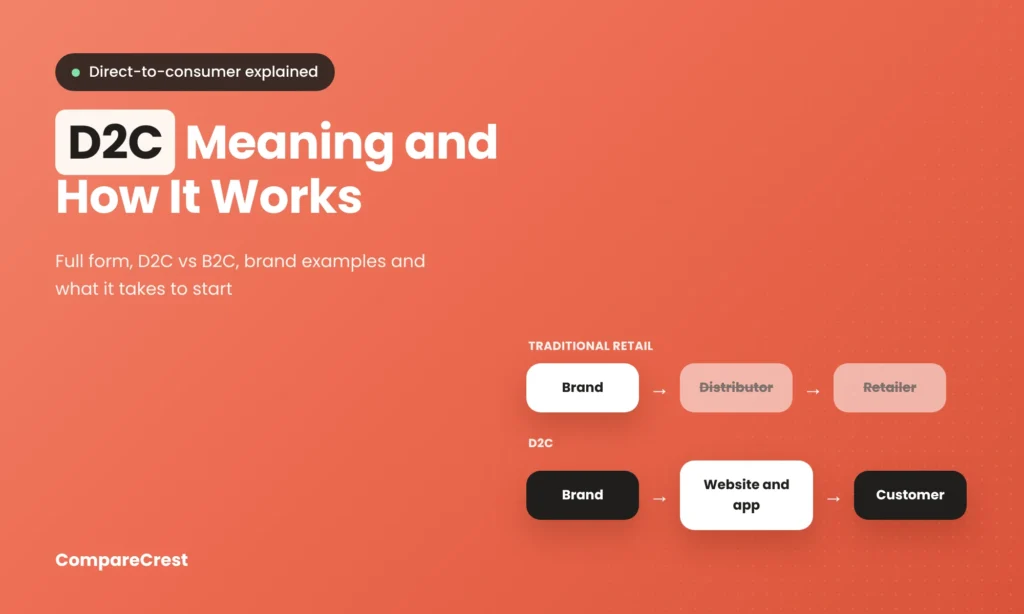

D2C stands for direct-to-consumer. A D2C brand makes or sources its own products and sells them straight to customers through its own website, app or stores, instead of relying on distributors, wholesalers and retailers. Lenskart selling glasses on its own app, or Mamaearth selling face wash on its own site, are D2C sales.
The model gives a brand control over its price, customer experience and customer data, and a bigger margin per order. In exchange, the brand has to pay to find every customer itself and handle delivery, returns and support. In India, D2C brands have raised about $6 billion in equity funding since 2021, according to Tracxn.
D2C Meaning in Short
| Question | Answer |
|---|---|
| D2C full form | Direct-to-Consumer (also written DTC) |
| D2C meaning | A brand selling its own products directly to the end customer |
| Where D2C brands sell | Their own website, app, social media, WhatsApp and owned stores |
| Example in India | Lenskart, boAt, Mamaearth, Licious |
| Example abroad | Warby Parker, Allbirds, Glossier |
| What it replaces | Distributor, wholesaler and retailer in the middle |
| D2C meaning in Hindi | डायरेक्ट-टू-कंज्यूमर, यानी ब्रांड से सीधे ग्राहक तक बिक्री |
D2C Full Form and Meaning
The full form of D2C is direct-to-consumer, and in the US it’s more often written DTC. Both mean the same thing: the company that owns the brand also owns the sale.
In a traditional chain, a shampoo maker sells to a distributor, who sells to a wholesaler, who sells to the kirana store where you buy it. Each step takes a margin, and the maker never learns who bought the bottle. A D2C shampoo brand skips those steps. You order from its website or app, it ships to you, and it keeps your name, address, order history and contact details.
D2C is a sales model, not a product category. A D2C brand can sell clothes, mattresses, snacks, eyewear, meat or software subscriptions.
What Is a D2C Business and How Does It Work?
A D2C business runs the full chain from product to customer:
- Makes or sources the product under its own brand, often with a contract manufacturer.
- Sells through its own channels, such as a Shopify or custom website, a mobile app, Instagram and WhatsApp.
- Finds customers through marketing, mainly paid ads on Meta and Google, influencers and content.
- Collects payment through a payment gateway, using UPI, cards, wallets or cash on delivery.
- Ships the order through its own warehouse or a logistics partner.
- Uses customer data to bring buyers back through email, WhatsApp, SMS and loyalty programmes.
Many D2C brands in India don’t sell only on their own site. They also list on Amazon, Flipkart, Myntra, Nykaa and quick commerce apps, and many later open offline stores. What makes them D2C is that the brand-owned channel is central to the business, and the brand controls the product, price and customer relationship.
Quick commerce apps such as Blinkit, Zepto and Swiggy Instamart have become another channel for D2C brands, especially in food, beverages and personal care. They bring fast, high-intent orders, but like marketplaces they own the customer, so brands usually treat them as a way to find buyers who later come back to the brand’s own site or app.
Types of D2C Business Models
| Model | How it works | Indian example |
|---|---|---|
| Hero-product brand | Builds the brand around one category or a few best-sellers | Minimalist (skincare actives) |
| Subscription | Customers sign up for regular deliveries | Country Delight (daily milk and dairy) |
| Omnichannel D2C | Starts online, then adds owned stores and marketplaces | Lenskart (app plus stores) |
| Digitally native vertical brand (DNVB) | Born online, controls design, making and selling | boAt, Mamaearth |
| D2C arm of an established company | A traditional manufacturer opens its own online store | FMCG companies selling on their own sites |
D2C, DTC, DNVB and Other Related Terms
- DTC: The same as D2C, the spelling more common in the US.
- DNVB (digitally native vertical brand): A D2C brand born online that controls its product from design to sale.
- B2B2C: A business sells through another business that owns the customer, such as a brand on a marketplace.
- D2R (direct-to-retail): A brand sells straight to retailers, skipping distributors.
- C2C: Consumers selling to each other, as on OLX.
D2C vs B2C vs B2B vs Marketplace
| Model | Who sells | Who buys | Example |
|---|---|---|---|
| D2C (direct-to-consumer) | The brand itself | Individual customers | Buying boAt earbuds on boat-lifestyle.com |
| B2C (business-to-consumer) | Any business, including retailers | Individual customers | Buying several brands’ earbuds at Croma |
| B2B (business-to-business) | A business | Another business | A packaging company selling boxes to boAt |
| Marketplace | Third-party sellers on a platform | Individual customers | Buying earbuds from a seller on Amazon |
All D2C is B2C, but not all B2C is D2C. The difference is the middle layer: in D2C, nobody sits between the brand and the buyer. When a brand sells through its own seller account on a marketplace, it sells directly but the platform owns the customer relationship and data, so it’s a grey area between the two.
Examples of D2C Brands in India
| Brand | Category | Notable milestone |
|---|---|---|
| Lenskart | Eyewear | Raised $981 million and listed on the stock market in November 2025 |
| Mamaearth (Honasa Consumer) | Personal care | Fastest of the funded D2C companies to reach an IPO |
| Minimalist | Skincare | Acquired by Hindustan Unilever for $350 million in January 2025 |
| Licious | Meat and seafood | Among the most-funded D2C companies in India |
| Country Delight | Dairy subscription | Among the most-funded D2C companies in India |
| BlueStone | Jewellery | Among the most-funded D2C companies in India |
| Mufti (Credo Brands) | Fashion | Listed in December 2023 without institutional funding |
| boAt | Audio and wearables | Grew mainly through online sales of its own brand |
Abroad, Warby Parker (eyewear), Allbirds (shoes), Glossier (beauty) and Dollar Shave Club (razors), which Unilever bought in 2016, are among the best-known D2C brands.
D2C Unit Economics: How a D2C Brand Makes Money
A D2C brand earns more per order than a brand selling through shops, but it often loses money on a customer’s first order and profits only when they come back. An illustrative ₹1,000 order:
| Line | Amount | Note |
|---|---|---|
| Order value | ₹1,000 | What the customer pays |
| Product cost | −₹300 | Making and packing the product |
| Shipping and packaging | −₹80 | Delivery partner charges |
| Payment gateway fee | −₹20 | About 2% of the order |
| Contribution before marketing | ₹600 | What’s left to pay for ads and overheads |
| Cost to acquire the customer (CAC) | −₹500 | Ads and influencer spend per new buyer |
| Profit on the first order | ₹100 | Before rent, salaries and returns |
These figures are an example, not industry averages. The key ratio is customer lifetime value (LTV) to CAC: if that customer orders three more times without new ad spend, each repeat order adds ₹600, so the brand earns ₹1,900 across four orders instead of ₹100. If they never return, a refused cash-on-delivery order or a return can turn the first sale into a loss. That’s why D2C brands invest in WhatsApp, email and loyalty programmes, and why repeat-purchase categories such as dairy and meat are among the most-funded D2C sectors in India.
What D2C Gives a Brand, and What It Costs
| D2C gives you | D2C costs you |
|---|---|
| Higher margin per order, with no distributor or retailer cut | Paying to acquire every customer, often through ads |
| Full control of price, packaging and brand experience | Running delivery, returns and customer support |
| Customer data for remarketing and product decisions | Cash-on-delivery orders that get refused (RTO) |
| Faster feedback and new product launches | Building traffic from zero, without a retailer’s footfall |
Customer acquisition cost is one of the numbers that decides whether a D2C brand survives. Funding for Indian D2C brands peaked at $1.6 billion in 2022, fell to $824 million in 2024 and recovered to $898 million in 2025.
What You Need to Start a D2C Business
- A product with a clear reason to buy it online.
- An online store on Shopify, WooCommerce or a website builder.
- A payment gateway that supports UPI, cards and cash on delivery.
- A logistics partner for shipping, returns and cash-on-delivery collection.
- A WhatsApp, email or SMS channel to bring customers back.
- A marketing budget for ads, influencers and content.
- GST registration and an FSSAI licence if you sell food.
CompareCrest has guides for most of these steps: website builders for small business, Shopify fees per sale, payment gateways for D2C brands in India and WhatsApp Business API pricing in India. If you hire someone to build your store, our Shopify Partner Program guide explains how agencies work with Shopify.
Rules Every D2C Brand in India Must Follow
- Consumer Protection (E-Commerce) Rules: Amended on 9 September 2026, with changes in force from 1 January 2027. A brand selling from its own site must show country of origin for imported goods, best-before dates, return, refund, warranty and delivery terms, and a prior price alongside any discount, defined as the lowest price in the previous 30 days. It also needs a grievance officer who acknowledges complaints within 48 hours, and a yearly self-audit, with a displayed certificate, confirming the site has no dark patterns.
- Legal Metrology (Packaged Commodities) Rules: Packaged products must declare details such as the manufacturer or packer, net quantity, MRP, date of manufacture or import, consumer care contact and country of origin, and online listings must show these declarations too.
- GST: Marketplaces deduct tax collected at source (TCS) on your sales through them, cut to 0.5% from 10 July 2024. Registration rules differ for selling on marketplaces and on your own site, so confirm yours with a CA.
- FSSAI: Food and beverage brands need an FSSAI licence and must show its number on labels and bills.
D2C in India: Funding and Exits
According to Tracxn, Indian D2C brands raised about $6 billion in equity funding across nearly 2,000 rounds between January 2021 and August 2026. The sector has produced 15 IPOs and 105 acquisitions, including Lenskart’s November 2025 listing and Hindustan Unilever’s purchase of Minimalist. The most-funded companies sell eyewear, meat and seafood, jewellery and dairy.
A Short History of D2C
The D2C model took off in the US in the early 2010s, when brands such as Warby Parker (founded 2010) and Dollar Shave Club (founded 2011) used social media and online ads to sell directly, undercutting retailers’ markups. Unilever’s 2016 purchase of Dollar Shave Club showed large consumer companies that online-first brands could scale. In India, Lenskart (2010) and a wave of brands from the mid-2010s, including Mamaearth (2016), followed the same path, helped by cheap mobile data, UPI payments and Instagram. Since 2021, the focus has shifted from growing fast to running profitably, with several D2C brands now listed on the stock market or bought by larger companies.