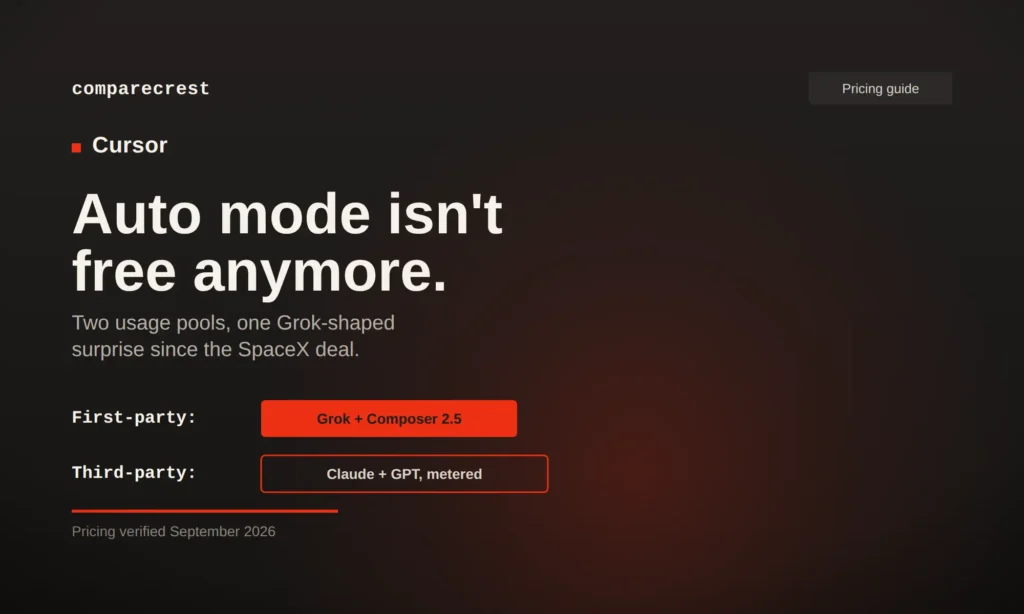
Cursor runs four individual plans (Hobby, Pro, Pro+, Ultra), two Teams seat types, and custom Enterprise pricing, and on paper that’s stayed fairly stable through 2026. What hasn’t stayed stable is what those prices actually buy. On August 24, 2026, Cursor ended flat-rate Auto mode entirely, the free, unlimited option most guides still describe as the default way to use the editor cheaply. Every request now draws from one of two separate usage pools, and understanding that split matters more than the sticker price on any plan.
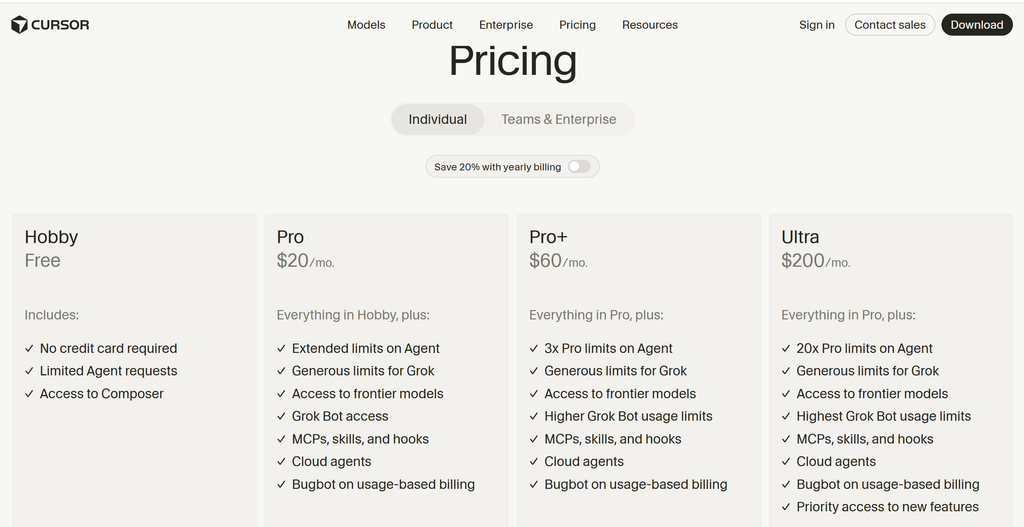
The Four Plans, and What Changed Three Weeks Ago
| Plan | Price | Annual price | Who it’s for |
|---|---|---|---|
| Hobby | Free | Free | Limited Agent requests, access to Composer, no card required |
| Pro | $20/mo | $16/mo | Extended Agent limits, frontier model access |
| Pro+ | $60/mo | Not published | Cursor’s own recommendation for daily agent users |
| Ultra | $200/mo | Not published | Cursor’s own recommendation for agent power users |
Every paid plan includes a monthly dollar-denominated usage pool roughly matching the subscription price. That part hasn’t changed. What changed on August 24 is Auto mode itself: it used to route requests to a cost-efficient model at no charge against your pool. As of that date, every Auto request bills against whichever pool its routed model belongs to, at that model’s rate. Enterprise customers kept the old flat-rate Auto as a legacy option until September 7, 2026; that grace period has also closed. If a guide you’re reading still describes Auto as unlimited, it’s describing a version of Cursor that stopped existing weeks ago.
Two Pools, Not One Number
Since June 2026, every plan, Individual and Teams alike, tracks two separate balances instead of one. The First-party models pool covers Cursor’s own models, Grok and Composer 2.5, generously. The second pool, billed at third-party API rates, covers named frontier models like Claude and GPT, and it’s the one that empties fast. A $20 Pro plan doesn’t mean $20 of any model you want; it means generous first-party usage and a much smaller allowance once you manually select a third-party model.
Auto itself now prices at fixed token rates against whichever pool applies: roughly $1.25 per million input tokens, $6 per million output tokens, and $0.25 per million cache-read tokens. Named premium models cost more against the third-party pool specifically, Claude 4.6 Sonnet runs about $3 per million input and $15 per million output tokens, for example, which is why two people on the same Pro plan can have completely different monthly experiences depending on which models they pick.
Grok Is the Flagship Model Now, Not a Bonus
Cursor’s own pricing page lists “generous limits for Grok” as a headline Pro plan benefit, ahead of general frontier model access, and Grok Bot access appears as a named line item on Pro, Teams, and Enterprise. The top navigation on cursor.com now has a dedicated “Models” menu that links directly to a Grok page. None of this is an accident: in 2026, SpaceX agreed to acquire Anysphere, Cursor’s parent company, for $60 billion in stock, the largest startup acquisition on record at the time. Elon Musk also owns xAI, which builds Grok, and Cursor’s pricing page increasingly reads like a company steering its included-usage generosity toward its new sibling model rather than treating Grok as one option among many.
Teams Splits Into Two Seats, One Costs 3x for 5x
Teams changed on June 1, 2026, splitting what used to be a single seat type into Standard and Premium. Standard runs $40/user/month ($32 annual) and now includes more total usage than before at no added cost. Premium, new as of that update, runs $120/user/month ($96 annual) for 5 times the included usage at 3 times the price, aimed specifically at the small group of power users Cursor’s own internal data shows drive most of a team’s spend and unpredictable on-demand costs. Teams can mix seat types freely rather than committing every seat to the same tier.
Also read: Cursor vs GitHub Copilot: Which AI Coding Tool Is Better?
Bugbot Stopped Being a Subscription in May
Cursor’s automated code review tool, Bugbot, used to cost a flat $40 per seat per month. Since May 2026, it bills per review run instead, at roughly $1 to $1.50 per run, and it now triggers on every commit push rather than once per pull request. For a team pushing frequently, that’s a meaningfully different cost shape than the old flat fee, cheaper for light reviewers, potentially more expensive for teams that push many small commits per day.
What $20, $60, and $200 Actually Buy in Practice
Cursor’s own guidance, echoed consistently across independent usage reports, breaks down roughly like this: daily Tab-completion users tend to stay within the $20 Pro plan comfortably. Developers running Agent mode daily typically spend $60 to $100 a month, which is why Cursor itself recommends Pro+ as the default for that usage pattern. Anyone running multiple agents in parallel or doing heavy Max Mode work should expect $200 or more, landing them at Ultra or past it into on-demand billing.
The India-Only Plan Most Guides Don’t Mention
Cursor sells a region-specific Start plan in India, priced at roughly ₹649 a month rather than a dollar-converted equivalent of Pro. It’s a genuinely underrated angle for India-based teams evaluating Cursor: most pricing guides are written from a US-centric view and simply don’t mention that a lower, rupee-denominated entry point exists. Confirm current terms directly at cursor.com, since region-specific plans tend to change without much announcement.
Cursor Against Claude Code, Copilot, and What Windsurf Became
| Tool | Entry paid price | Top individual tier | Notable for |
|---|---|---|---|
| Cursor | $20/mo (Pro) | $200/mo (Ultra) | Deepest editor-native agent workflow, now Grok-forward |
| Claude Code | $20/mo (Claude Pro) | $200/mo (Max 20x) | 1M-token context, bundled into Anthropic’s own subscription |
| GitHub Copilot | $10/mo (Pro) | $100/mo (Max) | Cheapest entry point, unlimited completions outside AI Credits |
| Windsurf (now Devin) | N/A | N/A | Folded into Cognition’s Devin pricing; the standalone product no longer exists |
Copilot wins on raw entry price and stays the default for teams that mainly need completions rather than autonomous agents. Claude Code and Cursor land at identical price points on both ends ($20 entry, $200 ceiling), so the choice between them comes down to workflow preference more than cost. Windsurf isn’t a fair fourth comparison anymore, since Cognition absorbed it into Devin’s pricing; anything still comparing “Windsurf’s plans” against Cursor is describing a product that no longer exists as its own thing.
Also read: Best Cursor Alternatives: 7 AI Coding Tools Compared
Pricing Caveats to Budget Around
- Auto mode has billed against your usage pools since August 24, 2026; it is no longer free or unlimited
- The First-party models pool (Grok, Composer 2.5) and third-party pool (Claude, GPT) are tracked and drained separately
- Teams Premium costs 3x Standard for 5x the usage, not a flat markup, so per-user value depends on actual usage
- Bugbot now bills per review run rather than as a flat seat subscription
- India-specific pricing exists and isn’t dollar-equivalent; confirm current regional rates directly with Cursor
Is Cursor's Auto mode still free?
No. Cursor ended flat-rate Auto on August 24, 2026. Every Auto request now bills against your first-party or third-party usage pool at that model’s rate.
What's the difference between the First-party and third-party usage pools?
The First-party pool covers Cursor’s own models (Grok, Composer 2.5) generously. The third-party pool covers named models like Claude and GPT, billed at API rates, and typically runs out faster.
Is SpaceX's acquisition of Cursor going to change pricing further?
SpaceX agreed to acquire Anysphere, Cursor’s parent company, for $60 billion in 2026. Cursor’s pricing page already shows a clear shift toward Grok (owned by Musk’s xAI) as the generously-included model, though Anthropic and OpenAI-model access remains available through the third-party pool.
Is Cursor cheaper than Claude Code?
Roughly equal at both ends: both start at $20/month and top out at $200/month for individual power users. The real cost difference depends on which models you use and how often you exceed the included pool, not the subscription price itself.
What happened to Windsurf pricing?
Windsurf was absorbed into Cognition’s Devin product and no longer exists as a separately priced tool. Any guide still comparing Windsurf’s standalone plans against Cursor or Claude Code is out of date.
Does Cursor have a cheaper plan for India?
Yes, a Start plan priced at roughly ₹649/month, distinct from a straight dollar conversion of Pro. It’s not well covered in most English-language pricing guides, so confirm current details directly with Cursor.
Pricing current as of September 2026, based on Cursor’s official pricing page and product blog. Cursor has changed its pricing structure multiple times in 2026 alone; verify current rates and pool sizes directly with Cursor before budgeting around any figure here.

Ajay is an Organic Growth Manager specializing in SEO, competitive research, and digital growth. With experience across fintech, e-commerce, Gaming, and healthcare, he analyzes SaaS platforms, AI tools, payment gateways, and business software beyond marketing claims. CompareCrest is where he turns in-depth research, feature analysis, pricing comparisons, and real-world insights into practical buying guides businesses can trust.