
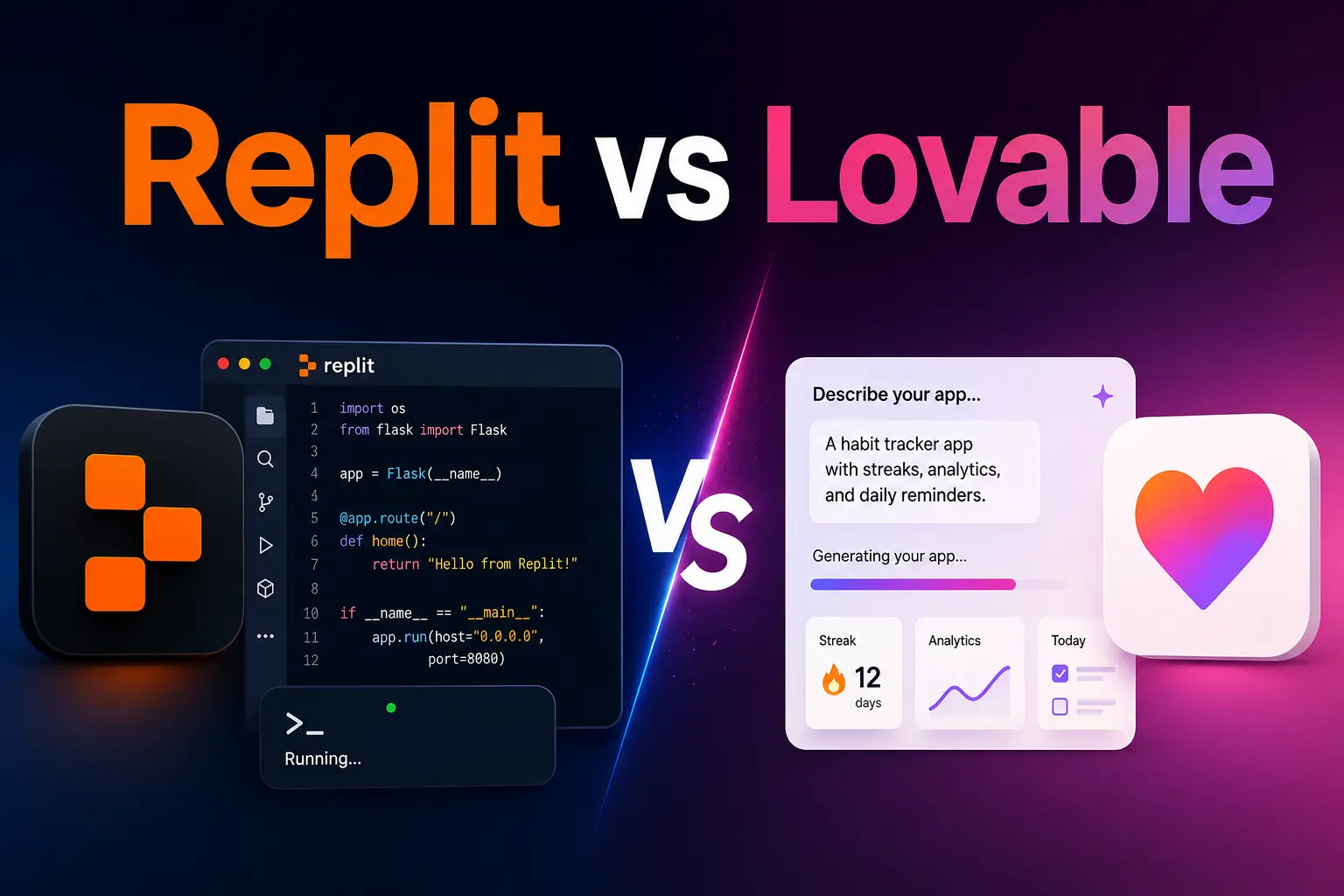
Both platforms will take an idea and hand you working software faster than writing it by hand. That’s where the similarity ends. Replit is a full cloud development environment with an AI agent bolted onto it. Lovable is a prompt-to-app generator that happens to produce real code. Picking between them isn’t really about which AI is smarter, it’s about how much of the machinery you want to see.
Replit vs Lovable: Quick Answer
Choose Replit if you want to see and control the code, need a language other than React, or plan to ship a native mobile app. Choose Lovable if you want the fastest route from a plain-English description to a polished, deployable web app and you’re fine living inside React and Supabase. Neither tool removes the need to read what it built. Users of both platforms consistently describe getting pulled into debugging loops the moment a project grows past a simple prototype.
| Replit | Lovable | |
| What it is | Cloud IDE with an autonomous coding agent | Prompt-to-app builder for React web apps |
| Best fit | Developers, multi-language projects, mobile apps | Developers, multi-language projects, mobile apps |
| Languages | 50+ languages, any framework | React + TypeScript + Vite only |
| Backend | Built-in Postgres database, auth, storage | Lovable Cloud (managed Supabase) or your own Supabase |
| Mobile apps | Yes — React Native / Expo | No, web only |
| Debugging | Real-time multiplayer editing, shared terminal | Largely chat-based; errors often need to be pasted back in |
| Collaboration | Real-time multiplayer editing, shared terminal | More limited, workspace-based |
Key Differences Between Replit and Lovable
Code-First vs. Prompt-First: Who’s Actually Driving
Replit is code-first. You see the file tree, the terminal, and the live preview at the same time, and the Agent works inside that environment rather than replacing it. Lovable is description-first: you type what you want in a chat window, and the interface shows you a rendered app rather than a workspace. That difference shows up in the review data too, Lovable tends to produce a more polished-looking layout on the first pass, while Replit’s early output looks more functional than polished until you specifically ask for design work.
Framework Lock-In: React-Only vs. 50+ Languages
This is the sharpest technical divide between them. Lovable builds React, TypeScript, and Vite. There’s no option to generate a Python backend or a Go service. Replit supports over fifty languages and doesn’t push you toward any particular stack. For a standard SaaS dashboard this barely matters. For anything that needs Python for data work, a specific database, or infrastructure Lovable doesn’t generate, it matters a lot, and it’s consistently flagged as Lovable’s single biggest technical constraint in independent comparisons.
Debugging: Agent Autonomy vs. Chat-Based Fixes
Replit’s Agent reads its own terminal output, error stack traces, and console logs, then attempts a fix without being asked, independent evaluations consistently single this out as one of the platform’s strongest capabilities. Lovable’s debugging leans more on the chat loop: when something breaks, you frequently need to copy the error back into the conversation yourself. That’s not a dealbreaker for a simple app, but it becomes noticeable friction once a project has more moving parts, and it’s a recurring complaint in Lovable’s own review base.
Mobile App Development: Replit vs. Lovable
Replit builds and deploys native mobile apps through React Native and Expo integration. Lovable is web-only, there’s no path to an App Store or Google Play listing without exporting the code and finishing the mobile build somewhere else. If a mobile app is even a maybe for the project, this alone can settle the decision.
Backend and Database: Lovable Cloud vs. Replit’s Native Postgres
Lovable used to require a separate Supabase account for anything beyond a static frontend. Since Lovable Cloud shipped in late September 2025, that’s no longer strictly true – Cloud is a managed backend (database, auth, storage, edge functions) that Lovable provisions automatically, still built on Supabase under the hood, but without the separate signup. Replit’s backend has always been native: Postgres, environment variables, and hosting live in the same workspace as the code. Functionally the gap has narrowed; architecturally, Lovable’s backend is still a wrapper around a third party where Replit’s is not.
Replit vs Lovable Pricing: Plans and Costs Compared
| Platform | Plan | Price | Monthly Credits | Notes |
| Replit | Starter | Free | Daily Agent credits | 1 published project |
| Replit | Core | $20/mo billed annually ($25/mo monthly) | $25 | Up to 5 collaborators |
| Replit | Pro | $95/mo billed annually ($100/mo monthly) | $100 | Up to 15 collaborators, 10 parallel agents |
| Replit | Enterprise | Custom | — | SSO, dedicated support |
| Lovable | Free | $0 | ~5/day, capped around 30/month* | — |
| Lovable | Pro | $25/mo | 100, rolls over | — |
| Lovable | Business | $50/mo | 100 | Adds SSO, team governance |
| Lovable | Enterprise | Custom | — | — |
Pricing checked against both companies’ official pages in August 2026. Both platforms have adjusted pricing more than once this year — verify current numbers before relying on this for budgeting.
The sticker prices don’t tell the whole story: both platforms run on effort-based, per-task credit consumption rather than flat per-message pricing, and the gap between the advertised price and the real monthly bill is the single most common complaint for both user bases. Simple tasks are cheap; complex or debugging-heavy tasks can burn through a month’s credits fast, and neither platform makes the per-task cost obvious in advance. Setting a spending cap before a long build session is a reasonable habit on either platform.
Replit vs Lovable Reviews: What Users Actually Experience
The recurring positive theme for both tools is speed to a working first version – reviewers on both platforms describe going from idea to something demoable in hours rather than weeks, often with no formal coding background.
Where the experiences diverge is what happens after that first version. Replit reviewers consistently praise the Agent’s autonomy and its ability to import an existing codebase, but nearly every detailed review mentions the same friction points: credit consumption that’s hard to predict in advance, occasional debugging loops that burn through those credits without resolving the underlying error, and a UI complex enough that non-technical reviewers describe a real learning curve before it clicks. Lovable reviewers are more consistent on ease of use – G2’s aggregated ratings put Lovable ahead of Replit on ease of use (9.3 vs 8.9 out of 10), ease of setup (9.4 vs 9.1), and quality of support (8.4 vs 8.1) – but the same review base flags credits disappearing faster than expected and the AI occasionally misreading more complex, multi-part instructions.
Who Should Choose Replit
Developers who want to read and edit the code, teams working across more than one language, anyone planning a mobile app, and builders who value having a full IDE and real-time multiplayer editing available rather than a chat window standing between them and the codebase. If part of the appeal of AI-assisted building is that you can still open the terminal and fix something yourself, Replit is built for that.
Who Should Choose Lovable
Founders and designers who want a polished, demoable web app fast and don’t want to think about infrastructure. Teams validating a concept before committing engineering time. Anyone who’s comfortable with the idea that the entire stack will be React and a Supabase-based backend, and who’s optimizing for how the first version looks and feels rather than for long-term flexibility.
When Neither Replit Nor Lovable Is the Right Fit
Regulated industries handling sensitive data, complex backend logic with custom infrastructure requirements, or anything where “the AI got stuck in a debugging loop” is an unacceptable outcome mid-launch. A common workaround for exactly this gap shows up repeatedly in independent reviews: generate the UI quickly in Lovable, export it to GitHub, then move backend and production logic into a more controllable environment – sometimes Replit, sometimes a traditional IDE with Cursor or a similar assistant.
Final Verdict: Replit vs Lovable
If the project is a standard web app – auth, a dashboard, CRUD, maybe Stripe – and you want it to look good with minimal fuss, Lovable gets there faster. If you need control, flexibility beyond React, or a mobile build, Replit is the only one of the two that can actually deliver it. The billing model on both platforms deserves more attention than either company’s pricing page gives it: set a spending cap before a long build session, regardless of which one you pick.
How We Researched This Comparison
This comparison draws on current product and pricing information, independent hands-on evaluations, and recurring user experiences across major review platforms. We use these sources to identify practical strengths, limitations, and trade-offs rather than relying on feature lists alone.
Where relevant, individual user experiences are treated as experiences rather than universal product behavior.
Is Replit or Lovable cheaper?
Neither, reliably. The subscription prices look close ($20/month Replit Core vs. $25/month Lovable Pro), but both burn through included credits based on task complexity, not message count. Real monthly cost depends far more on how much debugging your project needs than on the plan you choose.
Can I use Lovable to build a mobile app?
No. Lovable generates React web apps only. For a native mobile app you’d need to export the code and build it in a separate mobile framework, or use Replit, which supports React Native and Expo directly.
Which one is better for someone who can't code at all?
Lovable’s chat-first interface and higher ease-of-use ratings in independent reviews make it the more approachable starting point. Replit is learnable without a coding background too, but its IDE layout — file tree, terminal, deployment logs all visible at once — has a steeper initial learning curve according to multiple reviewer accounts.
Do both platforms let me export my code?
Yes. Both support GitHub sync, so you’re not locked into either platform if a project outgrows the builder.
What's the biggest limitation of each platform right now?
For Lovable, it’s the React-and-Supabase-only stack — fine for standard apps, a hard wall for anything else. For Replit, it’s billing predictability — the effort-based credit model makes it genuinely difficult to forecast what a complex build will cost before you’ve already spent the money.
