Proposal software has quietly split into two different jobs. One is drafting the thing – turning a rough idea into a client- ready copy. The other is managing it – templates, tracking, e- signatures, CRM sync. Most tools lean hard into the second job and bolt AI onto the first as an afterthought. A few don’t.
We checked official pricing and feature pages for five tools that show up consistently in this category, to see which actually generate proposal content versus which just help you format and send it.
Which One Should You Actually Use?
If you want AI that drafts real proposal content – not just formatting help – Qwilr’s AI Proposal Creator and Proposify’s embedded AI writer are the two with the clearest, officially confirmed drafting features. Qwilr starts at $35/user/month; Proposify at $19/user/month annual.
If you’re a solo freelancer or just starting out, Bookipi Proposal AI is free to start and generates a full draft from a prompt – genuinely built for one person, not a sales team.
If you want one platform for proposals, quotes, and e- signatures and can live with AI that’s more “ask questions about this document” than “write this document,” PandaDoc ($19–$49/user/month) is the safer all-in-one pick.
If you’re responding to formal RFPs with a large team and a content library to manage, none of the above are really built for that – Loopio is.
Rather than relying on feature lists or marketing claims, we reviewed each product using official pricing pages, product documentation, feature announcements, and help centre articles.
-
What the AI actually does – not just what the marketing page says.
-
Whether it can generate proposal content or simply improve existing documents.
-
Pricing transparency and overall value.
-
Proposal management features such as templates, collaboration, analytics, CRM integrations, e-signatures, and payment collection.
-
Which type of business the platform is genuinely designed for.
Where pricing wasn’t publicly available, we’ve clearly identified it as an estimate rather than presenting it as a confirmed figure.
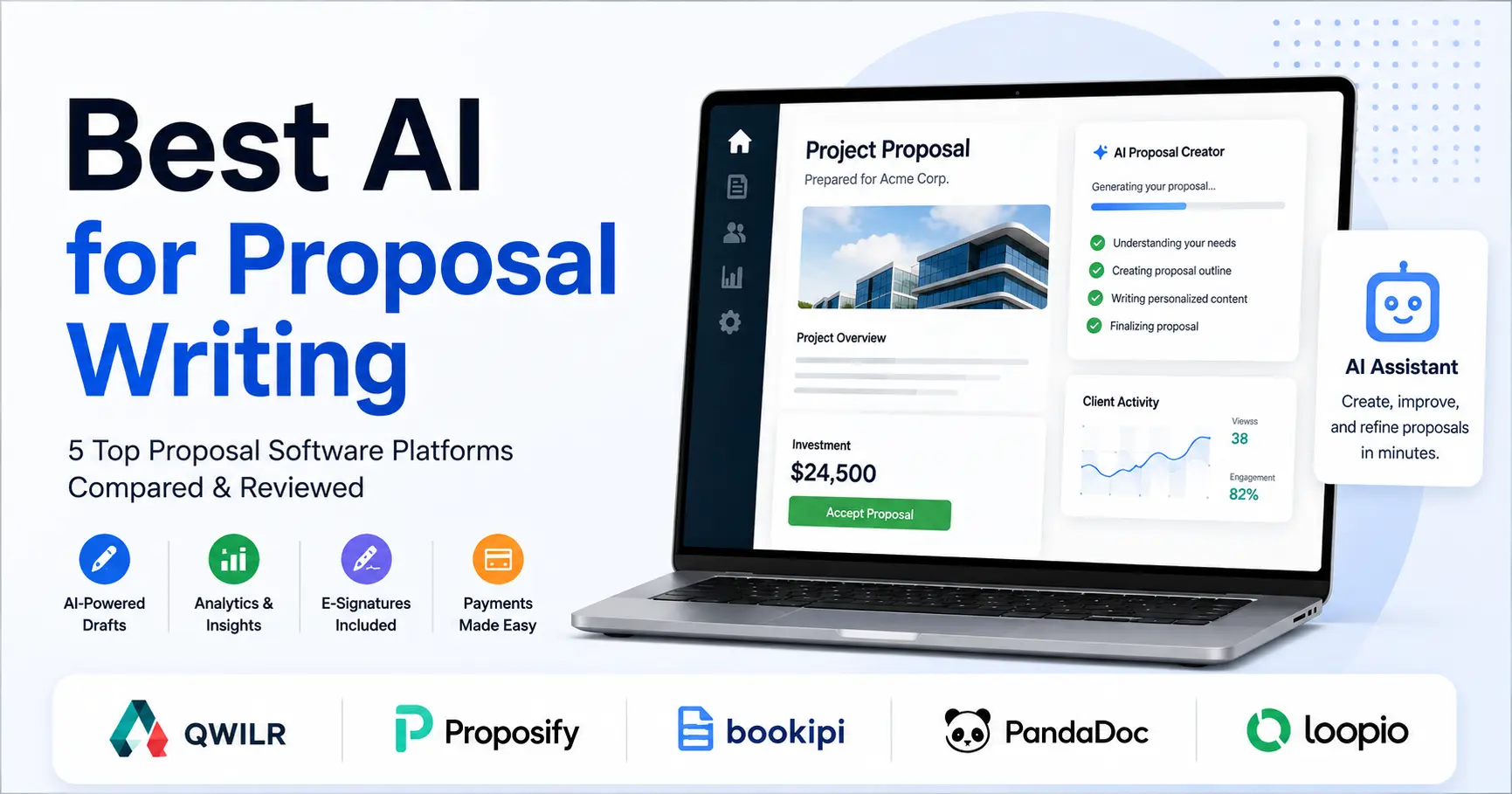
List of Top 5 AI Tools for Proposal Writing
| Tool | Starting Price | AI Capability | Best For | Free Option |
|---|---|---|---|---|
| Qwilr | $35/user/mo (annual) | AI Proposal Creator + AI Prefill (Scale tier) | Interactive, design- led proposals | 14- day trial |
| Proposify | $19/user/mo (annual) | Embedded AI writer (draft, refine, condense) | Sales teams wanting design control | 14- day trial |
| PandaDoc | $19/user/mo (annual) | AI Assistant – document Q&A, summaries, tagging | All- in- one docs, quotes, e- sign | Free (60 docs/yr) |
| Bookipi Proposal AI | Free to start | Full- draft generation from a prompt | Solo freelancers, first proposal | Yes, limited sends |
| Loopio | Custom pricing | Magic AI – drafts from content library | Enterprise RFP teams | None – contact sales |
A distinction worth knowing before you pick: PandaDoc’s AI is built for understanding and organizing documents you already have – summarizing, tagging, answering questions about a contract – more than generating new proposal copy from a blank page. If drafting is what you actually need AI for, Qwilr, Proposify, or Bookipi fit that job more directly than PandaDoc does.
Qwilr – Best for Interactive, AI- Drafted Proposals
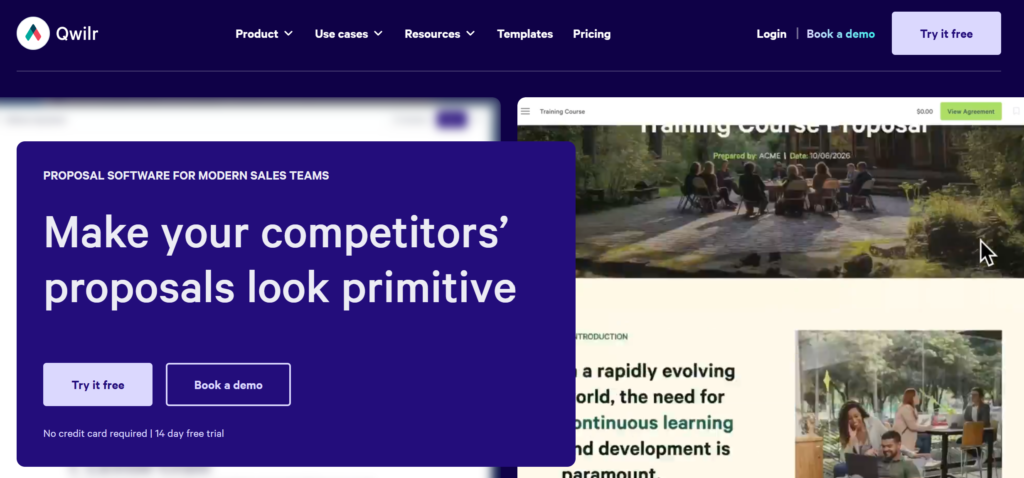
Pricing: Starter $35/user/month (annual), Growth $55/user/month (5- seat minimum), Scale $75/user/month (10- seat minimum), per Qwilr’s official pricing page.
AI Capability: A dedicated AI Proposal Creator generates a first draft from a prompt; AI Prefill (Scale tier) auto- populates proposals with client and deal data.
Pros: Interactive, web- based proposals (not static PDFs), built- in payments and e- signature, strong analytics on how long clients spend on each section.
Cons: Growth and Scale plans have 5- and 10- seat minimums, so a solo user or two- person team is priced out of the AI Prefill feature. Contact Qwilr’s team to confirm current seat- minimum terms before committing.
Proposify – Best for Sales Teams Wanting Design Control
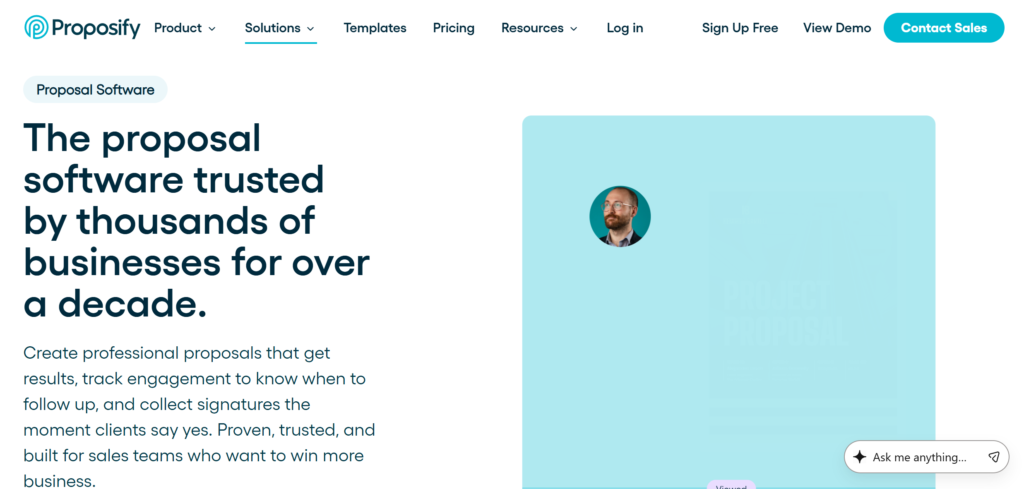
Pricing: Basic $19/user/month (annual), Team $41/user/month (annual), Business starts at $3,900/year (custom), per Proposify’s official pricing page.
AI Capability: An embedded AI writing widget drafts, refines, fixes grammar, and condenses text directly inside the editor.
Pros: Genuine design control over layout and branding, unlimited document creation on every plan, transparent send- limit structure (10/mo Basic, 30/mo Team).
Cons: Proposify’s own materials show some inconsistency on Business- tier pricing – the official page says “starts at $3,900/year” while other Proposify content cites a per- seat monthly rate. Contact Proposify’s team for exact Business- tier terms before budgeting.
PandaDoc – Best All- in- One Document Platform
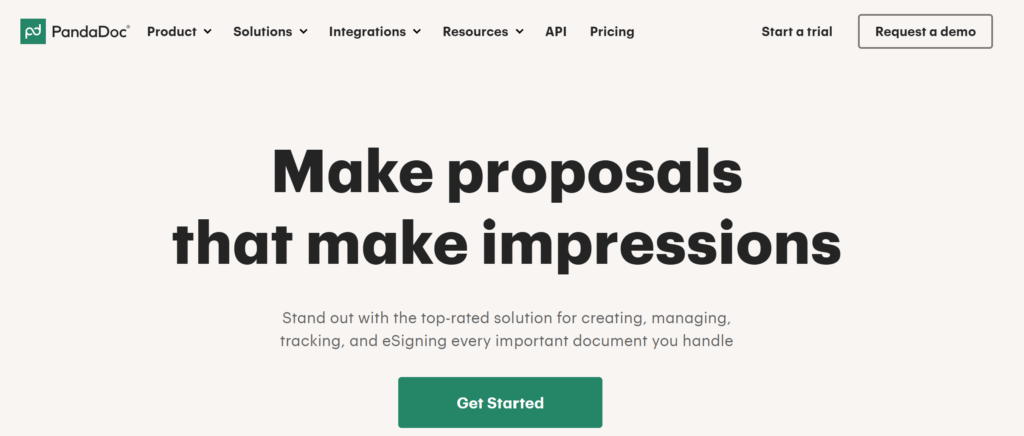
Pricing: Free (60 docs/year), Starter $19/user/month (annual), Business $49/user/month (annual), Enterprise custom, per PandaDoc’s official pricing page.
AI Capability: An AI Assistant handles document summaries, Q&A, and automatic tagging – closer to document intelligence than proposal drafting.
Pros: A genuine free tier, one platform for proposals, quotes, contracts, and e- signatures, strong CRM integrations on the Business plan.
Cons: CRM integrations and custom branding are locked to the $49/user/month Business tier, and the free/Starter tiers don’t include them. If drafting proposal copy with AI is the main goal, PandaDoc’s AI leans more toward answering questions about documents than writing them.
Bookipi Proposal AI – Best Free Option for Freelancers
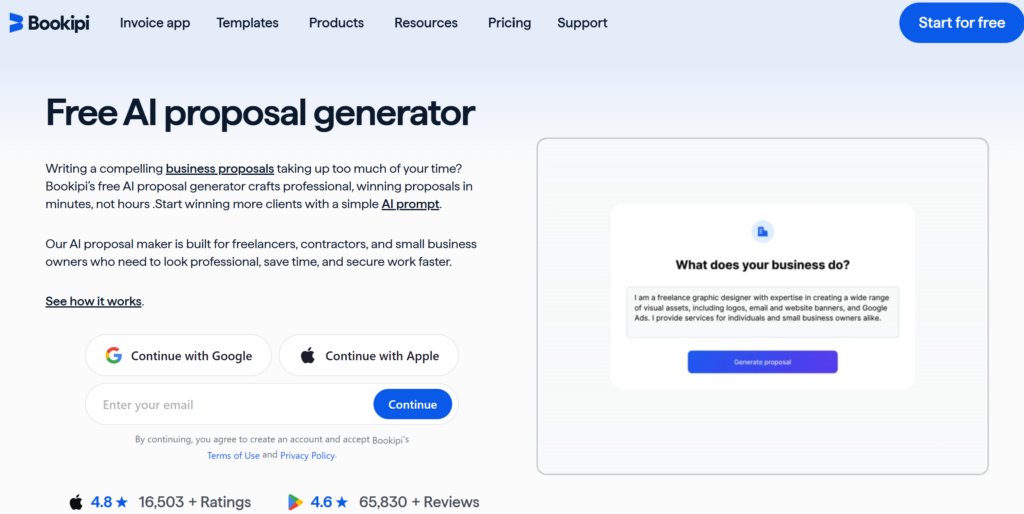
Pricing: Free to start with limited monthly sends; paid plans from roughly $7.60–$9.99/month (annual) bundle Proposal AI with invoicing and contracts, per Bookipi’s official pricing page.
AI Capability: Generates a complete proposal draft from a single prompt describing the business and project – the most direct “prompt in, draft out” AI of the five.
Pros: Free to start, genuinely fast for a first draft, bundled with invoicing and e- signatures so a freelancer doesn’t need three separate tools.
Cons: It’s part of a broader small- business platform rather than a dedicated proposal tool, so teams needing deeper collaboration or approval workflows will outgrow it quickly. Contact Bookipi’s team to confirm current free- tier send limits, which change periodically.
Loopio – Best for Enterprise RFP Teams
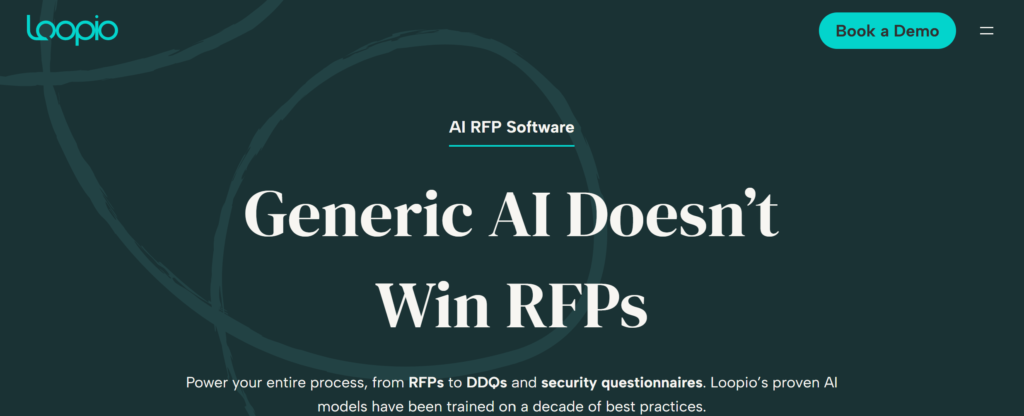
Pricing: Custom pricing- please contact Loopio’s team for an actual quote
AI Capability: “Magic AI” drafts RFP responses by pulling from a centralized, team- maintained content library. Reviews are mixed: strong for repetitive, previously- answered questions, less reliable on novel or highly specific ones.
Pros: Purpose- built for formal RFP response workflows, mature content library and permissions system, strong customer support reputation.
Cons: This is not proposal software for a solo user or small team – pricing, setup, and the content- library- maintenance overhead are built for organizations running high RFP volume with a dedicated team.
What Actually Matters Before You Pick
If AI drafting quality is the deciding factor, test it on a real proposal before committing – a prompt-to-draft demo in a sales call often looks better than what the tool produces on your actual, messier project details.
Seat minimums quietly change the real price. Qwilr’s Growth and Scale tiers require 5 and 10 seats respectively, so a two- person team evaluating Qwilr for its best AI features is actually pricing out a much larger commitment than the per- seat number suggests. And AI isn’t automatically the differentiator it’s marketed as. PandaDoc and Loopio both call their features “AI,” but one is document Q&A and the other is library- based response drafting – genuinely different capabilities that happen to share a label.
Can ChatGPT or Claude Replace Proposal Software?
For some businesses, yes. If all you need is help writing proposal text, tools like ChatGPT or Claude can produce strong first drafts when given clear instructions. Where they fall short is everything that happens after the writing. They won’t manage proposal templates, collect electronic signatures, track client engagement, integrate with your CRM, or process payments.
Dedicated proposal software combines those tasks into a single workflow. A practical approach is to think of general AI assistants as writing tools, while proposal platforms are workflow tools.
If writing is your only challenge, a general AI assistant may be enough. And If proposals are a core part of your sales process, dedicated software usually provides far more value over time.
What is the best AI tools for proposal writing?
For most businesses, Qwilr offers the strongest combination of AI-generated proposal drafts, presentation, analytics, payments, and electronic signatures.
If you’re looking for a free option, Bookipi Proposal AI is a good place to start.
Is AI proposal software worth paying for?
It depends on how often you send proposals.
If proposals directly affect your revenue and your team creates them regularly, dedicated software can save hours of manual work each month.
If you only send occasional proposals, a general AI assistant combined with a document editor may be sufficient.
Which AI proposal writing software is best for freelancers?
Bookipi Proposal AI is our recommendation for freelancers because it offers AI-generated drafts, a free plan, and essential business tools without the complexity of enterprise platforms.
What's the difference between proposal software and RFP software?
Proposal software is designed to help businesses create and send sales proposals.
RFP software is designed for organizations responding to formal procurement requests that often involve multiple departments, extensive content libraries, and standardized response workflows.
Although both categories now include AI, they’re solving different business problems.
